
Executive Summary
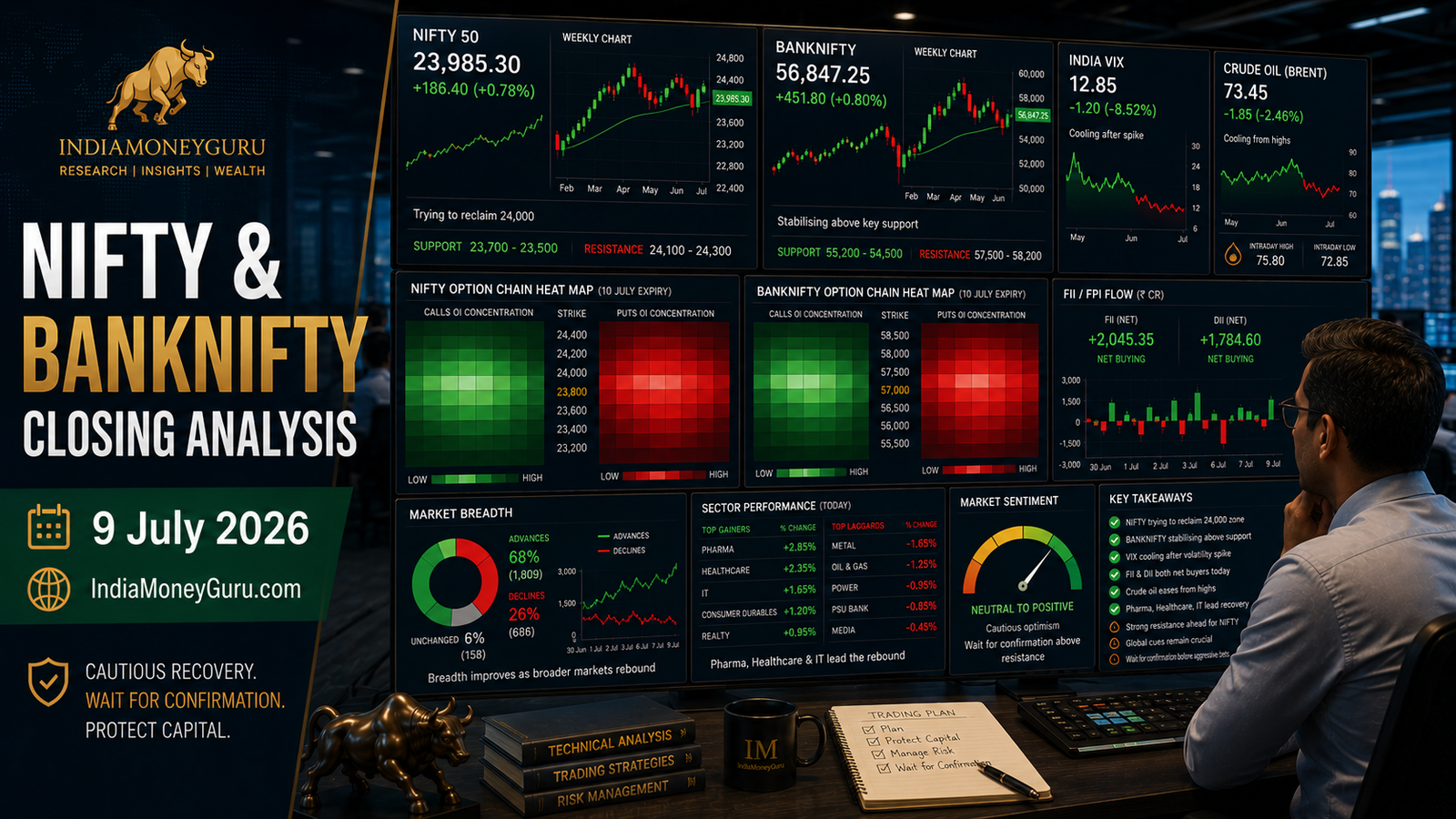
Indian equity markets staged a controlled rebound on Thursday, 9 July 2026, after the sharp crude-led sell-off seen in the previous session. The NIFTY 50 rose 0.34% to 23,962.80, recovering part of Wednesday’s losses as geopolitical anxiety cooled and investors shifted focus toward corporate earnings, especially the beginning of the IT results season.
The recovery was not a full reversal of the previous day’s damage, but it was important because panic did not extend for a second consecutive session. The broader market also participated strongly, with midcap and smallcap indices rising 1.4% and 1.8% respectively, while 14 of 16 sectors closed higher.
BANKNIFTY stabilised with the broader market, helped by better sentiment in financial heavyweights such as HDFC Bank, Kotak Mahindra Bank, IndusInd Bank and SBI. However, banking leadership did not become decisively aggressive. After Wednesday’s sharp risk-off session, the banking index remains in a repair phase rather than a clean breakout phase.
India VIX cooled sharply, falling around 10% to 13.27, after jumping more than 26% in the previous session. This decline in volatility is one of the most important signals of the day. It shows that traders stepped back from panic hedging, although volatility remains higher than the extremely comfortable levels seen earlier in the week.
NIFTY & BANKNIFTY Closing Analysis – 9 July 2026: The market message is clear – Thursday was a relief rebound, not a confirmed bullish reversal. For the next session, traders should watch whether NIFTY can reclaim and sustain above 24,000 and whether BANKNIFTY can regain leadership from the financial sector.
Table of Contents
Market Intelligence Scorecard
| Indicator | Status | Interpretation |
|---|---|---|
| NIFTY Trend | 🟡 Recovering | Rebounded near 24,000 but not fully repaired |
| BANKNIFTY Trend | 🟡 Stabilising | Banking recovered but leadership still needs confirmation |
| India VIX | 🟢 Improving | Volatility cooled sharply after Wednesday’s spike |
| Market Breadth | 🟢 Positive | Broader market rebound supported sentiment |
| Sector Participation | 🟢 Broad Recovery | 14 of 16 sectors closed higher |
| Institutional Mood | 🟢 Improving | FIIs continued buying in latest available data |
| Option Writers | 🟡 Selectively Comfortable | Premium sellers returning, but macro risk remains |
| Overall Bias | Relief Recovery | Positive, but confirmation above key levels required |
Previous Session vs Today
| Parameter | 8 July 2026 | 9 July 2026 | Interpretation |
|---|---|---|---|
| NIFTY 50 | 23,882.05 | 23,962.80 | Relief rebound after sharp fall |
| BANKNIFTY | Sharp weakness | Stabilising recovery | Banking repaired part of the damage |
| India VIX | 14.68 | 13.27 | Fear cooled meaningfully |
| Market Breadth | Very weak | Positive | Risk appetite improved |
| Sector Trend | All sectors negative | 14 of 16 sectors positive | Broad recovery attempt |
| Primary Driver | Crude + geopolitical shock | Relief from crude/geopolitical fear | Panic reduced |
Market Snapshot
| Index / Indicator | Closing / Reading | Market Message |
|---|---|---|
| NIFTY 50 | 23,962.80 | Recovered 0.34%, still below 24,000 |
| BANKNIFTY | Stabilising after prior sell-off | Needs stronger financial leadership |
| India VIX | 13.27 | Volatility cooled around 10% |
| Nifty Midcap 100 | Up around 1.4% | Broader market rebound |
| Nifty Smallcap 100 | Up around 1.8% | High-beta recovery after sell-off |
| Sector Breadth | 14 of 16 sectors higher | Broad relief rally |
Market Overview
Thursday’s market rebound was driven by three factors: easing crude anxiety, continued foreign investor support, and expectations from the start of the Q1 earnings season.
The immediate relief came from the fact that the crude-led panic did not worsen. Brent crude eased from the previous day’s spike after geopolitical fears cooled slightly, while the Indian rupee also gained modestly with likely support from the Reserve Bank of India and softer oil prices. Reuters reported that the rupee closed at 95.3875 per U.S. dollar, up about 0.2% from the previous close, helped by likely RBI intervention and lower oil prices.
NIFTY recovered 0.34% to close at 23,962.80, but the index still remained below the psychologically important 24,000 mark. This means the market recovered, but it did not yet reclaim the level that would restore full short-term confidence.
The broader market performed better than the headline index. Midcap and smallcap indices gained strongly, suggesting that traders were willing to re-enter riskier pockets after the previous day’s panic. However, such rebounds after sharp falls should be interpreted carefully. A one-day bounce confirms relief, not necessarily trend resumption.
The market also started shifting focus to earnings. TCS was in focus ahead of its quarterly result, while pharma and healthcare stocks gained as investors looked for sectors less directly vulnerable to crude oil volatility.
IndiaMoneyGuru Unique Insight
The unique signal from Thursday’s session is this:
The market moved from panic to probation.
Wednesday was a panic day. Thursday was a probation day. A probation day means the market has stopped falling sharply, but it still has to prove that buyers are strong enough to rebuild the trend.
This distinction is important for traders. Many traders make the mistake of treating every bounce after a sharp fall as a fresh bullish signal. But after a volatility shock, the first bounce is often driven by short covering, bargain hunting and volatility cooling. The real test comes later: can the index hold higher levels when fresh buying pressure is required?
For IndiaMoneyGuru readers, the practical framework is simple:
- If NIFTY reclaims 24,000 and holds, the rebound gains credibility.
- If BANKNIFTY starts outperforming again, institutional confidence improves.
- If India VIX continues cooling, option sellers regain control.
- If crude rises again or VIX spikes again, the rebound may fail quickly.
This is why Thursday should be respected as a recovery session, but not over-celebrated as a confirmed bullish reversal.
NIFTY Analysis
NIFTY’s close at 23,962.80 shows that buyers defended the market after yesterday’s sharp fall, but the index still needs to reclaim 24,000 to improve short-term structure.
The recovery was constructive because the market did not see follow-through panic selling. However, the index remained below a key psychological level. This makes the next session important. A sustained move above 24,000 can attract fresh buying and short covering. Failure to hold above 24,000 may keep the index in a consolidation range.
Technically, the market is now in a repair zone. A repair zone is different from a bullish breakout zone. In a repair zone, traders should focus on confirmation rather than anticipation. NIFTY needs stronger closing strength, broader sector support and lower volatility before the earlier bullish structure can be restored.
The best approach for traders is to avoid chasing gap-up moves. Pullbacks near support with improving breadth offer better risk-reward than buying aggressively near resistance.
BANKNIFTY Analysis
BANKNIFTY stabilised after Wednesday’s sharp pressure, but it has not yet regained clear leadership. This is important because banking and financial services were among the strongest areas before the crude shock, and their behaviour will likely decide whether NIFTY can reclaim 24,000 convincingly.
Banking stocks remain sensitive to three variables right now: foreign inflows, crude-linked macro risk, and earnings expectations. Recent foreign interest in Indian banking stocks remains a medium-term positive, but Wednesday’s shock showed how quickly macro concerns can pressure financials.
On Thursday, banking heavyweights showed mixed but stabilising behaviour. HDFC Bank rose 0.89%, Kotak Mahindra Bank rose 1.77%, IndusInd Bank rose 2.06%, SBI gained 0.51%, while ICICI Bank ended only marginally higher and underperformed peers.
For BANKNIFTY, the next session should be judged by leadership quality. If private banks and heavyweight lenders support the index, the recovery can extend. If banking remains flat while other sectors carry the market, the rebound may remain fragile.
BANKNIFTY traders should avoid assuming a one-day bounce means full strength has returned. The better signal would be sustained buying in HDFC Bank, ICICI Bank, Axis Bank, SBI and other heavyweight lenders along with improved option-chain support.
Option Chain Intelligence
The option-chain environment improved compared with Wednesday, but it is still not as comfortable as it was earlier in the week.
The fall in India VIX from 14.68 to 13.27 helped option sellers, as fear premium reduced after the panic session. However, this does not mean the market has returned to a low-risk premium-selling environment. VIX remains above the very calm zone seen before the crude shock, and macro headlines can still create sudden moves.
For NIFTY, 24,000 becomes the most important reference point. If Call writers defend 24,000 aggressively, upside may remain capped. If NIFTY moves above 24,000 and sustains, Call writers may be forced to adjust, which can support further recovery.
For BANKNIFTY, option traders should monitor whether Put writing returns near lower levels. Strong Put writing near supports would indicate confidence that Wednesday’s fall has been absorbed. Lack of Put writing would suggest that professional traders remain cautious.
The derivatives message is simple:
Volatility has cooled, but risk has not disappeared.
Institutional Activity
Foreign investor behaviour remains a key support for the market. Reuters reported that overseas investors were net buyers of around ₹19.63 billion, or approximately $205 million, on Wednesday, even during the high-volatility environment. That is important because the market’s recent rally depended partly on easing FII selling pressure.
The rupee also strengthened modestly on Thursday, helped by likely RBI intervention and softer oil prices. This matters because rupee stability can reduce the pressure on foreign investors to cut exposure. When crude rises sharply and the rupee weakens, FII selling risk increases. When crude cools and the rupee stabilizes, foreign flows can remain supportive.
DIIs and domestic mutual fund flows continue to provide structural support, but Thursday’s recovery was more meaningful because foreign investors did not appear to abandon Indian equities despite the previous day’s shock.
India VIX Analysis
India VIX dropped around 10% to 13.27 after jumping sharply on Wednesday. This is a strong relief signal.
A falling VIX after a major sell-off means that panic hedging has reduced. Traders are still cautious, but they are no longer pricing the same level of immediate fear seen during the crude spike. This helps both equity traders and option sellers.
For option sellers, the decline in VIX improves the environment, but discipline is still necessary. The market is not back to the ultra-low volatility comfort zone. A second geopolitical headline or another crude spike can quickly expand option premiums again.
For equity traders, lower VIX means stop-loss behaviour may become less erratic compared with Wednesday. But until NIFTY reclaims 24,000 and BANKNIFTY shows leadership, volatility cooling should be treated as supportive, not conclusive.
Sector Rotation
| Sector | Trend | Interpretation |
|---|---|---|
| Pharma / Healthcare | Strong | Defensive buying after macro shock |
| IT | Selective | TCS earnings kept focus on technology |
| Banking / Financials | Stabilising | Needs stronger leadership confirmation |
| Oil & Gas | Mixed | Sensitive to crude movement |
| FMCG | Recovering | Relief after input-cost concerns |
| Auto | Positive | Benefited from broad rebound |
| Midcaps | Strong rebound | Risk appetite improved |
| Smallcaps | Strong rebound | High-beta recovery after sell-off |
Thursday’s sector behaviour was healthier than Wednesday’s because most sectors participated in the rebound. However, the strongest signal would come only if banking and financial services regain leadership. Without financial leadership, NIFTY may struggle to sustain above 24,000.
Support and Resistance
| Index | S1 | S2 | S3 | R1 | R2 | R3 |
|---|---|---|---|---|---|---|
| NIFTY | 23,850 | 23,750 | 23,650 | 24,000 | 24,150 | 24,300 |
| BANKNIFTY | 56,800 | 56,400 | 56,000 | 57,700 | 58,000 | 58,500 |
Trading Plan for Next Session
The next session should be approached with confirmation-based trading.
For bullish traders, the first requirement is NIFTY sustaining above 24,000. A move above 24,000 without follow-through can become a bull trap, especially if BANKNIFTY remains weak. Long trades should be preferred only when price strength is supported by breadth and sector participation.
For BANKNIFTY traders, the focus should remain on heavyweight private banks. If banks lead, the recovery can become more reliable. If banks underperform while NIFTY tries to rise, the rally may remain vulnerable.
For bearish traders, aggressive shorting after Thursday’s rebound is risky unless NIFTY fails near resistance or breaks below support again. The better setup would be a failed reclaim of 24,000 followed by renewed weakness.
For option sellers, reduced VIX supports premium selling, but position size should remain smaller than usual because macro risk is still active. Defined-risk spreads remain preferable to naked exposure.
Risk Factors to Watch
Key risks for the next session include:
- NIFTY failing to sustain above 24,000
- BANKNIFTY underperformance
- Brent crude rising again
- Rupee weakness
- Fresh Middle East escalation
- TCS earnings reaction and IT sector commentary
- India VIX moving back above 14
- Weakness in broader market despite index recovery
The biggest risk is a failed recovery. If the market opens strong but cannot hold gains, traders may again shift toward defensive positioning.
Trading Lessons
Today’s session offers three practical lessons.
First, relief rallies must be tested. A bounce after a crash is useful, but it becomes reliable only when the index sustains above key levels.
Second, VIX cooling is necessary but not sufficient. Lower volatility improves sentiment, but price still needs to confirm strength.
Third, sector leadership matters. A recovery led only by defensive or selective sectors may not be enough. BANKNIFTY and financials must participate for a stronger index rebound.
Key Takeaways
For equity investors, the recovery reduces panic but does not remove uncertainty. Quality accumulation should be gradual and focused on strong companies rather than weak momentum names.
For swing traders, wait for confirmation above 24,000 before taking aggressive long positions.
For option sellers, the environment has improved from Wednesday, but macro risk still demands hedges and smaller size.
For intraday traders, the most important level is NIFTY 24,000. Price behaviour around this level can decide whether the next session becomes a continuation day or a failed recovery day.
Editorial Conclusion
Indian markets recovered on 9 July 2026 after the previous session’s sharp crude-led sell-off. NIFTY closed at 23,962.80, India VIX cooled to 13.27, and broader markets rebounded strongly. The session was constructive because panic did not extend.
However, the recovery is not yet a confirmed bullish reversal. NIFTY still needs to reclaim 24,000, BANKNIFTY needs to regain leadership, and crude-linked macro risks remain active.
IndiaMoneyGuru View:
The market has moved from panic to recovery attempt. Traders should stay constructive but selective. Fresh aggression should wait for NIFTY above 24,000, improving BANKNIFTY leadership and continued cooling in India VIX.
FAQs
What was the NIFTY closing level on 9 July 2026?
NIFTY 50 closed at 23,962.80, up 0.34%.
Did the market recover fully from Wednesday’s fall?
No. The market recovered part of the fall, but NIFTY still closed below 24,000, so the recovery needs confirmation.
Why did India VIX fall today?
India VIX cooled as panic hedging reduced after crude and geopolitical fears eased compared with the previous session.
Is BANKNIFTY bullish again?
BANKNIFTY has stabilised, but it has not yet regained strong leadership. Traders should wait for confirmation from private banking heavyweights.
What is the most important level for NIFTY now?
The 24,000 level is the most important near-term resistance and confirmation level.
Should traders buy the rebound?
Traders should avoid chasing. Fresh buying is better after NIFTY sustains above 24,000 with improving breadth and BANKNIFTY support.
Is option selling safe again?
The environment has improved because VIX cooled, but macro risk remains. Defined-risk option strategies are safer than naked selling.
Which sectors looked better today?
Pharma, healthcare, broader markets and selective IT counters showed strength, while banking stabilised.
Disclaimer
The information provided in this article is for educational purposes only and should not be considered investment advice. Trading and investing in financial markets involve risk. Always conduct your own research and consult a SEBI-registered investment adviser before making any investment decisions.
1 thought on “NIFTY & BANKNIFTY Closing Analysis – 9 July 2026”