

Table of Contents
If you follow the Indian stock market, you have likely run into a frustrating puzzle during earnings season.
A headline flashes across your screen: “IT Giant Secures $9.6 Billion in Mega Deal Wins!” You expect the stock to surge the next morning. Instead, the share price dips or trades sideways, and analysts on television start talking about “cautious guidance” and “sluggish revenue conversion.”
It feels completely wrong. How can a company sign billions of dollars in new contracts and yet report revenue growth of just 1% or 2%?
To understand why Indian IT deal wins and revenue growth often seem to tell two different stories, we need to lift the hood on how enterprise technology contracts actually work. Once you understand the journey a contract takes from the boardroom handshake to the income statement, you will never look at an IT press release the same way again.
What Happened: The $15 Billion Q2 FY27 Earnings Paradox
During the September quarter (Q2 FY27) earnings season, India’s technology bellwethers delivered impressive contract announcements:
- Tata Consultancy Services (TCS) logged $9.6 billion in Total Contract Value (TCV) deal bookings, while reporting that its annualized AI revenue crossed $3.1 billion (over 10% of its total revenue).
- Infosys signed $5.2 billion in large deals, 62% of which came from brand new clients, yet management trimmed its full-year constant-currency revenue growth guidance to 1.5%–2.5%.
- HCLTech posted its highest-ever quarterly net profit (up 21.2% YoY to ₹5,132 crore) driven by strong software products, while Tech Mahindra led profit recovery with a 32.7% surge.
Here is the paradox: while total deal wins across top firms crossed $15 billion in just three months, overall revenue growth remained in modest single digits (0.5% to 2.5% quarter-on-quarter in constant currency).
Understanding corporate deal flow is only half the battle. To see how interest rate hikes and global macro trends compress stock valuations across tech and growth sectors, investors must also track central bank policy decisions.
To see why mega deal wins do not immediately translate into skyrocketing quarterly revenue, let us walk through the accounting journey.
How It Actually Works: The Journey from Handshake to Revenue
Think of a multi-billion-dollar IT deal like booking a multi-year hotel subscription rather than buying a single cup of coffee.
When an IT company signs a $1.2 billion, 5-year contract with a global bank, that total amount is known as the Total Contract Value (TCV). However, the company cannot simply record $1.2 billion in its bank account on day one.
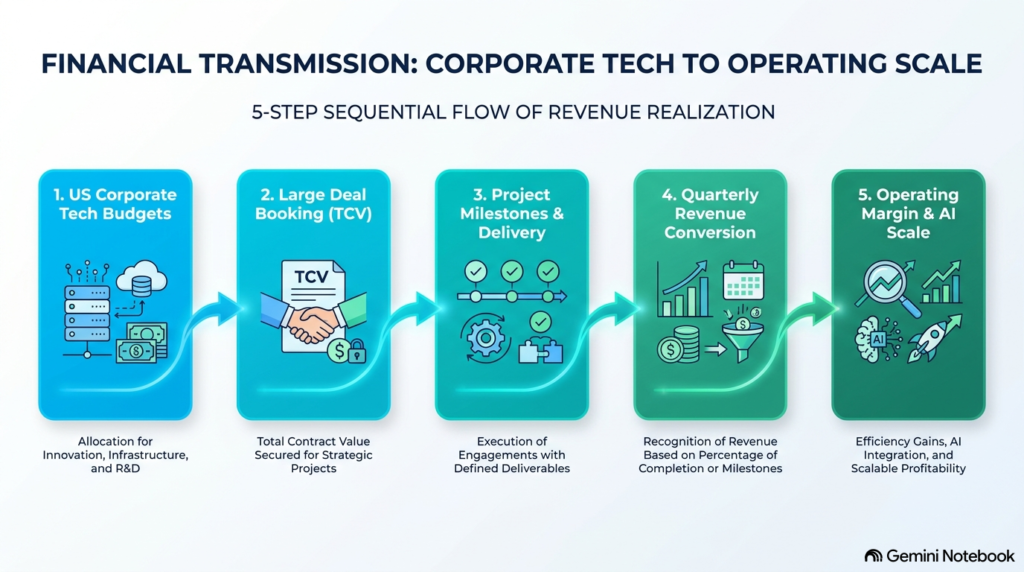
Here is how that $1.2 billion deal moves through five distinct real-world stages:
Stage 1: US & European Corporate Tech Budgets
Over 60% of revenue for Indian IT firms originates from North America. When US chief financial officers (CFOs) face economic uncertainty or high interest rates, they become selective. They still sign essential long-term transformation projects, but they pause small, discretionary projects.
Stage 2: Contract Booking (The TCV Headline)
The full value of the multi-year deal ($1.2 billion over 5 years) is announced as TCV. On a per-year basis, this contract is worth $240 million annually, or $60 million per quarter.
Stage 3: Project Ramp-Up & Transition
Before generating full revenue, the IT firm must deploy engineers, audit legacy software systems, and set up security protocols. This ramp-up phase usually takes 3 to 6 months, during which recognized revenue is minimal.
Stage 4: Quarterly Revenue Realization
Only as milestones are completed each month does a portion of that $60 million enter the quarterly income statement. If an older $60 million/quarter contract happens to expire at the exact same time, the new deal simply replaces the old one, resulting in zero net revenue growth!
Stage 5: Margin Realization & AI Automation
As engineers automate repetitive tasks using Artificial Intelligence (AI) tools, the IT firm lowers its cost of delivery, improving its operating margins over time.
The Simple Math: Why Net New Work Matters More Than TCV
To evaluate whether a deal win will actually drive stock price growth, retail investors should look at two details hidden in the footnotes of earnings releases:
Quarterly Revenue Impact = [ (Total TCV × Net New Share %) / Contract Duration in Years ] – Expiring Contracts
Let us break down what this formula means in plain language:
- Renewals vs. Net New Work: If a $1.0 Billion TCV deal consists of 60% Renewals ($600M) and 40% Net New Work ($400M), the $600M renewal portion simply replaces existing revenue to prevent it from falling. Only the $400M net new portion drives genuine new revenue growth over the next 3 to 5 years!
- Contract Duration: A $500 million deal spread over 10 years adds just $12.5 million per quarter. Meanwhile, a $100 million deal spread over 1 year adds $25 million per quarter—twice the quarterly revenue impact!
The AI Puzzle: Proof of Concepts vs. Scaled Enterprise Revenue
Another major question on investors’ minds is Artificial Intelligence. If every IT company is building AI solutions, why aren’t revenues skyrocketing?
The answer is that enterprise AI adoption currently sits in an implementation transition:
- Phase 1: Proof of Concept (PoC): Global clients test small AI tools (like internal chatbots or automated code assistants). These projects cost $50,000 to $200,000, exciting for technology, but small for revenue.
- Phase 2: System Integration (Current Stage): Indian IT majors clean up massive client databases and connect AI models into legacy core banking and ERP software. This is where TCS reached $3.1 billion in annualized AI revenue.
- Phase 3: Autonomous AI Workflows (Future Stage): Enterprise-wide deployment where AI handles end-to-end business operations, driving scalable, high-margin software contracts.
While AI deal pipelines are expanding rapidly, clients are often funding AI projects by cutting back on legacy IT maintenance. As a result, AI revenue is currently replacing older service revenue rather than simply adding on top of it.
What Should Retail Investors Look For?
Instead of being distracted by flashy TCV headlines, smart investors focus on three practical indicators during IT earnings season:
- Book-to-Bill Ratio: Compare total deal bookings against quarterly revenue. A book-to-bill ratio consistently above 1.2x signals healthy revenue growth 2 to 3 quarters down the line.
- Constant Currency (CC) Growth: Always look at constant-currency revenue growth figures. They strip out exchange-rate fluctuations, showing whether the business is actually selling more services.
- Headcount and Attrition Trends: IT is a talent-driven industry. When hiring stabilizes and voluntary attrition drops into a healthy band (11%–13%), it indicates that companies are optimizing costs while preparing teams for upcoming project rollouts.
Traders managing options positions during earnings announcements can refine their Nifty expiry day trading strategies to account for implied volatility crush post-results.
IndiaMoneyGuru Takeaway
Deal wins are the seed; revenue conversion is the harvest. A headline announcing billions in TCV shows that clients trust an IT company’s capabilities, but turning those contract signatures into earnings per share takes time. Don’t judge an IT stock by a single quarter’s headline deal total; watch how consistently those contracts convert into cash flows over a 12-to-18-month horizon.
Frequently Asked Questions (FAQs)
What is the difference between TCV and recognized revenue in IT stocks?
TCV (Total Contract Value) is the complete lifetime value of a multi-year contract. Recognized revenue is only the specific portion of that contract billed and earned during a single 3-month financial quarter.
Why do IT stock prices drop even after reporting strong deal wins?
If a large portion of the deal wins consists of contract renewals rather than net new work, or if management signals that clients are delaying project start dates, short-term revenue growth may remain flat despite high TCV numbers.
What does “constant currency revenue growth” mean?
Constant currency measures revenue growth while holding foreign exchange rates fixed. This allows investors to see whether sales grew because of higher operational volume or simply because the Rupee weakened against the US Dollar.
References
- TCS Investor Relations: (TCS Q2 FY27 Financial Results & TCV Announcements)
- Infosys Investor Relations: (Infosys Financial Disclosures & Large Deal Guidance)
- Livemint Markets Desk: (Indian IT Earnings Coverage & Deal Conversion Trends)
- Business Today Technology & Markets Desk: (Tier-1 IT Earnings Coverage & AI Monetization Trends)
Disclaimer
The information provided in this article is for educational purposes only and should not be considered investment advice. Trading and investing in financial markets involve risk. Always conduct your own research and consult a SEBI-registered investment adviser before making any investment decisions.