
Introduction
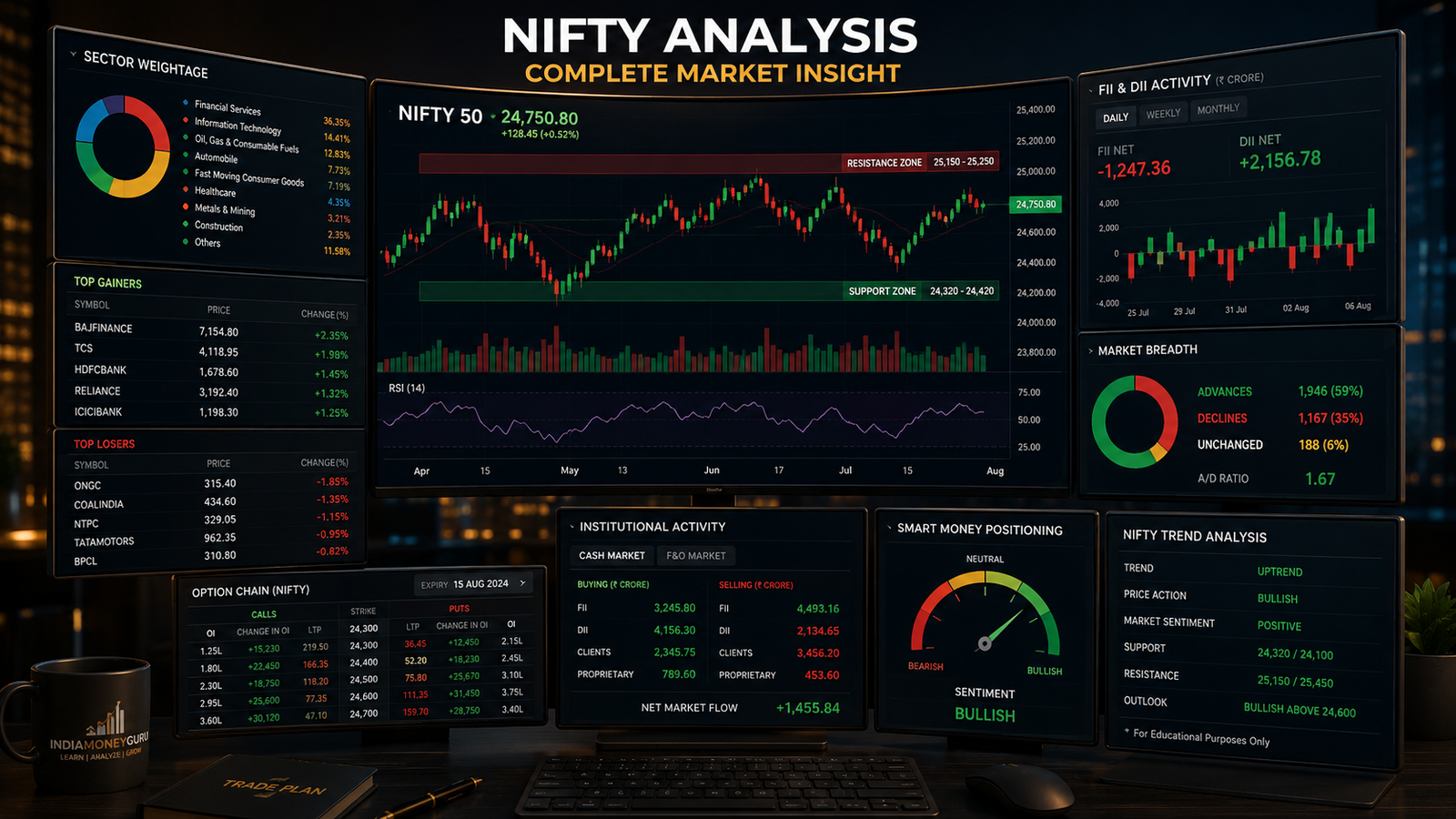
NIFTY Analysis is one of the most important skills every Indian trader and investor should learn. Whether you trade index options, invest through mutual funds, buy stocks, or follow daily market movements, understanding how to analyze NIFTY can significantly improve your decision-making.
The NIFTY 50 is widely considered the benchmark index of the Indian stock market. It reflects the performance of India’s largest and most liquid companies across multiple sectors. Because of its broad market representation, traders often use NIFTY as the primary indicator of overall market sentiment.
This guide explains NIFTY Analysis from beginner to advanced level, covering market structure, sector influence, institutional activity, option chain interpretation, support and resistance analysis, and professional trading frameworks.
Table of Contents
What Is NIFTY 50?
NIFTY 50 is the flagship equity index of the National Stock Exchange (NSE).
It consists of 50 large-cap companies representing major sectors of the Indian economy.
These companies are selected based on:
- Market capitalization
- Liquidity
- Free-float market value
- Trading activity
The index serves as a benchmark for:
- Mutual funds
- ETFs
- Portfolio managers
- Institutional investors
- Traders
Why NIFTY Matters
NIFTY influences almost every segment of the Indian financial market.
It helps traders:
- Understand overall market sentiment
- Assess risk appetite
- Identify trends
- Analyze institutional activity
- Trade index derivatives
When NIFTY performs strongly, broader market sentiment usually improves.
When NIFTY weakens significantly, risk appetite often declines across sectors.
How NIFTY Is Calculated
NIFTY uses a free-float market capitalization methodology.
This means only shares available for public trading are considered.
The calculation reflects:
- Company size
- Public shareholding
- Market value
As a result, larger companies have a greater impact on index movement.
Major Sectors Influencing NIFTY
NIFTY is diversified across multiple sectors.
The most influential sectors typically include:
Financial Services
Banks and financial institutions often carry the highest weight.
Information Technology
Large IT companies can significantly influence NIFTY direction.
Energy
Oil and energy companies contribute heavily to index movement.
FMCG
Consumer-focused businesses provide stability during uncertain markets.
Automobile
Auto stocks often reflect economic growth expectations.
Pharma
Healthcare and pharmaceutical companies provide defensive exposure.
Understanding Market Structure
Professional NIFTY Analysis begins with market structure.
Key questions include:
- Is NIFTY making higher highs?
- Is NIFTY making lower lows?
- Is the trend bullish?
- Is the trend bearish?
- Is the market consolidating?
Understanding structure helps traders avoid trading against the dominant trend.
NIFTY Trend Analysis
Uptrend
Characteristics:
- Higher highs
- Higher lows
- Strong buying participation
Downtrend
Characteristics:
- Lower highs
- Lower lows
- Persistent selling pressure
Range-Bound Market
Characteristics:
- Repeated support tests
- Repeated resistance tests
- Lack of directional conviction
Support and Resistance in NIFTY Analysis
Support and resistance form the foundation of technical analysis.
Support
A zone where buying interest increases.
Resistance
A zone where selling pressure increases.
Support and resistance can be identified using:
- Price action
- Moving averages
- Trendlines
- Option chain analysis
Role of Option Chain Analysis in NIFTY
Option chain analysis provides insight into market positioning.
Traders monitor:
- Open Interest
- Put Call Ratio
- OI Build-Up
- OI Migration
These factors help identify:
- Potential support zones
- Potential resistance zones
- Institutional sentiment
For deeper understanding, refer to our Option Chain Analysis Guide.
Understanding FII and DII Activity
Institutional activity often drives major market moves.
Foreign Institutional Investors (FIIs)
FIIs bring global capital into Indian markets.
Heavy FII buying often supports market rallies.
Heavy FII selling can create significant pressure.
Domestic Institutional Investors (DIIs)
DIIs include:
- Mutual Funds
- Insurance Companies
- Pension Funds
DII buying often offsets FII selling.
Global Factors Affecting NIFTY
NIFTY is influenced by global developments.
Major factors include:
- US Federal Reserve decisions
- US inflation data
- Crude oil prices
- Geopolitical events
- Currency movements
- Global market sentiment
Market Breadth Analysis
Market breadth helps determine whether participation is broad or narrow.
Examples:
- Advance-Decline Ratio
- Sector Participation
- Midcap Performance
- Smallcap Performance
Strong breadth usually supports sustainable rallies.
Risk Management in NIFTY Trading
Successful NIFTY Analysis is incomplete without risk management.
Key principles:
Position Sizing
Avoid excessive exposure.
Defined Risk
Know maximum loss before entering trades.
Discipline
Follow predefined trading plans.
Event Awareness
Major events can significantly increase volatility.
Daily NIFTY Analysis Framework
At IndiaMoneyGuru, a structured framework can be used:
Step 1
Assess global market cues.
Step 2
Analyze overnight developments.
Step 3
Evaluate FII and DII activity.
Step 4
Study option chain positioning.
Step 5
Identify support and resistance zones.
Step 6
Assess market breadth.
Step 7
Build probability-based scenarios.
Common Mistakes Traders Make
Trading Without Trend Analysis
Trend should always be considered.
Ignoring Institutional Activity
FII and DII flows matter.
Ignoring Risk Management
No analysis is perfect.
Overreacting to News
Focus on market structure rather than headlines.
How Professional Traders Analyze NIFTY
Professional traders combine:
- Market Structure
- Price Action
- Option Chain Analysis
- Institutional Flows
- Risk Management
- Market Breadth
No single indicator is used in isolation.
Relationship Between NIFTY Analysis and Options Trading
Most NIFTY option traders rely heavily on index analysis.
Better NIFTY Analysis often leads to:
- Better option positioning
- Better strike selection
- Better risk control
- Improved trade management
Conclusion
NIFTY Analysis is much more than simply watching index levels. It involves understanding market structure, sector participation, institutional flows, option chain positioning, and risk management.
By combining technical analysis, option chain interpretation, and disciplined trading practices, traders can develop a structured framework for evaluating market conditions and making informed decisions.
Successful traders focus on probabilities rather than predictions, and NIFTY Analysis helps improve those probabilities.
FAQs
What is NIFTY Analysis?
NIFTY Analysis is the process of evaluating the NIFTY 50 index using technical, fundamental, and derivative market data.
Why is NIFTY important?
NIFTY represents the overall performance of major Indian companies and serves as a benchmark for the stock market.
How do traders analyze NIFTY?
Traders analyze market structure, option chain data, support and resistance, institutional activity, and global cues.
What role does option chain analysis play in NIFTY?
Option chain analysis helps identify support, resistance, and market sentiment.
Are FII flows important for NIFTY?
Yes. FIIs often influence short-term market direction.
Can NIFTY Analysis predict market direction?
No. It helps traders evaluate probabilities and scenarios rather than guarantee outcomes.
What is the best indicator for NIFTY Analysis?
There is no single best indicator. Professional traders combine multiple tools.
Is NIFTY Analysis useful for option traders?
Yes. It is essential for understanding market direction and selecting option strategies.
How often should NIFTY be analyzed?
Active traders often review NIFTY daily, while investors may focus on weekly and monthly trends.
Is risk management important in NIFTY trading?
Absolutely. Risk management is essential regardless of analysis quality.
References
Disclaimer
The information provided in this article is for educational purposes only and should not be considered investment advice. Trading and investing in financial markets involve risk. Always conduct your own research and consult a SEBI-registered investment adviser before making any investment decisions.
38 thoughts on “Complete Guide to NIFTY Analysis for Indian Traders (2026 Edition)”