
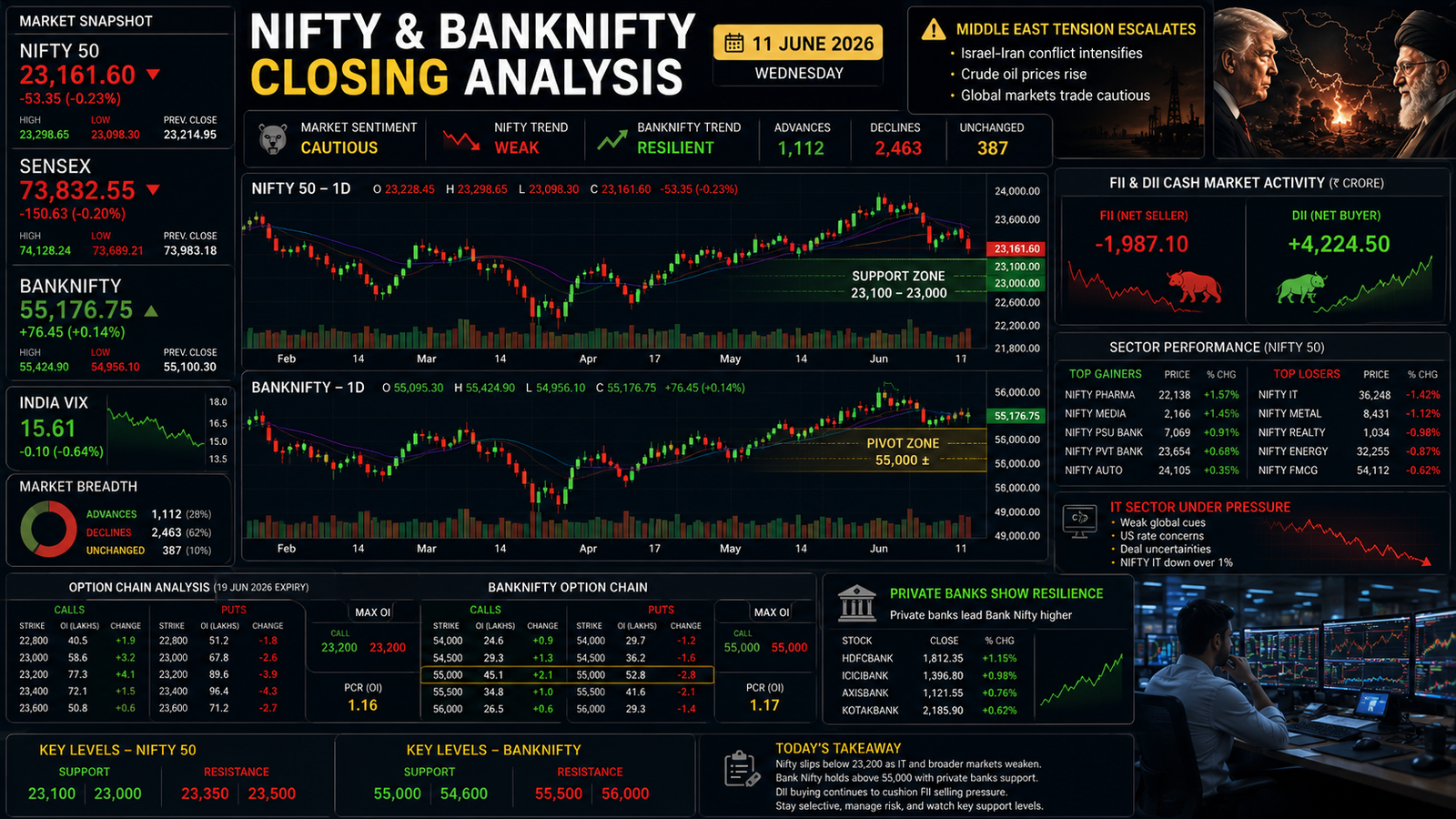
The NIFTY BANKNIFTY Closing Analysis 11 June 2026 shows another cautious and volatile trading session as NIFTY ended below 23,200, while BANKNIFTY managed to hold firm due to strength in private banks. Broader market weakness, IT sector pressure, renewed Middle East tensions, and continued FII selling kept traders defensive through the session.
Table of Contents
Market Snapshot
- NIFTY 50 closed at 23,161.60, down 53.35 points or 0.23%.
- Sensex closed at 73,832.55, down 150.63 points or 0.20%.
- BANKNIFTY closed around 55,176.75, up 76.45 points or 0.14%.
- India VIX closed near 15.61.
- FIIs sold ₹1,987.10 crore in the cash market.
- DIIs bought ₹4,224.50 crore in the cash market.
- IT stocks remained weak, while private banks, pharma and media showed relative strength.
NIFTY BANKNIFTY Closing Analysis 11 June 2026: Market Overview
Indian equity markets ended lower for the second straight session as traders remained cautious amid renewed Middle East escalation and concerns around prolonged high US interest rates. NIFTY slipped below 23,200, while Sensex also closed in the red.
The broader market was weaker than the headline indices. Midcap and smallcap indices declined more sharply, indicating that risk appetite was limited beyond selected large-cap pockets.
BANKNIFTY was the relative outperformer. Private banks supported the index even as the broader market remained weak. This divergence between NIFTY weakness and BANKNIFTY resilience is an important signal for tomorrow’s session.
NIFTY Analysis
NIFTY failed to sustain above 23,200 and closed weak.
Key observations:
- NIFTY closed at 23,161.60.
- Immediate support is near 23,100.
- Stronger support is placed near 23,000.
- Resistance remains near 23,350–23,500.
- A decisive breakout above 23,500 is needed to reverse the short-term bearish structure.
The index remains in a consolidation-to-weakness phase. Unless NIFTY reclaims 23,350–23,500 with strength, every bounce may face selling pressure.
BANKNIFTY Analysis
BANKNIFTY showed resilience and closed slightly positive despite broader market pressure.
Key observations:
- BANKNIFTY held above 55,000.
- Private banks supported the index.
- Immediate support is near 55,000 and 54,600.
- Resistance is visible near 55,500 and 56,000.
- Sustaining above 55,500 may improve short-term momentum.
BANKNIFTY is still stronger than NIFTY on a relative basis. However, if NIFTY continues to weaken, BANKNIFTY may also face pressure near higher resistance zones.
Option Chain Analysis
The option chain setup suggests a range-bound but cautious market.
Important observations:
- NIFTY 23,000 remains a major support zone.
- NIFTY 23,500 remains an important resistance zone.
- BANKNIFTY 55,000 is the key short-term pivot.
- BANKNIFTY 55,500–56,000 may act as the next supply zone.
- India VIX near 15.61 suggests controlled volatility, but global event risk remains active.
The setup favours disciplined range trading rather than aggressive directional positions.
FII DII Activity
Institutional activity remained clearly divided.
FIIs were net sellers of ₹1,987.10 crore in the cash segment, while DIIs were net buyers of ₹4,224.50 crore.
This continues the familiar June pattern where domestic institutions are absorbing foreign selling. DII support is helping prevent a deeper fall, but sustained FII selling is keeping upside limited.
Smart Money Interpretation
Smart money positioning remains defensive.
Key signals:
- FIIs continued to sell.
- DIIs continued to support the market.
- BANKNIFTY showed resilience.
- NIFTY failed to reclaim higher resistance.
- IT weakness continued to drag sentiment.
- Broader markets showed deeper weakness than headline indices.
This suggests that institutions are not aggressively chasing the market higher. Selective buying is visible, mainly in private banks and defensive sectors.
Trap Moves Observed
Today’s session created a selective strength trap.
Traders looking only at BANKNIFTY strength may have assumed the broader market was healthy. However, NIFTY weakness, IT selling and broader market decline told a different story.
This type of divergence can trap aggressive bullish traders if they ignore overall market breadth.
Tomorrow’s Key Levels
| S1 | S2 | R1 | R2 | |
| NIFTY | 23,100 | 23,000 | 23,350 | 23,500 |
| BANKNIFTY | 55,000 | 54,600 | 55,500 | 56,000 |
If NIFTY breaks below 23,100, it may retest 23,000. If BANKNIFTY sustains above 55,500, banking stocks may continue to outperform.
Risk Management Notes
- Avoid aggressive long positions unless NIFTY reclaims resistance.
- Watch BANKNIFTY 55,000 as the key pivot.
- Option sellers should avoid overexposure near global event risk.
- Track FII selling intensity closely.
- Respect broader market weakness even if banking stocks remain firm.
Conclusion
The NIFTY BANKNIFTY Closing Analysis 11 June 2026 indicates a cautious market where NIFTY remains under pressure below 23,200 while BANKNIFTY continues to show relative strength. DIIs are supporting the market, but continued FII selling, weak IT stocks, broader market pressure and geopolitical concerns suggest traders should stay selective and disciplined.
FAQs
1. Why did NIFTY fall on 11 June 2026?
NIFTY fell due to weak global cues, renewed Middle East tensions, IT sector weakness and continued FII selling.
2. Why did BANKNIFTY outperform NIFTY?
BANKNIFTY outperformed because private banks showed relative strength and helped the index close slightly positive.
3. What is the key NIFTY support for tomorrow?
NIFTY support is near 23,100 and 23,000.
4. What is the key BANKNIFTY support for tomorrow?
BANKNIFTY support is near 55,000 and 54,600.
5.What does India VIX near 15.61 indicate?
India VIX near 15.61 indicates controlled volatility, but traders should still remain cautious due to global event risk.
References
- 5paisa FII DII Data
- Angel One India VIX Data
- ICICI Direct BANKNIFTY Data
- Reuters
- NSE India
- Moneycontrol
Disclaimer
The information provided in this article is for educational purposes only and should not be considered investment advice. Trading and investing in financial markets involve risk. Always conduct your own research and consult a SEBI-registered investment adviser before making any investment decisions.
1 thought on “NIFTY BANKNIFTY Closing Analysis 11 June 2026”