
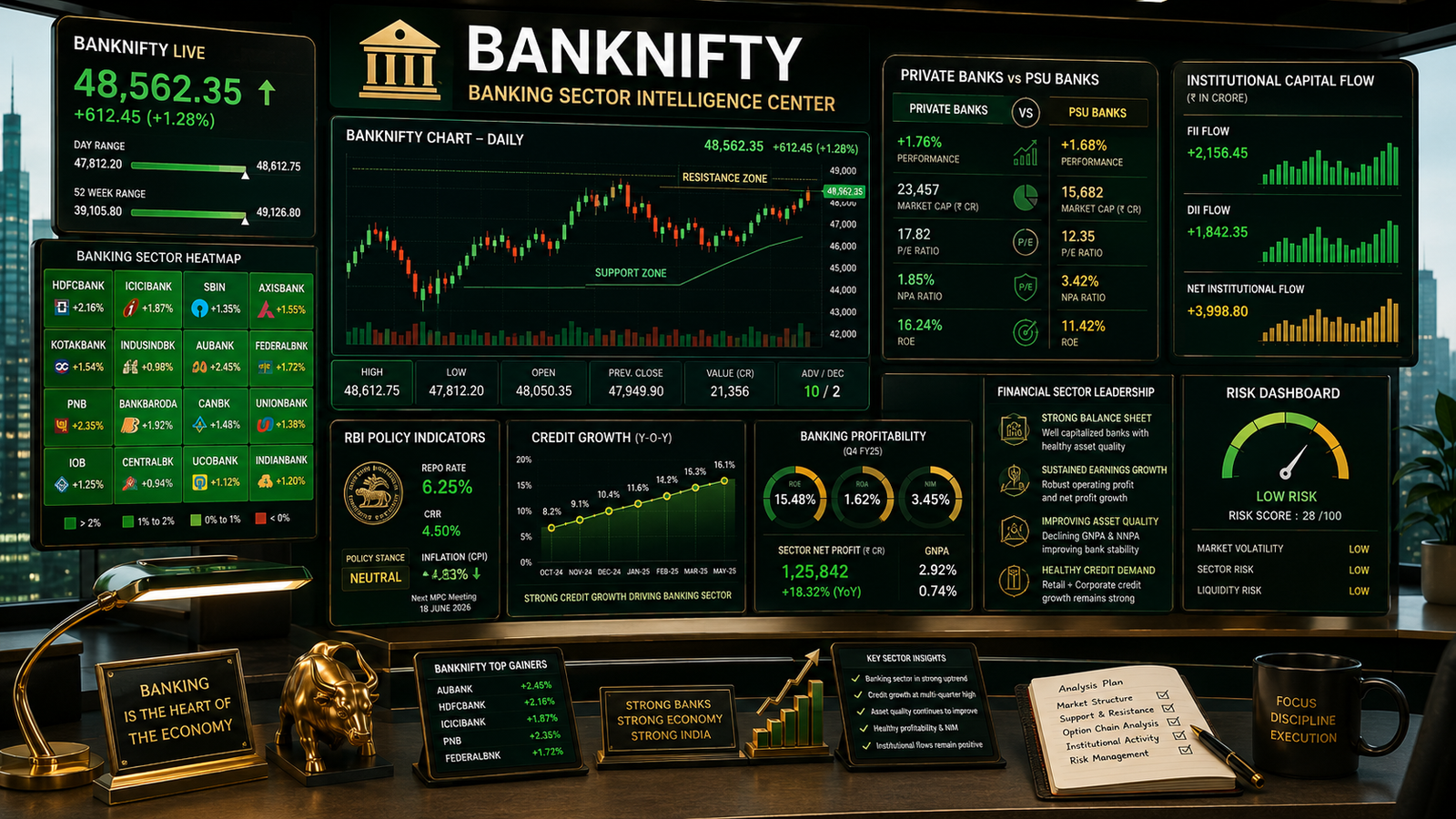
Introduction
BANKNIFTY Analysis is one of the most important skills for traders participating in the Indian derivatives market. While NIFTY represents the broader market, BANKNIFTY focuses specifically on India’s banking sector, which often drives overall market sentiment and volatility.
The banking sector carries significant weight within the Indian economy. As a result, movements in major banks frequently influence not only BANKNIFTY but also broader market direction.
Understanding BANKNIFTY Analysis helps traders identify trends, support and resistance levels, institutional positioning, option chain signals, and volatility patterns.
This guide explains BANKNIFTY Analysis from beginner to advanced level and provides a structured framework for traders and investors.
Table of Contents
What Is BANKNIFTY?
BANKNIFTY is the banking sector index of the National Stock Exchange (NSE).
It tracks the performance of major banking stocks listed on the exchange.
The index includes leading:
- Private sector banks
- Public sector banks
- Financial institutions
BANKNIFTY is widely used by:
- Traders
- Institutional investors
- Portfolio managers
- Derivatives participants
Because of its sector concentration, BANKNIFTY often exhibits higher volatility than NIFTY.
Why BANKNIFTY Matters
The banking sector plays a central role in economic activity.
Banks influence:
- Credit growth
- Economic expansion
- Corporate lending
- Consumer spending
- Liquidity conditions
When banking stocks perform strongly, overall market sentiment often improves.
When banking stocks weaken significantly, broader market sentiment may deteriorate.
Why BANKNIFTY Is More Volatile Than NIFTY
One of the defining characteristics of BANKNIFTY is volatility.
Reasons include:
- Concentrated sector exposure
- Institutional participation
- Interest-rate sensitivity
- Economic data impact
- Banking earnings influence
As a result, BANKNIFTY frequently experiences larger percentage swings than NIFTY.
Major Constituents of BANKNIFTY
BANKNIFTY consists of major banking stocks.
Examples include:
- HDFC Bank
- ICICI Bank
- State Bank of India
- Axis Bank
- Kotak Mahindra Bank
- IndusInd Bank
- AU Small Finance Bank
- Federal Bank
The performance of these banks significantly influences index direction.
Private Banks vs PSU Banks
Understanding sector leadership is important.
Private Banks
Often drive:
- Institutional participation
- Long-term growth
- Market leadership
PSU Banks
Often reflect:
- Government policy expectations
- Economic recovery themes
- Value-oriented participation
Leadership shifts between these groups can influence BANKNIFTY trends.
Understanding Market Structure
Professional BANKNIFTY Analysis begins with market structure.
Key questions include:
- Is BANKNIFTY making higher highs?
- Is BANKNIFTY making lower lows?
- Is the trend bullish?
- Is the trend bearish?
- Is the market consolidating?
Market structure helps traders align with prevailing momentum.
BANKNIFTY Trend Analysis
Uptrend
Characteristics:
- Higher highs
- Higher lows
- Strong buying participation
- Sector leadership
Downtrend
Characteristics:
- Lower highs
- Lower lows
- Weak banking participation
- Increased selling pressure
Sideways Market
Characteristics:
- Repeated support tests
- Repeated resistance tests
- Lack of directional conviction
Support and Resistance in BANKNIFTY
Support and resistance remain fundamental to BANKNIFTY Analysis.
Support
Zones where buying activity increases.
Resistance
Zones where selling activity increases.
Traders identify these levels using:
- Price action
- Swing highs and lows
- Moving averages
- Trendlines
- Option chain positioning
Option Chain Analysis in BANKNIFTY
Option chain analysis plays a major role because BANKNIFTY is heavily traded in the derivatives market.
Key metrics include:
- Open Interest
- Put Call Ratio
- OI Build-Up
- OI Unwinding
- OI Shifting
These indicators help traders identify:
- Support zones
- Resistance zones
- Institutional positioning
- Potential volatility
Institutional Activity and BANKNIFTY
Institutional flows frequently influence BANKNIFTY.
Important participants include:
- FIIs
- DIIs
- Proprietary desks
- Option writers
- Institutional hedgers
Their positioning can significantly affect intraday and swing movements.
Interest Rates and BANKNIFTY
Unlike many sectors, banking stocks are particularly sensitive to interest-rate expectations.
Factors influencing BANKNIFTY include:
- RBI policy decisions
- Repo rate changes
- Inflation data
- Liquidity conditions
Traders should monitor monetary policy developments closely.
Banking Sector Leadership
Strong BANKNIFTY rallies often occur when:
- Multiple banks participate
- Private banks lead
- Market breadth improves
- Institutional flows support the move
Weak participation may reduce trend quality.
Volatility Analysis
Volatility is a defining characteristic of BANKNIFTY.
Traders should monitor:
- India VIX
- Option premiums
- Intraday ranges
- Sector momentum
Higher volatility creates both opportunities and risks.
Risk Management in BANKNIFTY Trading
Because BANKNIFTY moves aggressively, risk management becomes even more important.
Key principles:
Position Sizing
Avoid excessive exposure.
Defined Risk
Know the maximum loss before entering a trade.
Discipline
Follow predetermined trading plans.
Event Awareness
Banking-related news can significantly influence price action.
Practical BANKNIFTY Analysis Framework
Step 1
Assess global market cues.
Step 2
Analyze banking sector strength.
Step 3
Review institutional activity.
Step 4
Study option chain positioning.
Step 5
Identify support and resistance levels.
Step 6
Evaluate market breadth.
Step 7
Develop bullish, bearish, and neutral scenarios.
Common Mistakes Traders Make
Ignoring Banking Sector Leadership
BANKNIFTY direction often depends on a handful of major banks.
Ignoring Volatility
BANKNIFTY volatility can quickly invalidate poor risk management.
Trading Against Market Structure
Trend alignment remains critical.
Ignoring Option Chain Signals
Institutional positioning frequently provides valuable information.
Relationship Between BANKNIFTY and NIFTY
Although closely related, BANKNIFTY and NIFTY are not identical.
BANKNIFTY:
- Sector-focused
- More volatile
- Banking-driven
NIFTY:
- Broad market index
- Diversified sectors
- Lower relative volatility
Analyzing both indices together often improves market understanding.
How Professional Traders Analyze BANKNIFTY
Professional traders combine:
- Market structure
- Banking sector leadership
- Option chain analysis
- Institutional flows
- Volatility assessment
- Risk management
No single indicator is used in isolation.
Conclusion
BANKNIFTY Analysis is an essential skill for traders seeking to understand banking sector trends, institutional participation, and market volatility.
By combining trend analysis, support and resistance, option chain interpretation, sector leadership, and disciplined risk management, traders can build a structured framework for evaluating market opportunities.
Successful BANKNIFTY trading focuses on probabilities, discipline, and risk management rather than prediction.
FAQs
What is BANKNIFTY?
BANKNIFTY is the banking sector index of the National Stock Exchange
Why is BANKNIFTY more volatile than NIFTY?
Because it focuses on a single sector and attracts heavy institutional participation.
Which stocks influence BANKNIFTY the most?
Major private and public sector banks have the largest influence.
Is option chain analysis useful for BANKNIFTY?
Yes. It helps identify support, resistance, and institutional positioning.
Why do RBI policy decisions affect BANKNIFTY?
Because banking profitability and credit growth are influenced by interest rates.
Is BANKNIFTY suitable for beginners?
It can be challenging due to higher volatility, so risk management is essential.
How do traders analyze BANKNIFTY?
Using market structure, trend analysis, option chain data, institutional flows, and sector participation.
What is the relationship between NIFTY and BANKNIFTY?
BANKNIFTY often influences overall market sentiment because of the banking sector’s importance.
Is volatility good for traders?
Volatility creates opportunities but also increases risk.
Is risk management important in BANKNIFTY trading?
Yes. It is one of the most important aspects of successful trading.
Disclaimer
The information provided in this article is for educational purposes only and should not be considered investment advice. Trading and investing in financial markets involve risk. Always conduct your own research and consult a SEBI-registered investment adviser before making any investment decisions.