
Executive Summary
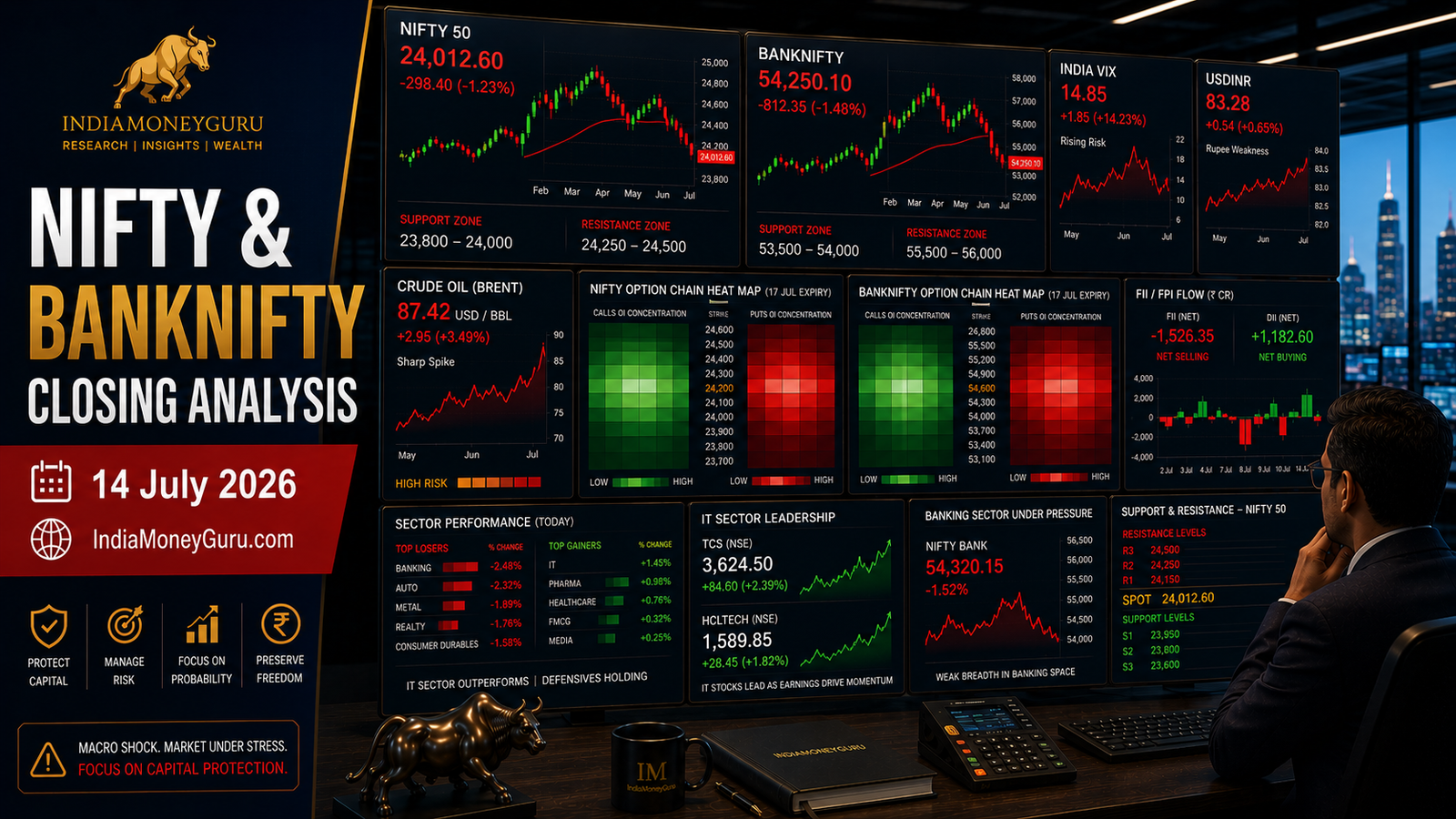
Indian equity markets ended Tuesday, 14 July 2026, with a clear risk-off tone as escalating Middle East tensions pushed crude oil prices sharply higher and revived inflation concerns for India. The NIFTY 50 fell 0.66% to 24,052.05, while broader sentiment weakened across financials, autos, banks, midcaps, and smallcaps.
The session marked a clear shift from Monday’s support-defense structure. Rising crude oil, rupee weakness, bond-yield pressure, and inflation concerns pushed traders toward risk reduction. Brent crude jumped around 4.1% to $87 per barrel, while the rupee weakened to 96.2375 per U.S. dollar, its weakest level in more than a month.
BANKNIFTY and banking stocks faced pressure because banks are sensitive to foreign flows, currency movement, bond yields, and macro risk. State Bank of India fell 2.13%, while IndusInd Bank and Kotak Mahindra Bank also declined.
NIFTY & BANKNIFTY Closing Analysis – 14 July 2026 simply analyzes that the market did not merely fall because of profit booking; it fell because macro risk returned.
Table of Contents
Market Intelligence Scorecard
| Indicator | Status | Interpretation |
|---|---|---|
| NIFTY Trend | 🔴 Short-Term Weak | Closed near 24,052 after oil-led selling |
| BANKNIFTY Trend | 🔴 Weak | Banks and financials came under pressure |
| Crude Oil Risk | 🔴 High | Brent crude surged on Middle East escalation |
| Rupee Impact | 🟠 Negative | Rupee slipped past 96/USD |
| Market Breadth | 🔴 Weak | Midcaps and smallcaps declined |
| Sector Participation | 🔴 Broad Selling | Financials, autos and banks were weak |
| Institutional Mood | 🟠 Cautious | Oil and currency risk may test flows |
| Overall Bias | Cautious | Avoid aggressive dip buying without stabilization |
Previous Session vs Today
| Parameter | 13 July 2026 | 14 July 2026 | Interpretation |
|---|---|---|---|
| NIFTY 50 | Around 24,211 | 24,052.05 | Support-defence gave way to selling pressure |
| BANKNIFTY | Mixed | Weak | Banks failed to confirm recovery |
| India VIX | Elevated near 13.28 | The risk environment still elevated | Volatility concerns remain |
| Market Breadth | Slightly positive | Weak | Broader market pressure increased |
| Sector Leader | IT | Defensive pockets only | Leadership weakened |
| Primary Driver | IT-led recovery | Crude + geopolitical risk | Macro pressure returned |
Market Snapshot
| Index / Indicator | Closing / Reading | Market Message |
|---|---|---|
| NIFTY 50 | 24,052.05 | Down 0.66%; close near key support zone |
| BANKNIFTY | Weak banking participation | Financials failed to support NIFTY |
| Sensex | 77,054.94 | Down 0.72%; broad benchmark pressure |
| Brent Crude | Around $87/barrel | Major macro trigger for Indian markets |
| Rupee | 96.2375/USD | One-month low; oil pressure visible |
| Market Tone | Risk-off | Banks, autos, financials and broader markets declined |
Market Overview
Tuesday’s market fall was mainly triggered by a fresh escalation in Middle East tensions. Reuters reported that the U.S. conducted a third consecutive night of strikes against Iran, reinstated a blockade on Iranian shipping, and proposed a 20% fee for securing the Strait of Hormuz. Brent crude jumped after an Iranian attack on two Emirati oil tankers.
For India, this matters deeply because higher crude prices can widen the import bill, raise inflation expectations, pressure the rupee, increase bond yields, and reduce corporate margin comfort. The rupee slid past 96/USD to a one-month low, and the 10-year benchmark bond yield rose 6 basis points.
The NIFTY 50 fell 0.66% to 24,052.05, while the Sensex declined 0.72% to 77,054.94. Financials, autos, and banks broadly declined. The auto index fell notably as traders worried about inflation, fuel costs, and discretionary demand.
IndiaMoneyGuru Unique Insight
The most important insight from today’s session is the following:
This was not just an index fall. It was a macro sensitivity test.
When markets fall because of stock-specific earnings or sector rotation, traders can often find opportunities in unaffected sectors. But when markets fall because crude oil, currency, and inflation risks rise together, the pressure becomes broader.
Today’s fall showed that India’s market remains highly sensitive to crude oil shocks. NIFTY was already near an important support zone, BANKNIFTY was not leading, and India VIX had recently moved higher. That made the market vulnerable to a macro trigger.
For IndiaMoneyGuru readers, the lesson is clear:
- If crude rises and the rupee weakens together, reduce aggressive leverage.
- If NIFTY is near 24,000, wait for support confirmation before buying.
- If BANKNIFTY is weak, avoid assuming a quick index recovery.
- If broader markets fall with banks and autos, treat the move as risk-off.
Today’s session was a reminder that technical levels matter, but macro triggers decide whether those levels hold.
NIFTY Analysis
NIFTY’s close at 24,052.05 brings the index close to its most important near-term support zone. The 24,000 level has acted as a key psychological and technical reference in recent sessions. On Monday, NIFTY defended it. On Tuesday, the index moved much closer to testing it again.
The structure has turned cautious. The index is still above 24,000, but the quality of price action has weakened. A close below 24,000 in the next session could trigger further profit booking and may invite more Call writing from option sellers.
On the upside, NIFTY must reclaim 24,200 to repair short-term confidence. Until then, every bounce may face selling pressure near resistance zones.
BANKNIFTY Analysis
BANKNIFTY remains the most important confirmation index for NIFTY’s next move, and today it did not provide confidence. Banking stocks were broadly weak, with State Bank of India falling more than 2%, Kotak Mahindra Bank and IndusInd Bank also declining, while ICICI Bank showed only relative resilience.
This matters because banks are directly affected by rising bond yields, foreign flow sensitivity, currency weakness, and macro risk. When crude prices surge and the rupee weakens, financials often face selling pressure because traders start pricing inflation risk and possible policy tightening.
BANKNIFTY’s structure is now cautious. It needs broad participation from private banks and PSU banks to stabilize. If heavyweight banks continue to weaken, NIFTY may struggle to defend 24,000.
Option Chain Intelligence
The option-chain message is defensive.
For NIFTY, the 24,000 level becomes the immediate battleground. If Put writers defend 24,000, the market may attempt a short-covering recovery. If 24,000 breaks, Put unwinding may accelerate downside pressure.
Call writers are likely to become active near 24,200–24,300 because the index has failed to sustain higher levels in the presence of crude and currency pressure. Unless NIFTY reclaims 24,200 quickly, upside may remain capped.
For BANKNIFTY, option sellers should remain cautious. Weak financials and macro uncertainty can increase intraday swings. Selling aggressive near-the-money options without hedges is risky in this environment.
Institutional Activity
Institutional flows need close attention now. The market had recently benefited from foreign inflows, but oil shocks can quickly change foreign investor behavior.
Reuters reported that Indian equities declined as Middle East conflict raised inflation worries, while the rupee weakened sharply due to higher oil prices. This combination is important because foreign investors monitor both equity valuations and currency risk.
Domestic liquidity can cushion the market, but if FIIs turn cautious and BANKNIFTY weakens, index recovery may become slower.
India VIX Analysis
India VIX had already risen in the previous session, and today’s market weakness confirms that traders are again pricing higher risk. Even if the exact day-end VIX figure is less important than the direction, the broader message is that volatility comfort has reduced.
When NIFTY trades near 24,000 and crude oil spikes, option premiums usually expand because traders buy protection. This is why option sellers should avoid excessive confidence.
A sustained VIX rise would mean the market is preparing for wider intraday ranges. A cooling VIX with NIFTY holding 24,000 would be the first sign of stabilization.
Sector Rotation
| Sector | Trend | Interpretation |
|---|---|---|
| Banking / Financials | Weak | Macro risk and currency pressure hurt sentiment |
| Auto | Weak | Higher crude and inflation concerns weighed |
| Midcaps | Weak | Risk appetite reduced |
| Small caps | Weak | High-beta selling visible |
| IT | Mixed | Could not repeat Monday’s strong leadership |
| Oil-sensitive sectors | Weak | Crude spike created margin concerns |
| Defensive stocks | Selective | Investors shifted cautiously, not aggressively |
Today’s sector rotation was not a healthy rotation. It was risk reduction. When banks, autos, and broader markets decline together, traders should treat the session as macro-led selling rather than normal sector switching.
Support and Resistance
| Index | S1 | S2 | S3 | R1 | R2 | R3 |
|---|---|---|---|---|---|---|
| NIFTY | 24,000 | 23,850 | 23,650 | 24,200 | 24,300 | 24,500 |
| BANKNIFTY | 57,000 | 56,500 | 56,000 | 57,700 | 58,200 | 58,500 |
To find how traders identify key banking levels, you must read this article: “BANKNIFTY Support and Resistance Explained.”
Trading Plan for Next Session
The next session should be approached with caution.
For bullish traders, the first requirement is NIFTY holding above 24,000. A bounce from this level should be trusted only if BANKNIFTY stabilizes and market breadth improves.
For bearish traders, a decisive break below 24,000 can open the door for further downside toward lower support zones. However, fresh shorts near support should be managed carefully because short-covering rallies can be sharp.
For BANKNIFTY traders, focus on heavyweight banks. If HDFC Bank, ICICI Bank, Axis Bank, Kotak Mahindra Bank, and SBI remain weak together, the index may continue underperforming.
For option sellers, defined-risk strategies are preferable. Naked selling near key levels is risky because crude-led headlines can create sudden moves.
Risk Factors to Watch
Key risks for the next session include:
- Brent crude staying near or above $87
- Rupee weakness beyond 96/USD
- NIFTY breaking below 24,000
- BANKNIFTY failing to stabilize
- FII selling after currency pressure
- U.S.-Iran escalation
- Bond yield rise
- Auto and financial sector follow-through selling
- India VIX expansion
Trading Lessons
Today’s session gives three important trading lessons.
First, macro risk can quickly overpower technical optimism. NIFTY had defended 24,000 on Monday, but crude risk again forced selling pressure.
Second, BANKNIFTY confirmation is essential. Without banking participation, NIFTY’s recovery attempts remain vulnerable.
Third, crude oil is a major India-specific risk factor. Traders cannot ignore it when it moves sharply.
Key Takeaways
For equity investors, this is not a panic exit signal, but it is a reason to avoid chasing high-beta stocks blindly.
For swing traders, fresh positions should wait for NIFTY support confirmation and BANKNIFTY stabilization.
For option sellers, hedging is essential because macro-driven moves can quickly expand option premiums.
For intraday traders, 24,000 on NIFTY is the key decision level.
Editorial Conclusion
Indian markets closed lower on 14 July 2026 as rising Middle East tensions pushed crude oil higher and revived inflation concerns. NIFTY fell to 24,052.05, BANKNIFTY and banking stocks weakened, and broader markets also came under pressure.
The market is now close to a key decision zone. If NIFTY defends 24,000 and BANKNIFTY stabilizes, a recovery attempt is possible. But if crude remains elevated and the rupee weakens further, traders should prepare for more volatility.
IndiaMoneyGuru View:
The market has moved from selective resilience to macro caution. NIFTY 24,000 is now the key line. Until crude cools, the rupee stabilizes, and BANKNIFTY confirms strength, traders should prioritize risk management over aggressive buying.
FAQs
What was the NIFTY closing level on 14 July 2026?
NIFTY 50 closed at 24,052.05, down 0.66%.
Why did the Indian stock market fall today?
The market fell because escalating Middle East tensions pushed crude oil higher, raising inflation and rupee concerns for India.
Did BANKNIFTY support the market today?
No. Banking stocks were weak, and BANKNIFTY did not provide leadership.
Why is crude oil important for NIFTY and BANKNIFTY?
Higher crude can increase inflation, weaken the rupee, raise bond yields and pressure foreign flows, all of which affect equities and banks.
What is the key NIFTY support now?
The most important near-term support is 24,000.
Should traders buy the dip now?
Traders should wait for NIFTY to hold 24,000 and BANKNIFTY to stabilize before taking aggressive long positions.
What should option sellers do?
Option sellers should use hedged or defined-risk strategies because macro-led volatility can expand quickly.
Which sectors were under pressure today?
Financials, banks, autos, mid-caps, and small-caps were under pressure.
References
Disclaimer
The information provided in this article is for educational purposes only and should not be considered investment advice. Trading and investing in financial markets involve risk. Always conduct your own research and consult a SEBI-registered investment adviser before making any investment decisions.
2 thoughts on “NIFTY & BANKNIFTY Closing Analysis – 14 July 2026”