
Opening Hook
The market did not give a normal expiry-day close today. NIFTY slipped, Sensex also ended lower, but the real story was once again the new Closing Auction Session, or CAS.
After Monday’s sharp CAS-led spike, Tuesday showed the other side of the new closing system: uncertainty, late-session volatility and nervousness among option traders.
Table of Contents
Today’s Market in Simple Words
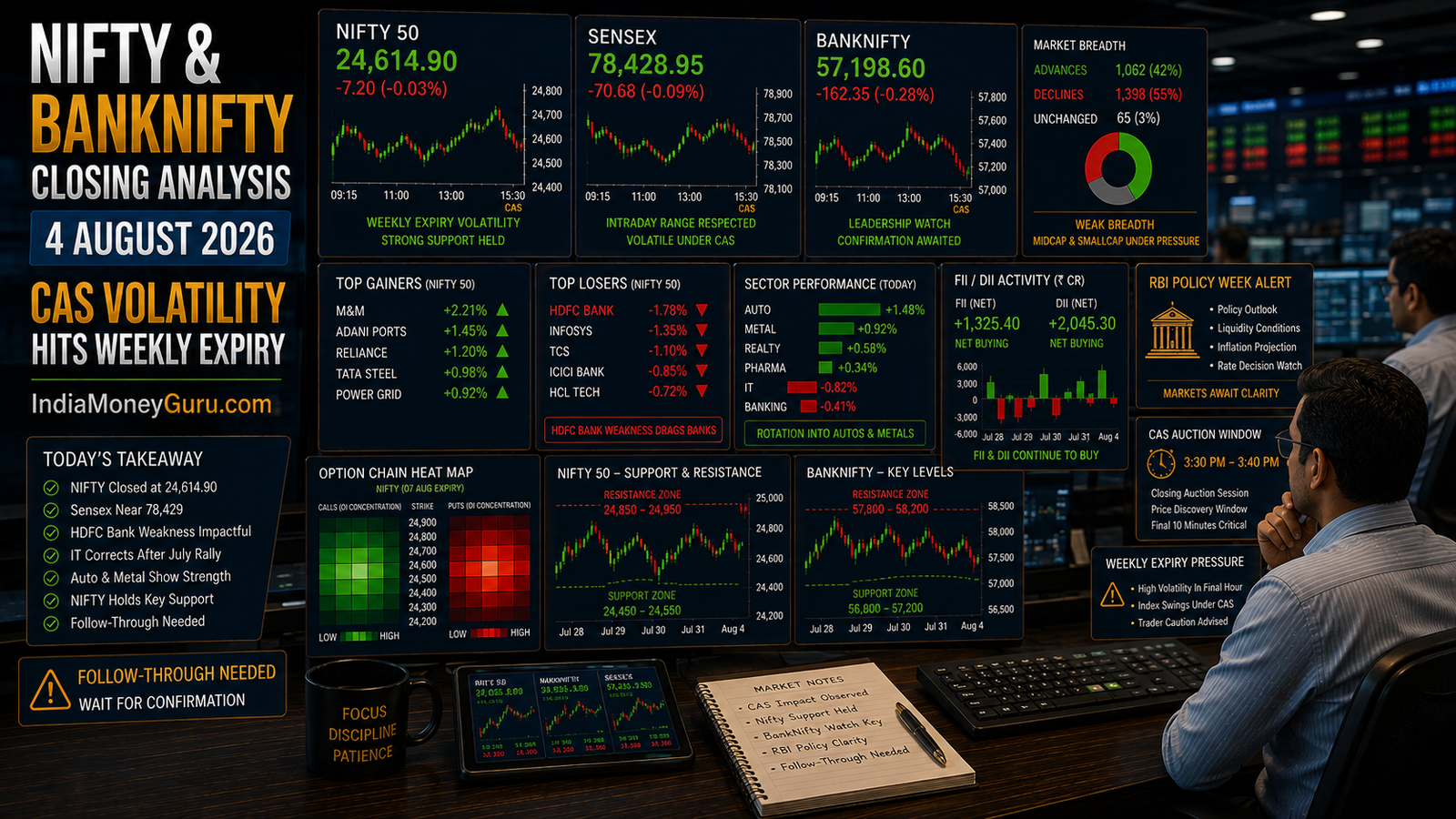
NIFTY BANKNIFTY Closing Analysis 4 August 2026: NIFTY closed at 24,614.90, down around 0.6%, while Sensex ended at 78,428.95, down 0.27%. The fall was not very deep, but the price action felt uncomfortable because it came on weekly expiry and under the new CAS framework.
This move should be read after the CAS-led closing move on 3 August 2026, where NIFTY had jumped sharply near the closing auction window.
Today, Reuters reported that NIFTY was down 1.25% at 3:15 PM, when the auction window opened, and later stood 0.6% lower at 24,614.90 when closing prices were set. That means the final close again depended heavily on how prices behaved inside the auction mechanism.
NIFTY View
NIFTY gave back a part of Monday’s unusual closing gain. This does not mean the recovery has completely failed, but it does mean traders should not treat Monday’s close as a clean breakout.
The index now needs to hold the 24,500–24,450 zone. If it does, the market can still consolidate and attempt a fresh move after RBI policy clarity. But if NIFTY slips below 24,450, then the CAS-led spike may be fully absorbed, and the index can move back into a broader consolidation zone.
The better approach is simple: do not chase the closing price blindly. Watch where the index trades during normal market hours and how it settles after CAS.
BANKNIFTY View
BANKNIFTY did not give strong leadership today. HDFC Bank underperformed, and MarketWatch reported that HDFC Bank shares fell 1.48% while the Sensex also ended lower.
This matters because BANKNIFTY is still the key confirmation index for the broader market. NIFTY can move sharply because of CAS and heavyweight adjustment, but a sustainable rally needs banks to participate more clearly.
Ahead of the RBI policy outcome, traders should track HDFC Bank, ICICI Bank, Axis Bank, SBI and Kotak Mahindra Bank closely. If these names stabilise, BANKNIFTY can support the market. If they remain weak, NIFTY may struggle to hold higher levels.
Sector and Breadth Check
The market was mixed rather than fully broken. The bigger issue was uncertainty around the closing mechanism, not broad panic.
HDFC Bank was weak. Some defensives also remained under pressure, while select large-cap names helped limit the damage. ScanX listed TCS, Titan, Bajaj Auto and UltraTech Cement among the day’s stronger names, while HUL, BEL, Coal India and Tata Consumer were among the weaker names.
This tells us the market is now stock-specific. Traders should avoid assuming that a strong index close means all sectors are strong or that one weak day means the rally is over.
Option Chain / VIX Signal
Tuesday was weekly expiry, and CAS made the final phase more difficult for option traders.
Reuters reported that analysts expected Tuesday’s volatility to affect option premiums because the closing index value determines settlement for option contracts. This is important for NIFTY traders because the cash market now enters the closing auction before the final official close, while derivatives continue trading until later.
For option sellers, this means the last 20–25 minutes can no longer be treated casually. Position sizing becomes more important during expiry. Traders can also review the Position Size Calculator before increasing exposure in volatile expiry sessions.
Support and Resistance
| Index | Support | Resistance |
|---|---|---|
| NIFTY | 24,500 / 24,450 | 24,700 / 24,800 |
| BANKNIFTY | 57,200 / 57,000 | 57,800 / 58,000 |
What Traders Should Watch Tomorrow
Wednesday will be important because the market will look for two confirmations.
First, traders need to see whether NIFTY can hold above 24,500 after expiry-day volatility. Second, BANKNIFTY needs to show whether banks are ready to support the market ahead of the RBI policy outcome.
This week should also be read in continuation with the 31 July market recovery with improving breadth because the rally before CAS was already improving but still needed banking confirmation.
IndiaMoneyGuru Takeaway
Today’s fall was not alarming, but it was a warning.
NIFTY is still above important short-term support, but the new CAS framework has changed how traders should read closing prices. Monday’s spike and Tuesday’s expiry volatility both show that the final close can now behave differently from the normal trading session.
Simple view: stay cautious, respect 24,500 on NIFTY, watch BANKNIFTY leadership, and wait for RBI policy clarity before taking aggressive positions.
FAQs
What was the NIFTY closing level on 4 August 2026?
NIFTY closed at 24,614.90, down around 0.6%.
Why was the market volatile today?
The market was volatile because it was weekly expiry, and traders were still adjusting to the new Closing Auction Session framework.
Did Sensex also fall today?
Yes. Sensex closed at 78,428.95, down 0.27%.
What should BANKNIFTY traders watch now?
BANKNIFTY traders should watch whether large private banks stabilise ahead of the RBI policy outcome.
Is NIFTY’s rally over?
Not yet. But the index needs to hold above 24,500 and show better follow-through during normal trading hours.
References
- Reuters: India’s new closing auction stokes sharp Nifty swings and options volatility on weekly expiry, 4 August 2026
- Economic Times: Sensex rises over 100 points, but Nifty slips near 24,600 – what is driving the divergence, 4 August 2026
- Times of India: What new stock market timings and closing auction session mean, 4 August 2026
- MarketWatch: HDFC Bank slides Tuesday, underperforms market, 4 August 2026
Disclaimer
The information provided in this article is for educational purposes only and should not be considered investment advice. Trading and investing in financial markets involve risk. Always conduct your own research and consult a SEBI-registered investment adviser before making any investment decisions.
2 thoughts on “NIFTY & BANKNIFTY Closing Analysis – 4 August 2026”