
Opening: Why Everyone Is Talking About CAS
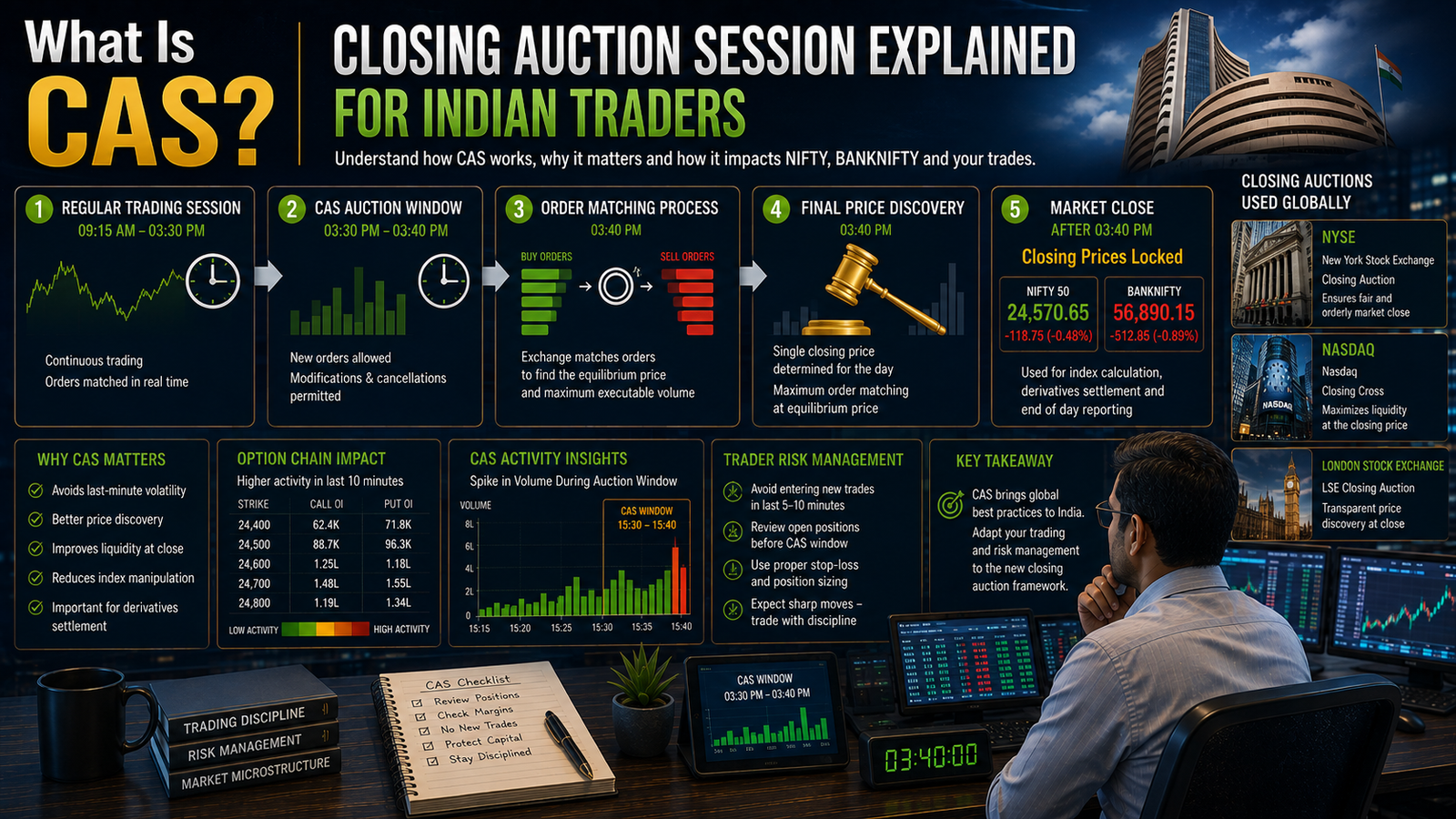
Closing Auction Session: The last 15 minutes of the Indian market have changed. If NIFTY’s closing moves confused you this week, you are not alone. The reason is the newly introduced Closing Auction Session, or CAS.
If you watched the market during the first week of August 2026, you probably noticed something unusual.
NIFTY and Sensex were not always moving in the same way near the close. Some sessions looked calm during regular trading, but the final closing price behaved differently. For many traders, especially option traders, this felt uncomfortable.
This term may sound technical, but the idea is simple. The exchange is trying to discover a better closing price by collecting buy and sell orders in a short auction window instead of relying only on the earlier final-30-minute average method.
This week’s impact was clearly visible in the 3 August CAS-led NIFTY closing analysis, where the market saw a sharp final move near the closing auction window.
Table of Contents
What Is CAS?
CAS stands for Closing Auction Session.
It is a short auction window near the end of the trading day. During this period, buy and sell orders are collected together. The exchange then finds the price at which the maximum quantity can be matched.
In simple words, CAS asks:
At what price can the highest number of buyers and sellers meet near the close?
That discovered price becomes the official closing price for eligible stocks.
From 3 August 2026, India started using CAS for stocks in the F&O segment. Earlier, closing prices were based on the weighted average price during the final 30 minutes of continuous trading. Under the new system, closing-price discovery moves to a separate auction process.
Why Did CAS Create Volatility in the First Week?
CAS created noise because traders were adjusting to a new market structure.
Reuters explained that India introduced CAS as a separate 20-minute window starting at 3:15 PM. It replaced the older system where closing prices were calculated from the average price of trades in the final 30 minutes. That is a big behavioural change for traders, institutions, arbitrage desks and option sellers.
The confusion became sharper during the 4 August CAS volatility on weekly expiry, when traders had to deal with both expiry pressure and the new auction mechanism.
In the first few sessions, the market was not only reacting to news, earnings or RBI policy. It was also learning how the new closing system behaves. That is why the final index print sometimes looked different from what traders saw during normal market hours.
Why Did SEBI Introduce CAS?
SEBI’s stated reason is to align India’s closing-price discovery with global practices and create a fair, equal and transparent mechanism for all categories of investors.
This matters because a closing price is not just a casual number on a chart. It is used by:
- mutual funds;
- ETFs;
- index funds;
- institutional investors;
- derivative traders;
- benchmark-tracking products;
- portfolio valuation systems.
If the closing price is based only on thin or random last-minute trading, it may not fully represent true supply and demand. A closing auction tries to bring more orders together and discover one more reliable price.
That is the long-term logic behind CAS. Read the latest updated article, “SEBI’s proposed changes to CAS and F&O expiry settlement.“
How Global Markets Use Closing Auctions
India is not doing something completely new. Major global exchanges already use closing-auction-style systems.
Nasdaq uses its Closing Cross to bring together closing buy and sell interest and set the official closing price for Nasdaq-listed securities. Nasdaq also reported record closing-cross activity during the June 2026 Russell US Indexes reconstitution, where billions of shares were matched through the closing process.
NYSE also has formal auction mechanisms, including closing auction order types and imbalance information. These auctions help market participants manage large closing orders in a more structured way.
In global markets, closing auctions are especially important on index-rebalancing days, fund-flow days and derivative-heavy sessions. Institutions often prefer auction windows because they offer a transparent place to execute large orders near the official close.
So while CAS feels new for many Indian traders, the idea is already a normal part of mature market structure globally.
How CAS Can Help Indian Traders in the Long Run
In the short term, CAS may feel inconvenient. That is normal whenever market structure changes.
But in the long run, CAS can help Indian traders in five ways.
1. Better closing price discovery
CAS can make the official closing price more meaningful because it reflects collected buy and sell interest instead of only the final stretch of continuous trading.
2. More transparent closing behaviour
Auction-based systems show that the close is a separate price-discovery event. This can help traders understand whether closing moves are backed by real order flow.
3. Better institutional participation
Large investors often need to execute near the close because fund values, index tracking and portfolio reporting depend on closing prices. CAS gives them a more structured mechanism.
4. Better global alignment
Since exchanges like Nasdaq and NYSE use closing auctions, CAS moves Indian markets closer to global market standards.
5. Better trading discipline
CAS will force traders to stop treating the last few minutes casually. This is especially useful for option sellers, who often underestimate closing-window and expiry-day risk.
What CAS Means for NIFTY and BANKNIFTY Traders
For NIFTY and BANKNIFTY traders, CAS changes how the final close should be interpreted.
Earlier, many traders looked at the 3:30 PM closing price as a simple market verdict. Now, they must ask a better question:
Was the close accepted by the market, or was it only an auction-window adjustment?
The broader weekly context is explained in the weekly market wrap-up for 7 August 2026, where CAS remained one of the biggest themes of the week.
A practical trader should now track:
- normal-session price action;
- CAS-window behaviour;
- next-day follow-through;
- BANKNIFTY confirmation;
- volume and breadth;
- option premium behaviour after the close.
If the next session sustains near the CAS closing level, that close becomes more reliable. If the market quickly reverses, traders should treat the earlier close with caution.
What Option Traders Should Learn from CAS
Option traders need to be extra careful.
CAS can affect final settlement behaviour, especially around expiry. If the closing price moves sharply during the auction window, option premiums and settlement expectations can change quickly.
This does not mean option traders should avoid the market. It means they should trade with better risk control.
Traders can use the Position Size Calculator before increasing exposure during volatile expiry or closing-auction sessions.
For option sellers, the key lesson is simple:
Do not increase lot size just because the market looked calm during regular trading hours.
The closing auction is now part of the risk equation.
Is CAS Good or Bad?
CAS is not good or bad by itself.
It is a market-structure change.
For traders who ignore it, CAS may feel confusing. For traders who understand it, CAS can become a useful signal. It can show where larger closing interest is concentrated and whether the market accepts a particular closing level.
The first week felt noisy because everyone was adjusting. Over time, traders, brokers, institutions and algos may adapt, and the closing auction may become more orderly.
The better approach is not to fear CAS. The better approach is to study it.
IndiaMoneyGuru View
CAS is a short-term adjustment but a long-term improvement.
Indian traders are uncomfortable because the close is no longer behaving exactly the way they were used to. That discomfort is understandable. But global markets already show that closing auctions can improve price discovery, support institutional liquidity and make official closing prices more meaningful.
For NIFTY and BANKNIFTY traders, the message is simple:
Do not blindly trade the final close. Understand how the close was formed.
CAS will reward traders who are disciplined, patient and aware of market structure. It may punish traders who oversize positions near expiry without understanding closing-window risk.
Key Takeaways
- CAS means Closing Auction Session.
- India introduced CAS for F&O-segment stocks from 3 August 2026.
- It replaced the earlier final-30-minute average method for closing-price discovery.
- CAS created volatility because traders were adjusting to a new market structure.
- SEBI says CAS aligns India with global practices and improves transparency.
- Global exchanges like Nasdaq and NYSE already use closing-auction mechanisms.
- CAS can help improve closing price discovery over time.
- Option traders should be more careful near expiry and closing windows.
- The final close should be confirmed by next-day price action.
FAQs
What is CAS in the Indian stock market?
CAS means Closing Auction Session. It is a separate auction window near market close used to discover the official closing price for eligible stocks.
When did CAS start in India?
CAS started from 3 August 2026 for stocks in the F&O segment.
Why did CAS create volatility?
CAS created volatility because traders were adjusting to a new closing-price discovery process. Large auction-window orders can influence final closing prices.
Is CAS used globally?
Yes. Global exchanges such as Nasdaq and NYSE use closing-auction mechanisms to determine official closing prices.
How can CAS help traders?
CAS can improve closing price discovery, increase institutional participation and make closing prices more transparent over time.
Should option traders worry about CAS?
Option traders should not panic, but they should manage risk carefully. CAS can affect expiry-day settlement behaviour and closing-window premium movement.
References
- Economic Times: Closing Auction Session — Why SEBI says the new framework is better than VWAP
- Times of India: Why stock market’s close is now an auction – explained
- Reuters: Why has India’s new closing price system for stocks spooked traders?
- Economic Times: D-Street overcomes CAS pain to post weekly gains
- Nasdaq: Nasdaq Closing Cross
- NYSE: Auctions
- Nasdaq: Record Trading Volume on the Nasdaq Closing Cross During June 2026 Russell US Index Reconstitution
Disclaimer
The information provided in this article is for educational purposes only and should not be considered investment advice. Trading and investing in financial markets involve risk. Always conduct your own research and consult a SEBI-registered investment adviser before making any investment decisions.
3 thoughts on “What Is CAS in Stock Market? Closing Auction Session Explained for Indian Traders”