
Executive Summary
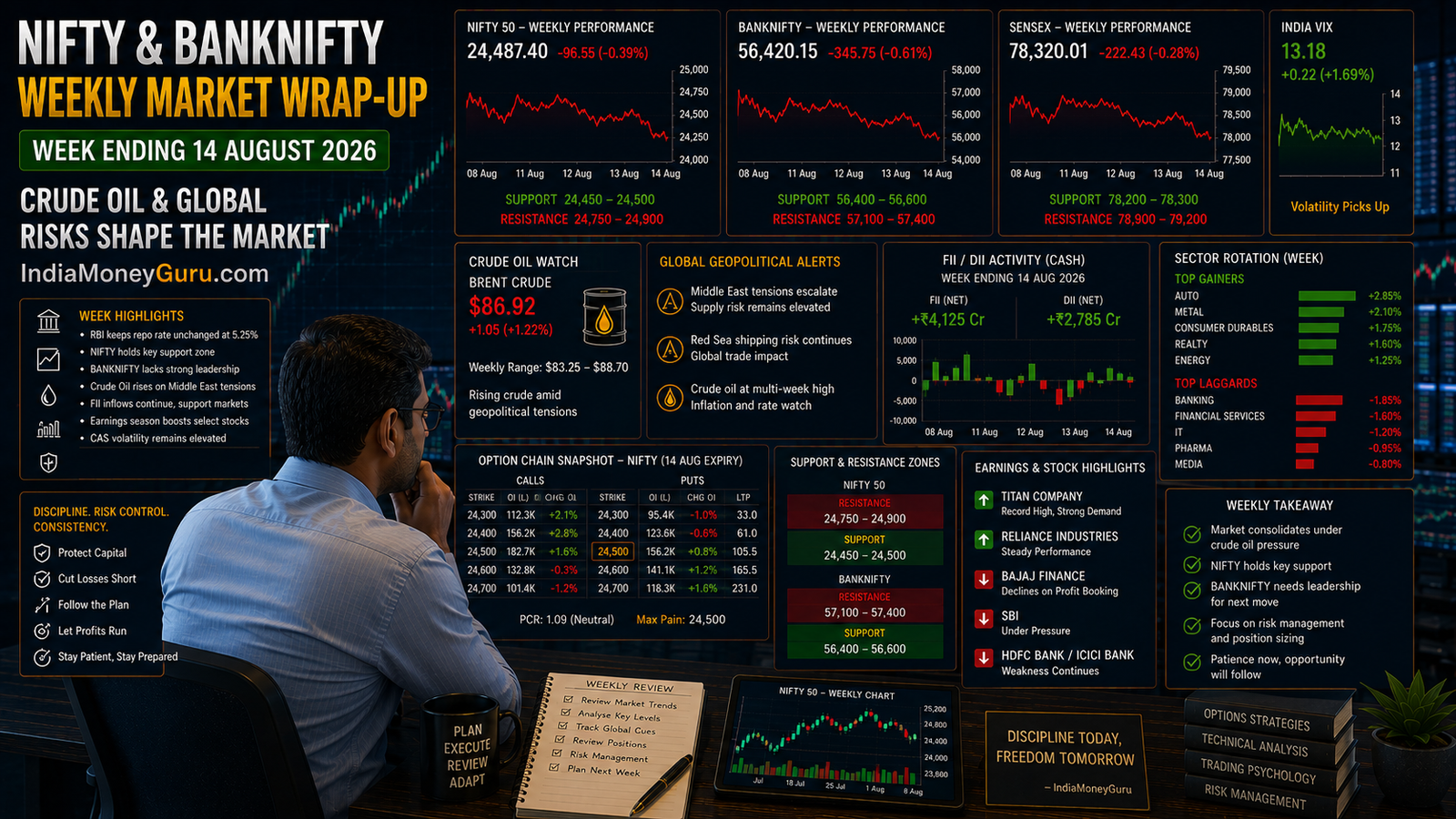
NIFTY BANKNIFTY Weekly Market Wrap-Up 14 August 2026: The second week of August reminded traders that markets don’t move only on domestic news.
While corporate earnings remained broadly supportive, three themes dominated investor sentiment:
- Rising crude oil prices due to Middle East tensions.
- Continued adjustment to the new Closing Auction Session (CAS).
- Weak participation from BANKNIFTY despite NIFTY holding key support for most of the week.
The market remained resilient early in the week but closed lower on Friday as global uncertainty outweighed domestic positives. The broader trend is still constructive, but traders have become noticeably more selective.
Table of Contents
The Week in Simple Words
If last week was about understanding the new Closing Auction Session (CAS), this week was about understanding how quickly global developments can influence Indian markets.
NIFTY spent most of the week consolidating after the RBI policy, while BANKNIFTY struggled to attract consistent buying. Midway through the week, investors remained optimistic because earnings were broadly encouraging and volatility stayed under control.
That changed toward the end of the week.
Crude oil climbed sharply as geopolitical tensions in the Middle East intensified. Since India imports most of its crude oil, higher prices immediately raised concerns about inflation, corporate costs and future foreign investment flows. Those concerns eventually pushed both NIFTY and Sensex lower on Friday.
What Moved the Market This Week?
1. Crude Oil Became the Biggest Driver
Brent crude moved close to $87–89 per barrel, becoming the week’s biggest concern. My article, “why rising crude oil hurts the Indian stock market?“, can help you before your next trading.
Higher crude prices matter because they can:
- increase India’s import bill;
- put pressure on the rupee;
- raise inflation expectations;
- reduce corporate profit margins.
Even though domestic fundamentals remained reasonably healthy, global oil prices overshadowed much of the positive news.
2. Traders Continued Adjusting to CAS
The Closing Auction Session (CAS) remained one of the week’s most discussed market developments.
During the first few sessions after its introduction, traders noticed that closing prices sometimes behaved differently from intraday price action. While this initially created confusion, CAS is designed to improve closing-price discovery over the long term by aligning India more closely with global market practices.
If you missed the earlier discussion, our upcoming Closing Auction Session (CAS) Explained for Indian Traders article explores how this mechanism works and why it matters for NIFTY, BANKNIFTY and option traders.
3. BANKNIFTY Could Not Lead
NIFTY remained relatively resilient for much of the week, but BANKNIFTY never developed sustained leadership.
Private banks traded with caution, preventing the broader market from building a stronger upward trend. This divergence became more visible as the week progressed and eventually contributed to Friday’s weakness.
NIFTY & BANKNIFTY Weekly Technical View
NIFTY
NIFTY spent most of the week defending the 24,500 region before slipping on Friday.
Although the final session weakened short-term momentum, the broader structure has not broken yet. The coming week will be important because buyers now need to defend the 24,300–24,350 zone.
BANKNIFTY
BANKNIFTY continued to underperform NIFTY.
The lack of broad participation from heavyweight private banks remains the biggest obstacle to a stronger market rally. Until financials improve, NIFTY is likely to remain dependent on stock-specific buying rather than broad-based momentum.
Sector Rotation
The week clearly favoured selective stock picking instead of aggressive index buying.
| Stronger Sectors | Weaker Sectors |
|---|---|
| Auto | Financials |
| IT | Metals |
| Capital Goods | Oil-sensitive sectors |
| Select mid-caps | Large Private Banks |
FII/DII, Rupee & Global Cues
Foreign investor sentiment remained mixed as global geopolitical risks increased.
The rupee stayed relatively stable thanks to continued RBI intervention, even as higher crude prices created pressure on the currency. Analysts expect the RBI to continue focusing on limiting excessive volatility rather than targeting a specific exchange rate.
Option Chain & India VIX
Despite Friday’s decline, India VIX did not indicate panic.
Option positioning continued suggesting a cautious but orderly market rather than widespread fear. However, if crude oil remains elevated next week, option premiums could become more sensitive to overnight global developments.
Before increasing exposure in such an environment, traders should review the Position Size Calculator.
Key Levels for Next Week
| Index | Support | Resistance |
|---|---|---|
| NIFTY | 24,300 / 24,200 | 24,500 / 24,700 |
| BANKNIFTY | 56,500 / 56,200 | 57,200 / 57,600 |
Three Possible Scenarios
🟢 Bullish
- Crude oil cools down.
- Banking stocks regain strength.
- NIFTY reclaims 24,500 and moves toward 24,700.
🟡 Neutral
- Crude remains elevated but stable.
- NIFTY consolidates between support and resistance.
- Stock-specific opportunities continue.
🔴 Bearish
- Crude oil rises further.
- Geopolitical tensions worsen.
- NIFTY breaks below 24,300, increasing selling pressure.
IndiaMoneyGuru Takeaway
The market didn’t become weak because India’s story changed.
It became cautious because global uncertainty increased.
That’s an important distinction.
Corporate earnings remain supportive, domestic economic fundamentals continue to be relatively stable and the RBI has not introduced any major negative surprise. The biggest challenge is external – higher crude-oil prices and geopolitical uncertainty.
For traders, this is a week that reinforces an old lesson:
Protect capital first. Opportunities always return, but capital lost through emotional trading is much harder to recover.
FAQs
Why did Indian markets end the week lower?
The biggest reason was rising crude oil prices and geopolitical tensions, which reduced investors’ willingness to take risks.
Why is crude oil so important for Indian markets?
India imports a significant share of its crude oil. Higher oil prices can increase inflation, weaken the rupee and affect corporate profitability.
Is the broader trend still positive?
The longer-term trend remains constructive, but the short-term outlook depends on whether NIFTY holds the 24,300 support zone.
What should traders watch next week?
Monitor crude oil prices, BANKNIFTY participation, foreign investor activity and whether NIFTY can defend key support.
References Used
- Reuters – Indian shares fall as crude remains at elevated levels (market context after the week)
- Reuters – RBI’s heavy FX footprint revives memories of a tightly managed rupee
- Reuters – Week Ahead: Indian rupee expected to be rangebound
- Reuters – Indian shares end week lower as higher crude tempers risk appetite (used in the 14 August daily analysis)
Disclaimer
The information provided in this article is for educational purposes only and should not be considered investment advice. Trading and investing in financial markets involve risk. Always conduct your own research and consult a SEBI-registered investment adviser before making any investment decisions.
3 thoughts on “NIFTY & BANKNIFTY Weekly Market Wrap-Up – 14 August 2026”