
Table of Contents
A stock can trade at one price near the end of the normal session and still finish with a different official closing price.
To the average investor, that difference may seem small. For an options or futures trader, the price that settles the contract on the final trading day directly determines the value at which the derivative expires.
That is why SEBI’s latest review of India’s Closing Auction Session (CAS) deserves attention.
After introducing CAS in August 2026 to improve closing-price discovery, SEBI is now considering how the auction should interact with the settlement of derivative contracts. Its latest consultation paper proposes changes to market timings, order handling and, most importantly for F&O traders, the method used to determine expiry-day settlement prices.
Behind the regulatory terminology is a simple but important question:
“The fairest representation of the market’s final price should be considered to be:“
What Is the SEBI Closing Auction Session?
Traditionally, investors may think of the closing price as simply the last price at which a stock traded.
That is not necessarily how an official closing price is determined.
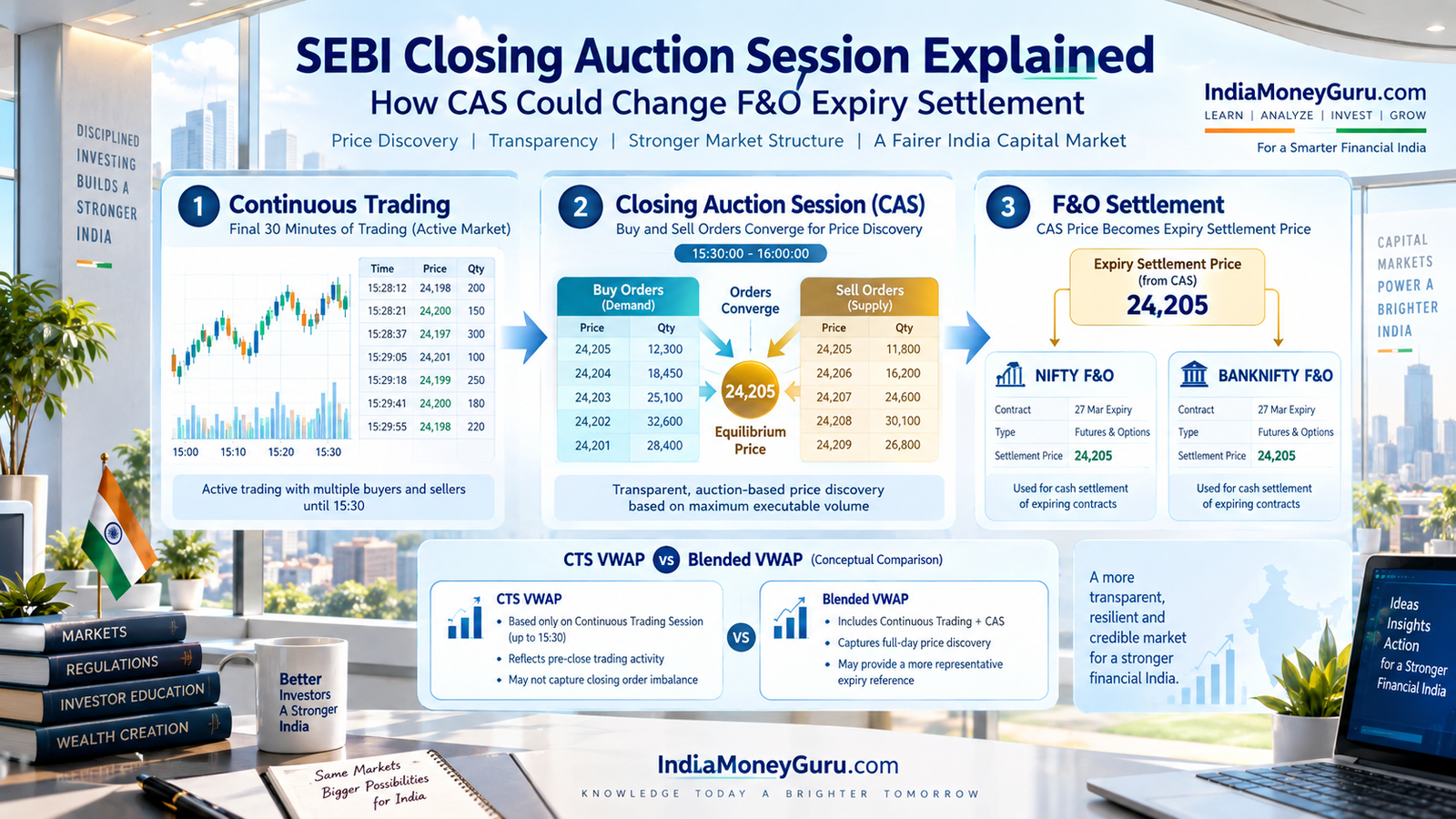
A Closing Auction Session creates a separate price-discovery process near the end of the trading day. Instead of relying only on the final transaction, buy and sell orders are brought together so that the market can discover an equilibrium closing price.
The basic idea is straightforward:
Buy orders + Sell orders → Closing auction → Price discovery → Official closing price
Closing auctions are particularly useful for institutional investors and passive funds.
An index fund, for example, often needs to buy or sell securities close to their official closing prices so that the fund can accurately track its benchmark.
A transparent auction can concentrate liquidity around the close and potentially improve that process. But derivatives introduce another layer of complexity.
Why Does CAS Matter More on F&O Expiry Day?
Suppose a NIFTY option expires today. Its final value depends on the settlement price of the underlying index. That makes the methodology used to calculate the expiry settlement price critical.
Now imagine significant price movement occurring during the closing auction after the continuous market has effectively completed its normal price-discovery process.
Should that auction price influence the settlement of contracts that have just reached expiry? That is the issue SEBI is trying to address.
CAS was introduced for improving cash-market closing-price discovery. But once the CAS-derived closing prices interact with derivatives settlement, the consequences extend to futures and options traders as well.
Market participants have raised concerns about sharp movements and differences between prices seen during continuous trading and those emerging through the closing auction.
SEBI’s response is not simply to abandon CAS. Instead, the regulator is examining how cash-market price discovery and derivative settlement can work together more effectively.
The Two Settlement Methods SEBI Is Considering
This is the most important part for traders.
SEBI has proposed two broad alternatives for determining expiry-day derivative settlement prices.
Option 1: Blended VWAP
Under this approach, the settlement price would be based on trading activity from:
the final 30 minutes of the Continuous Trading Session
and
10 minutes of the Closing Auction Session.
The weighting would depend on the actual traded value in the two periods.
Conceptually:
Final 30-minute trading VWAP + CAS VWAP → Blended settlement price
VWAP means Volume Weighted Average Price.
Instead of treating every transaction equally, VWAP gives greater influence to prices at which larger amounts were actually traded.
The attraction of this approach is that it could incorporate information from both normal trading and the dedicated closing-price discovery mechanism.
But there is a condition. For the approach to work effectively, CAS itself needs sufficient participation and liquidity.
A closing auction with limited participation should not necessarily be allowed to exert disproportionate influence over the settlement of a large derivatives market.
Option 2: Continue With CTS VWAP Initially
The second approach is more cautious.
Expiry settlement would initially continue to use the VWAP from the final 30 minutes of continuous trading, keeping CAS separate from derivatives settlement.
After the market has gained at least a year of experience with CAS, the framework could potentially transition towards the Blended VWAP method.
This gives investors, brokers, institutions and exchanges more time to adapt to the closing auction before it becomes an integral part of expiry settlement.
In practical terms, SEBI is therefore considering both the destination and the transition path.
Why Not Simply Use the Last Traded Price?
This question is central to market design.
Imagine that thousands of transactions take place between ₹995 and ₹1,005 during the final half-hour.
Then one small transaction occurs at ₹1,012 just before trading finishes.
Would ₹1,012 necessarily represent the fairest value of the stock?
Probably not.
A VWAP incorporates both price and traded volume, making it more representative of where meaningful trading activity occurred.
A closing auction attempts something slightly different: it aggregates buying and selling interest around the market close and discovers a price where the greatest executable demand can meet.
Therefore:
LTP tells us where the latest transaction occurred.
VWAP tells us where volume actually traded over a period.
CAS attempts to discover an equilibrium closing price through an auction.
These are related concepts, but they are not identical. That distinction is particularly important on expiry day.
Why Is SEBI Also Looking at Indicative Index Values?
Another interesting proposal concerns the information displayed during CAS.
During an auction, indicative prices can change as orders enter, change or disappear.
An indicative equilibrium price is useful because it gives participants an idea of where the auction might eventually clear.
But an indicative price is not yet an executed trade.
When indicative prices are used to calculate and display an indicative index level, traders can potentially interpret that number as if it represents an actual market price.
SEBI has therefore proposed changes to how such index information is disseminated during CAS.
This highlights a broader lesson that applies well beyond this particular regulation:
A displayed market value and an executed market price are not always the same thing.
Understanding that distinction can prevent traders from reacting to information without first understanding how it was calculated.
What Could Change for Options Traders?
For most long-term investors, the operational details of derivative settlement may appear remote. For active F&O traders, they matter directly.
Consider an option positioned close to its strike price on expiry day.
A relatively small difference in the final settlement value can affect whether the option finishes in-the-money or out-of-the-money and determine its final intrinsic value.
This is one reason expiry-day price discovery requires a robust methodology.
But traders should be careful not to reach the wrong conclusion.
CAS itself is not inherently good or bad for options traders.
The real objective is to create a closing and settlement mechanism that is:
liquid, transparent, difficult to manipulate and representative of genuine market activity.
SEBI’s consultation process is essentially about finding the best balance between those objectives.
Why This Matters Beyond CAS
There is a broader lesson here for retail traders.
Many traders spend enormous amounts of time studying charts, support and resistance, open interest and option premiums but relatively little time understanding market microstructure.
Yet market structure determines how orders are matched, prices are discovered, closing values are calculated and derivative contracts are settled.
Those mechanics become especially important around expiry.
Knowing that a chart shows a closing price is not enough.
A serious trader should occasionally ask:
How was that closing price actually determined?
That question becomes even more important whenever the exchange or regulator changes the mechanism.
What Should Traders Watch Next?
Three developments matter now.
SEBI’s final decision: The current framework is a proposal, not the final rule. Public comments are being invited until 3 October 2026.
Liquidity inside CAS: A blended methodology becomes more convincing if participation and traded value in the closing auction deepen over time.
The transition to Blended VWAP: Whether SEBI chooses immediate integration or allows the market more time to adapt could materially affect how quickly expiry settlement changes.
Until final rules are announced, traders should avoid treating any proposed methodology as already implemented.
IndiaMoneyGuru Takeaway
SEBI’s Closing Auction Session is about something much bigger than adding another few minutes to the trading process.
It addresses one of the fundamental questions in financial markets:
How should the market determine a fair closing price?
The challenge becomes more complicated when that closing price interacts with a large derivatives ecosystem.
SEBI’s proposed Blended VWAP attempts to combine the information contained in normal continuous trading with the dedicated price discovery of the closing auction. The alternative, continuing with the existing CTS VWAP, initially recognises that a new market mechanism may need time to develop sufficient liquidity and familiarity.
For retail traders, the durable lesson is simple:
The last price you see, the official closing price, and the price used for derivative settlement do not necessarily come from the same calculation.
Understanding this distinction is essential to grasping how the market actually works.
FAQs
What is the Closing Auction Session in the Indian stock market?
The Closing Auction Session is a dedicated auction-based mechanism designed to improve closing-price discovery by aggregating buying and selling interest near the end of the trading day.
What is VWAP?
VWAP stands for Volume Weighted Average Price. It calculates an average trading price while giving greater weight to prices at which more volume was transacted.
What is Blended VWAP?
Under SEBI’s proposed approach for expiry settlement, Blended VWAP would combine trading information from the final 30 minutes of continuous trading with trading during the Closing Auction Session, weighted according to traded value.
Why is SEBI reviewing F&O expiry settlement?
The introduction of CAS created new interactions between cash-market closing-price discovery and derivative settlement. Following market feedback and observed volatility, SEBI is reviewing how expiry settlement prices should be calculated.
Are SEBI’s proposed CAS changes already applicable?
No. The September 2026 proposals are part of a consultation process. SEBI has invited public comments until 3 October 2026 before determining the final framework.
References
- SEBI – Consultation Paper on Review of Closing Auction Session, Market Timings and Derivatives Settlement Methodologies
- SEBI – Review of Settlement Price Methodology Following CAS Rollout
- Reuters – India Regulator Proposes Revamp of Derivatives Expiry Pricing
- Economic Times – What SEBI’s Proposed CAS Changes Mean for Expiry-Day Trading and Settlement
Disclaimer
The information provided in this article is for educational purposes only and should not be considered investment advice. Trading and investing in financial markets involve risk. Always conduct your own research and consult a SEBI-registered investment adviser before making any investment decisions.