NIFTY and BANKNIFTY Analysis
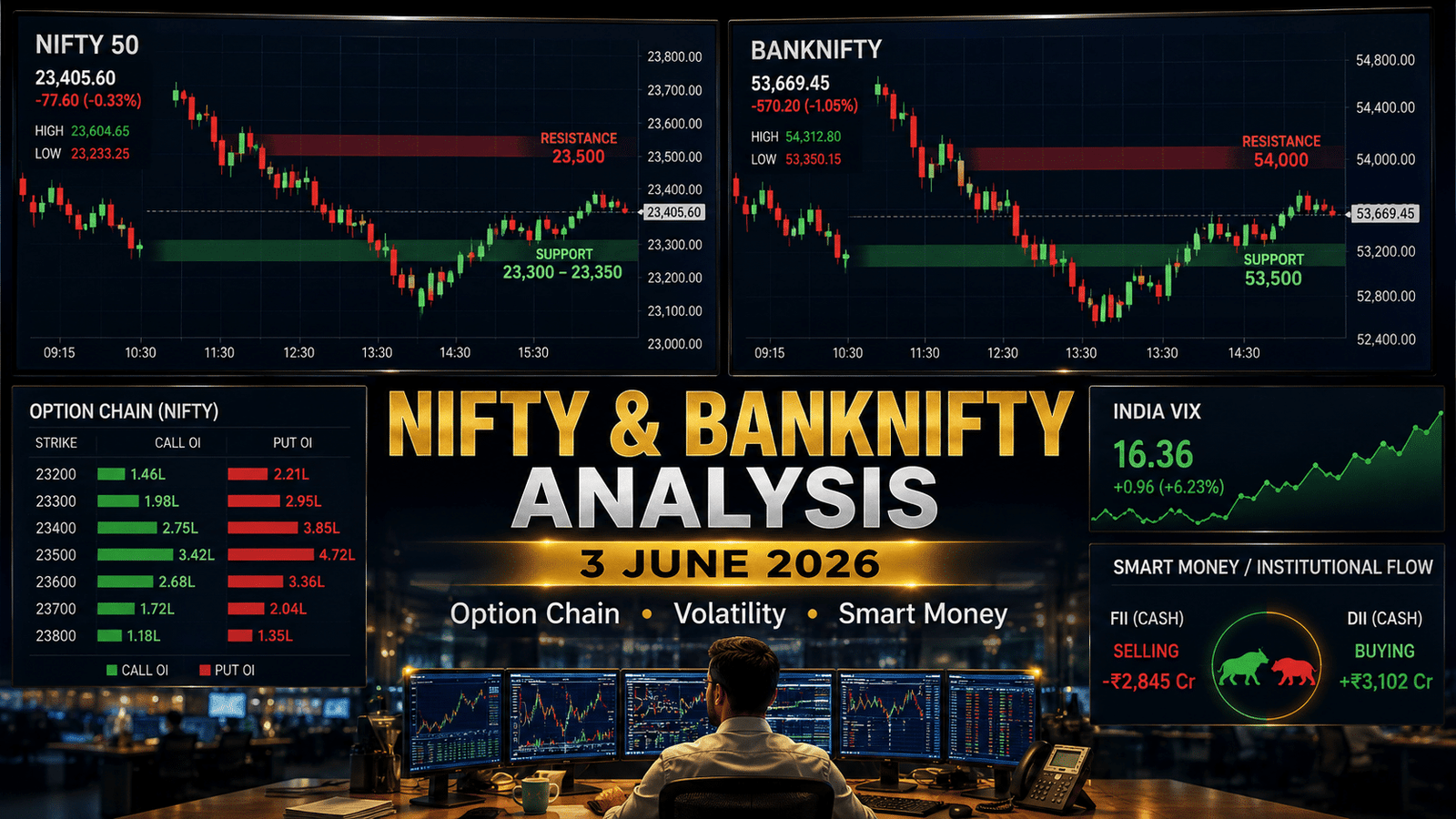
Indian equity markets ended lower on 3 June 2026, but the closing was much better than the intraday panic suggested. NIFTY 50 closed 0.33% lower at 23,405.60, while Sensex ended 0.41% lower at 74,346.17. BANKNIFTY also remained under pressure and closed near 53,669, down around 570 points.
The day was dominated by three major factors: sharp selling in IT stocks, rising crude oil prices, and volatility caused by geopolitical concerns. Reuters reported that the Nifty IT index fell 5.6%, its worst session in four months, as investors worried about AI-led disruption and muted earnings visibility in the sector. Crude oil also moved higher, adding pressure because India is a large crude importer.
Table of Contents
Market Closing Summary
NIFTY opened weak and slipped sharply during the session, but late short covering helped the index recover from lower levels. This recovery was important because it showed that sellers were not able to maintain full control below the lower intraday range.
BANKNIFTY was relatively weak because banking stocks came under pressure along with the broader market. However, compared with the panic seen in the first half, the closing structure still suggested controlled damage rather than a complete breakdown.
India VIX moved higher and closed around 16.31–16.38, gaining more than 6%. This clearly shows that option premiums expanded during the day, and traders were pricing higher uncertainty for the next session.
NIFTY Option Chain Analysis
The NIFTY option chain showed a volatile setup. When VIX rises and the index recovers from lower levels, option sellers usually become cautious. Instead of aggressively selling far out-of-the-money options, institutions often shift to wider-range positioning.
For NIFTY, the important support zone for tomorrow is likely around 23,350–23,300. If this zone breaks decisively, the next support may come near 23,200 and then 23,000. On the upside, 23,500 is the immediate resistance. Above that, 23,650–23,700 may act as the next supply zone.
The option-chain reading suggests that traders should avoid assuming a one-sided move unless NIFTY sustains above 23,500 or breaks below 23,300 with volume. The market is currently in a trap-prone zone where both call buyers and put buyers can get trapped if they chase late momentum.
BANKNIFTY Option Chain Analysis
BANKNIFTY closed near 53,669, keeping the index below immediate resistance zones. The key support for tomorrow is around 53,500. If this level breaks, 53,200 and 53,000 become important downside levels.
On the upside, 54,000 is the first resistance. If BANKNIFTY sustains above 54,000, short covering can take the index toward 54,300–54,500. However, until that happens, aggressive bullish trades should be avoided.
The broader option-chain structure indicates that BANKNIFTY may remain volatile because it is close to important round-number levels. In such conditions, option sellers should avoid tight stop-loss placement, while option buyers should avoid entering after a large candle.
Trap Moves and Institutional Positioning
Today’s market had a classic trap structure. The first half created fear because NIFTY and BANKNIFTY both moved sharply lower. Many retail traders may have entered fresh put buying near lower levels. But the late recovery trapped some of those late put buyers.
This is why institutional traders usually wait for confirmation instead of reacting to the first sharp move. When the index falls sharply and then recovers into the close, it often means stronger hands are using panic to adjust positions rather than simply building fresh shorts.
At the same time, the market did not close strongly enough to call it a bullish reversal. It was more of a damage-control session. Therefore, tomorrow’s first hour will be important. A gap-up that fails near resistance can again become a sell-on-rise setup, while a stable opening above support may invite short covering.
Smart Money Interpretation
Smart money behaviour today looked defensive but not completely bearish. The late recovery suggests that lower levels attracted covering or selective buying. However, rising VIX, weak IT stocks, crude oil pressure, and foreign selling concerns mean the market is still fragile.
FIIs were reported as net sellers in the cash segment, while DIIs continued to absorb selling pressure. This FII selling and DII buying combination often creates volatile intraday swings because foreign selling creates pressure, but domestic buying prevents a straight-line fall.
Tomorrow’s Key Levels
NIFTY Key Levels for 4 June 2026
Support: 23,350, 23,300, 23,200
Resistance: 23,500, 23,650, 23,700
A sustained move above 23,500 may trigger short covering. A breakdown below 23,300 may again bring pressure toward 23,200.
BANKNIFTY Key Levels for 4 June 2026
Support: 53,500, 53,200, 53,000
Resistance: 54,000, 54,300, 54,500
BANKNIFTY needs to reclaim 54,000 for a stronger recovery attempt. Below 53,500, sellers may again become active.
Volatility and Greeks View
With India VIX rising above 16, option premiums are no longer very cheap. This means option buyers need quicker directional follow-through, otherwise theta decay can hurt them. Option sellers, on the other hand, should respect higher gamma risk because fast intraday swings can expand losses quickly.
For tomorrow, traders should focus more on defined-risk strategies rather than naked directional trades. Debit spreads, hedged option selling, and smaller position sizing may be more suitable than aggressive naked buying or selling.
Risk Management Observations
The market is not giving a clean one-sided structure. It is giving volatility, gap risk, sector rotation, and sharp intraday traps. Retail traders should avoid overtrading in the first 30 minutes and should not chase moves near support or resistance.
A better approach is to wait for price acceptance above resistance or below support. Until then, trade smaller, protect capital, and treat every intraday move as probability-based, not prediction-based.
Conclusion
NIFTY and BANKNIFTY closed weak on 3 June 2026, but the late recovery reduced some bearish pressure. Still, rising India VIX, IT sector weakness, crude oil concerns, and FII selling keep the market cautious.
For 4 June 2026, NIFTY needs to hold 23,300–23,350 and reclaim 23,500 for recovery strength. BANKNIFTY needs to hold 53,500 and move above 54,000 for better short-covering momentum. Until these levels are crossed clearly, traders should focus on risk control, avoid emotional entries, and respect volatility.
FAQs
Q1. What is the key NIFTY support for tomorrow?
23,350–23,300 is the immediate support zone.
Q2. What is the key BANKNIFTY resistance?
54,000 is the first major resistance.
Q3. Is the market bullish or bearish now?
The structure is cautious and volatile, not clearly bullish or bearish.
Q4. What should option traders watch tomorrow?
Watch VIX, first-hour price acceptance, and whether NIFTY sustains above 23,500 or below 23,300.
Sources & References
Disclaimer
This article is for educational purposes only and is not investment or trading advice. Futures and options trading involves high risk. Please consult a SEBI-registered financial advisor before making any trading or investment decision.