
Table of Contents
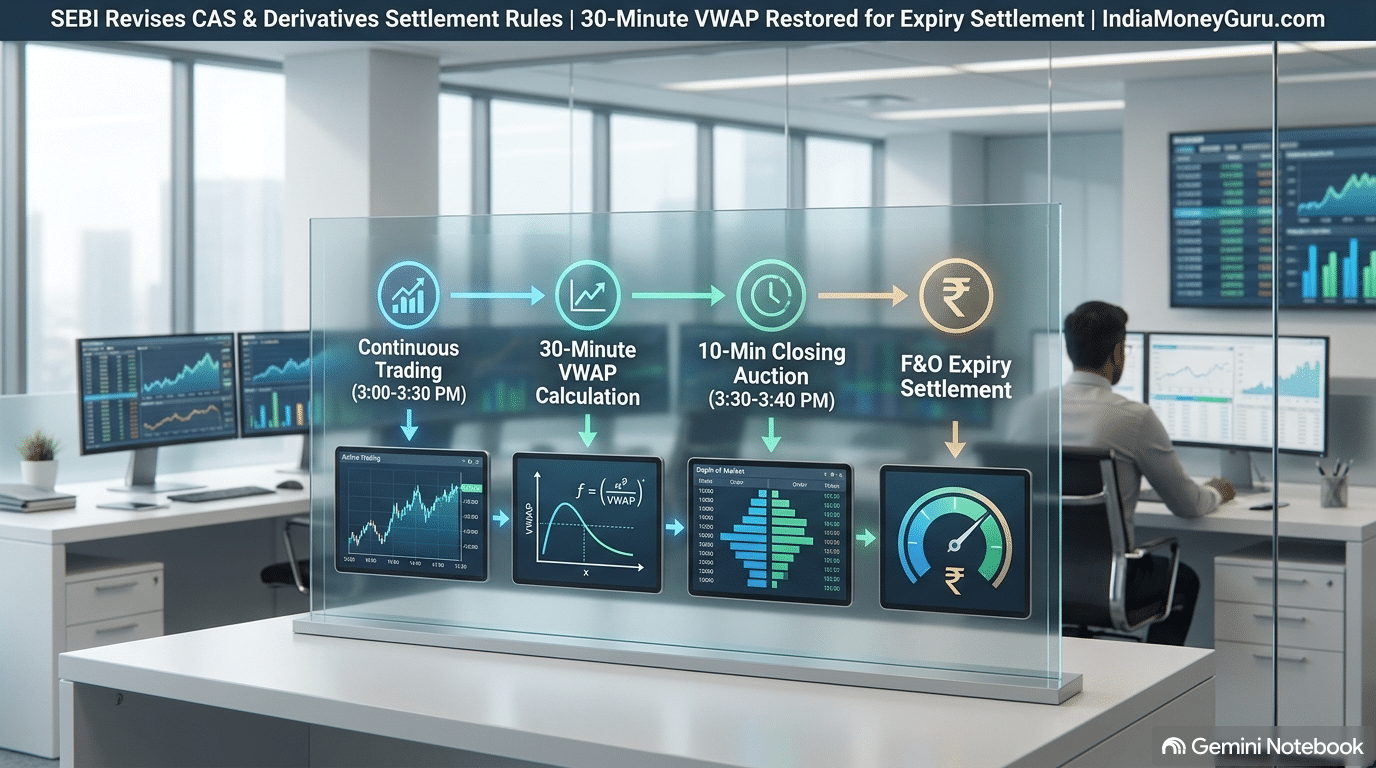
On October 15, 2026, the Securities and Exchange Board of India (SEBI) announced a major revision to the Closing Auction Session (CAS) and derivatives settlement rules. Under the updated regulatory framework, settlement prices for expiring stock and index derivatives will revert to the volume-weighted average price (VWAP) calculated over the final 30 minutes of regular trading, rather than relying on CAS auction pricing.
For traders navigating weekly and monthly options expiries on the National Stock Exchange (NSE) and Bombay Stock Exchange (BSE), this shift represents a crucial structural change in how final settlement prices are determined. To understand why SEBI made this adjustment, investors must look past the headline numbers and explore the mechanics of market microstructure and price discovery.
What Happened: SEBI’s October 15, 2026 Revision Explained
In recent quarters, market participants expressed growing concern over sharp price swings and illiquidity during the closing minutes of trading on derivatives expiry days. When SEBI previously expanded the role of the Closing Auction Session, the intention was to create a centralised, un-manipulable closing price. However, unexpected order imbalances during the auction window occasionally led to abnormal price jumps that did not reflect broader market supply and demand.
To address these vulnerabilities, SEBI’s revised circular introduces four major structural modifications:
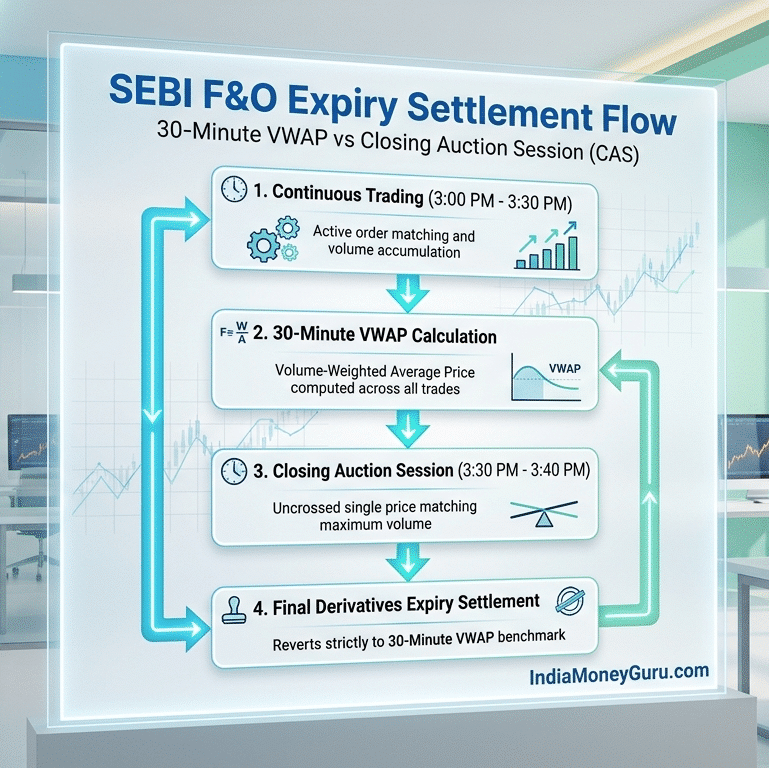
- Restoration of 30-Minute VWAP for F&O Settlement: Final settlement prices for expiring index and stock options/futures contracts will once again be computed using the VWAP between 3:00 PM and 3:30 PM.
- Shortened Closing Auction Session: The CAS duration is reduced from 20 minutes to 10 minutes (operating from 3:30 PM to 3:40 PM).
- Divergent Trading Cut-off Times: On expiry days, expiring index derivatives trading will halt strictly at 3:30 PM, while stock derivatives trading will continue until 3:45 PM.
- Order Transfer Rules for Limit and Iceberg Orders: Unexecuted limit and iceberg orders from the continuous session will be transferred seamlessly into the auction session to deepen liquidity.
These changes are scheduled to take effect on December 7, 2026, with order-transfer provisions coming into force on February 8, 2027.
How It Actually Works: VWAP vs. Closing Auction Sessions
To grasp why settlement methodology matters, it helps to break down how stock exchanges calculate prices during the last hour of trading.
The Math Behind Volume-Weighted Average Price (VWAP)
VWAP measures the average price a security traded at throughout a specific timeframe, weighted by the volume traded at each price point:
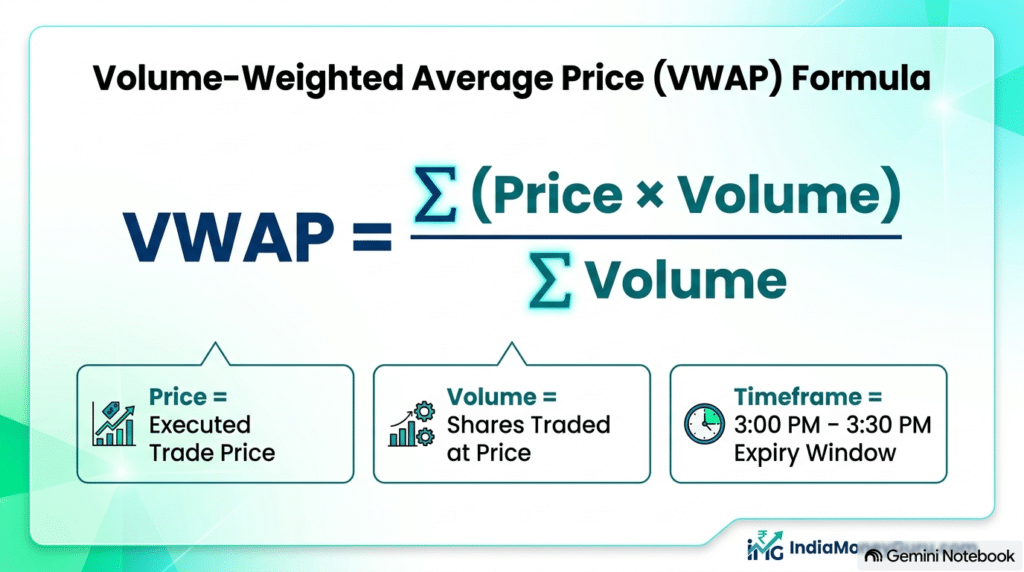
Because VWAP averages every single transaction executed across 30 minutes (3:00 PM to 3:30 PM), a sudden large order placed at 3:29 PM cannot single-handedly distort the final number. To move a 30-minute VWAP significantly, a buyer or seller must deploy immense capital continuously across the entire half-hour block.
The Mechanics of Closing Auction Sessions (CAS)
In contrast, CAS operates as a discrete multilateral auction between 3:30 PM and 3:40 PM. Traders enter buy and sell orders without execution, and the exchange’s matching engine calculates the Uncrossed Price—the single price at which the maximum number of shares can be traded.
While CAS is effective for establishing closing prices for cash equities, applying it as the sole settlement benchmark for multi-billion-dollar derivative contracts created an incentive for traders to push aggressive orders in the final seconds of the auction window.
Why It Matters for Indian Investors and Traders
For retail and institutional traders in Nifty 50, Bank Nifty, and stock options, SEBI’s return to 30-minute VWAP brings several practical advantages:
- Smoother Expiry Day Executions: By spreading the settlement calculation over a 1800-second window (3:00 PM to 3:30 PM), extreme price spikes triggered by last-minute option hedging are naturally smoothed out.
- Reduced Risk of Pin Risk for Option Sellers: Option sellers who hold out-of-the-money (OTM) strikes close to the spot price are less vulnerable to artificial jumps during the post-market auction window.
- Clearer Price Alignment: Cash equity prices and derivative settlement prices remain tightly linked, reducing arbitrary basis spread risk for arbitrageurs and institutional funds.
Important Nuance: Cash Closing Price vs. Derivative Settlement Price
A common point of confusion among retail investors is assuming that a stock’s official cash closing price and its derivative settlement price are identical.
Under the revised framework:
- Equity Cash Closing Price: Determined primarily through the 10-minute Closing Auction Session (3:30 PM–3:40 PM).
- F&O Expiry Settlement Price: Determined strictly by the 30-minute VWAP (3:00 PM–3:30 PM).
This structural separation ensures that while long-term cash investors benefit from single-price auction discovery, derivative traders are protected by a volume-weighted time average that resists short-term manipulation.
What Traders Should Watch Next
As the implementation dates approach, market participants should track two operational milestones:
- December 7, 2026: Go-live date for the 30-minute VWAP settlement rule and shortened 10-minute CAS window. Watch for adjustments in algorithmic trading setups and broker margin systems.
- February 8, 2027: Implementation of automated limit and iceberg order transfers into the CAS order book, which are designed to deepen cash market auction liquidity.
IndiaMoneyGuru Takeaway
Regulatory adjustments in market microstructure protect integrity rather than create trading signals. By shifting derivative settlement back to 30-minute VWAP while keeping Closing Auctions for cash markets, SEBI strikes a balance between auction efficiency and anti-manipulation safeguards. F&O traders should focus on underlying market trends rather than trying to game last-minute closing prices.
Frequently Asked Questions (FAQs)
What is the new settlement rule for Nifty and Bank Nifty option expiry?
Settlement prices for expiring index options and futures will be calculated using the 30-minute Volume-Weighted Average Price (VWAP) of the underlying index between 3:00 PM and 3:30 PM on the expiry day.
When do the revised SEBI CAS rules come into effect?
The revised VWAP settlement methodology and shortened 10-minute CAS auction take effect on December 7, 2026.
How does a 30-minute VWAP prevent price manipulation?
Because VWAP accounts for every transaction over 30 minutes weighted by volume, an isolated large order in the final seconds cannot dramatically alter the benchmark, making price manipulation significantly pricier and difficult.
References
Disclaimer
The information provided in this article is for educational purposes only and should not be considered investment advice. Trading and investing in financial markets involve risk. Always conduct your own research and consult a SEBI-registered investment adviser before making any investment decisions.