
Table of Contents
When the Indian rupee weakens sharply against the U.S. dollar, the explanation is often reduced to a simple headline:
“The dollar is getting stronger.”
That may be true, but it is rarely the complete story.
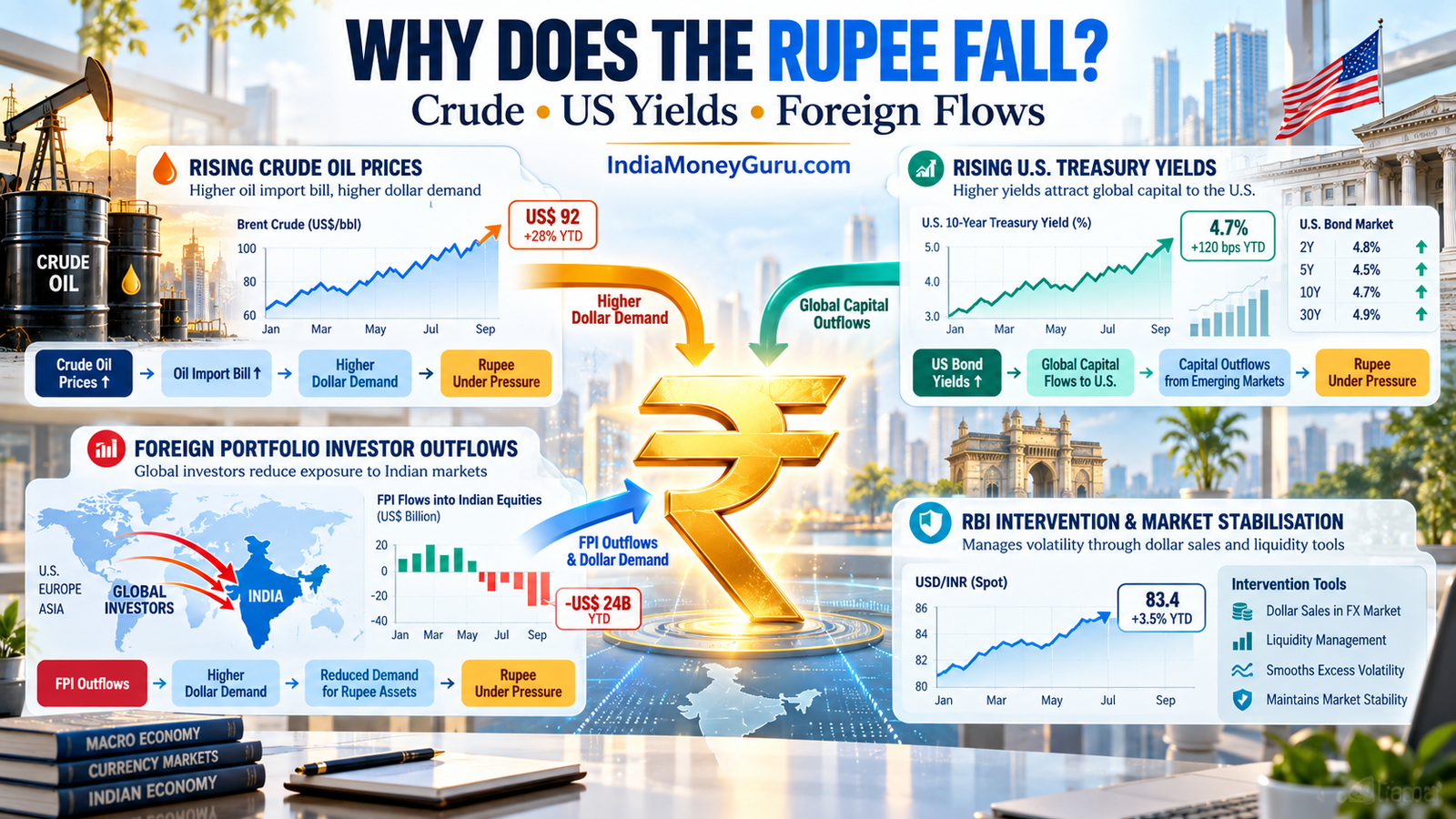
The Indian rupee can come under pressure when several forces begin working together: crude oil becomes expensive, U.S. bond yields rise, foreign investors withdraw capital from India, and demand for dollars increases.
October 2026 has provided a useful real-world example.
On 1 October, USD/INR closed at ₹96.3150, Brent crossed $100, the U.S. 10-year Treasury yield reached 5.34%, a 24-year high, and foreign portfolio outflows were also weighing on the currency. That is an unusually clean real-world setup for explaining the three transmission channels.
But instead of treating ₹96 as merely another currency-market headline, investors can use the episode to understand a much more important question:
Why does the Indian rupee fall in the first place?
The Rupee Is Ultimately a Demand-and-Supply Market
Think of dollars as something that must be bought and sold.
Indian companies need dollars to pay for imports. Foreign investors bring dollars into India when they invest and may take them out when they withdraw capital. Exporters earn foreign currency and convert part of it into rupees.
This creates a constantly changing demand-and-supply equation.
When demand for dollars becomes stronger relative to supply:
Dollar demand rises → USD strengthens → INR weakens
And when dollar inflows become stronger:
Dollar supply rises → INR can strengthen
This simple framework helps explain why seemingly unrelated developments such as crude oil, U.S. Treasury yields and foreign institutional flows can affect the same currency.
Why Rising Crude Oil Can Weaken the Rupee
Crude oil is particularly important for India because the country depends heavily on imported energy.
When international crude prices rise, Indian refiners and other importers may need more dollars to pay their overseas suppliers.
Imagine that India imports the same quantity of crude oil, but the global price rises sharply. The physical quantity may not have changed, but the dollar bill has.
Let’s understand it through an example. If an importer needs $10 million, ₹90/$ requires ₹90 crore; at ₹96/$ it requires ₹96 crore, even before considering a rise in the dollar price of oil. This scenario makes the feedback loop immediately understandable.
A weaker rupee can then make imported commodities When international crude prices rise, Indian refiners and other importers may need more dollars to pay their overseas suppliers.
The currency channel is only one part of the transmission mechanism; our guide to why rising crude oil hurts the Indian stock market explains how expensive energy can also influence inflation, corporate margins and equity valuations.
Imagine that India imports the same quantity of crude oil, but the global price rises sharply. The physical quantity may not have changed, but the dollar bill has. The transmission can therefore look like:
Crude oil rises → India’s import bill increases → Demand for dollars increases → Pressure on the rupee increases
The effect can become more important when oil remains elevated rather than merely spiking for a day.
A weaker rupee can then make imported commodities more expensive in rupee terms, potentially adding another layer of imported inflation.
That is why crude oil and the currency market can sometimes reinforce each other.
Higher crude → greater dollar demand → weaker rupee → more expensive imports
This relationship is also why Indian equity investors should not treat oil as merely a
commodity-market indicator.
Why US Treasury Yields Matter to the Rupee
Now, add another force: U.S. government bond yields. The U.S. Treasury market plays a central role in global finance because Treasury yields influence the return investors can earn on relatively low-risk dollar assets.
Suppose the U.S. 10-year Treasury yield rises materially.
Global investors now have an alternative:
Why take substantial emerging-market risk if dollar-denominated government securities are offering increasingly attractive yields?
That does not mean investors automatically abandon India whenever Treasury yields rise.
But the relative attractiveness of different assets changes.
The chain can become:
U.S. yields rise → Dollar assets become relatively more attractive → Capital becomes more selective toward emerging markets → FPI flows can weaken → Demand for dollars can increase → Rupee comes under pressure
We shouldn’t imply that “US yields rise → FPIs sell India” is an automatic relationship. Higher Treasury yields change relative returns and the opportunity cost of holding riskier emerging-market assets; actual flows also depend on Indian yields, growth, valuations, Fed expectations and risk appetite.
This phenomenon is one reason movements in a bond market thousands of kilometres away can eventually appear on an Indian investor’s currency screen.
For the wider equity-market transmission mechanism, see our guide explaining how US bond yields affect the Indian stock market, including their impact on valuations, capital flows and risk appetite.
FPI Outflows Add Another Layer
Foreign portfolio investors (FPIs) create another important currency-market transmission channel.
When an overseas investor wants to invest in Indian equities or bonds, foreign currency generally needs to be converted into rupees.
That creates demand for rupees.
But consider the reverse.
If foreign investors sell Indian assets and repatriate the proceeds, rupees may eventually need to be exchanged for foreign currency.
Therefore:
FPI inflows → supportive for INR
while
FPI outflows → potential pressure on INR
The relationship is not perfectly mechanical because many other currency flows occur simultaneously.
Exports, imports, foreign direct investment, remittances, corporate borrowing, hedging and central-bank operations all influence the market.
But large and sustained portfolio outflows can become an important part of the rupee equation.
This situation becomes particularly relevant when FPI selling coincides with rising crude prices and higher U.S. yields.
The Dangerous Combination: Oil + Yields + Outflows
This scenario is where the October 2026 episode becomes educational.
Any one of these factors can be manageable independently.
But when several appear simultaneously, their effects can reinforce one another.
Consider the complete chain:
U.S. Treasury yields rise → Foreign investors become more selective about emerging-market assets → FPI outflows increase → Dollar demand rises
Now the currency faces pressure from both capital flows and trade-related demand.
That is considerably more important than simply saying:
“Dollar strong, rupee weak.”
Does RBI Defend a Particular Rupee Level?
RBI explicitly says the rupee is market determined, and its intervention is intended to contain excessive volatility and maintain orderly market conditions and not defend a particular exchange-rate level.
The Reserve Bank of India can intervene in the foreign-exchange market when currency movements become excessively volatile or market conditions become disorderly.
For example, selling dollars into the market can increase dollar supply and help moderate abrupt currency movements.
But this should not automatically be interpreted as the RBI permanently defending a particular USD/INR number.
India operates a market-determined exchange-rate system. RBI’s stated approach has historically focused on containing excessive volatility and maintaining orderly market conditions rather than targeting a fixed exchange rate. This viewpoint is another common oversimplification.
A weaker rupee can hurt businesses that depend heavily on imported inputs because those imports become pricier in domestic currency terms.
The Finance Ministry itself has recently flagged high crude, geopolitical tension and tighter global financial conditions as risks for imported inflation, the rupee and capital flows.
Oil-intensive industries can face additional pressure.
Companies with substantial unhedged foreign-currency liabilities can also face higher costs.
But some exporters can benefit because overseas revenues translate into more rupees.
Exporters can benefit from currency translation, but hedging, overseas expenses, pricing, wage costs and client contracts determine how much of that benefit reaches earnings.
Indian IT services are a familiar example because they earn a significant portion of their revenues internationally.
The actual benefit, however, depends on hedging, costs, contract structures and the reason the rupee is weakening.
A gradually weaker rupee caused by normal economic adjustment is very different from a sudden depreciation caused by financial stress.
Investors should therefore ask:
Why is the rupee weakening?
not simply:
Is a weaker rupee good or bad?
Why ₹96/$ Does Not Automatically Mean the Rupee Is “In Crisis”
Such an approach would differentiate the article from generic currency explainers. A nominal record-low exchange rate alone doesn’t tell us whether a currency is experiencing a crisis. Investors should also examine the speed of depreciation, volatility, inflation, reserves, current-account pressures, capital flows and broader dollar strength.
That distinction is especially relevant now because the current global environment is not India-specific: the dollar has been strengthening amid very high U.S. yields, while global bond markets have been under pressure.
And there is another important India-specific nuance: the RBI’s FX operations are more sophisticated than simply “selling dollars to protect the rupee.” Reuters reported that RBI’s net forward dollar liabilities reached roughly $200 billion in August, alongside large policy-induced dollar inflows, illustrating why spot reserves alone do not provide a complete picture of the intervention.
What Should Indian Investors Watch?
Instead of trying to predict the exact USD/INR level, investors can monitor the variables driving the currency.
The most useful dashboard includes:
Brent crude oil: sustained increases can raise India’s dollar requirement for energy imports.
U.S. Treasury yields: higher yields can change global capital allocation and increase the attractiveness of dollar assets.
Foreign portfolio flows: persistent FPI selling can create additional currency pressure.
Dollar strength: a broad global dollar rally can weaken several emerging-market currencies simultaneously.
Indian bond yields: rising domestic yields can signal changing inflation, liquidity and risk expectations.
RBI activity: intervention may reduce disorderly volatility, although it does not eliminate underlying macroeconomic forces.
Looking at these variables together is far more useful than treating USD/INR as an isolated number.
IndiaMoneyGuru Takeaway
The Indian rupee does not weaken because of one headline.
Currency movements emerge from the interaction between trade flows, capital flows, interest-rate differentials, commodity prices, investor risk appetite and central-bank actions.
The October 2026 episode illustrates these dynamics particularly well.
Crude above $100 increased India’s external vulnerability. U.S. Treasury yields around multi-decade highs made global capital more demanding. Foreign portfolio selling added another source of dollar demand.
Together, these forces put pressure on the rupee.
For Indian investors, the durable lesson is simple:
Don’t watch the rupee alone. Watch the system around it.
Understanding why the Indian rupee falls makes it easier to interpret movements in inflation, interest rates, bond yields, foreign flows and ultimately the Indian stock market.
Frequently Asked Questions (FAQs)
Why does the Indian rupee weaken against the dollar?
The rupee can weaken when demand for U.S. dollars exceeds supply. Higher imports, foreign investor outflows, stronger U.S. interest rates and global risk aversion can all contribute.
Why does rising crude oil weaken the rupee?
India imports much of its crude oil requirement. Higher oil prices can increase the dollar cost of imports, increasing demand for foreign currency and potentially putting pressure on the rupee.
How do US bond yields affect the Indian rupee?
Higher U.S. yields can make dollar assets relatively more attractive to global investors. This can affect capital flows toward emerging markets such as India and potentially strengthen demand for dollars.
Do FPI outflows weaken the rupee?
They can. When foreign investors withdraw capital from Indian assets and repatriate funds, India imports much of its crude oil requirement. Higher oil prices can increase the dollar cost of imports, increasing demand for foreign currency and potentially putting pressure on the rupee.
How do US bond yields affect the Indian rupee?
Higher U.S. yields can make dollar assets relatively more attractive to global investors. This can affect capital flows toward emerging markets such as India and potentially strengthen demand for dollars.
Do FPI outflows weaken the rupee?
They can. When foreign investors withdraw capital from Indian assets and repatriate funds, such activity can increase demand for foreign currency. However, many other flows also influence the rupee.
Does RBI fix the value of the rupee?
No, India has a market-determined exchange-rate system. RBI may intervene to contain excessive volatility and maintain orderly market conditions rather than permanently
target a particular USD/INR level.
Is a weak rupee bad for the stock market?
Not necessarily. Import-dependent businesses can face higher costs, while some exporters may benefit from foreign-currency revenues. The broader market effect depends heavily on why the currency is weakening.
Does RBI fix the value of the rupee?
No, India has a market-determined exchange-rate system. RBI may intervene to contain excessive volatility and maintain orderly market conditions rather than permanently target a particular USD/INR level.
Is a weak rupee bad for the stock market?
Not necessarily. Import-dependent businesses can face higher costs, while some exporters may benefit from foreign-currency revenues. The broader market effect depends heavily on why the currency is weakening.
Disclaimer
The information provided in this article is for educational purposes only and should not be considered investment advice. Trading and investing in financial markets involve risk. Always conduct your own research and consult a SEBI-registered investment adviser before making any investment decisions.