
Introduction
NIFTY Expiry Day Trading Strategies are among the most discussed topics in options trading. Every weekly expiry creates unique market conditions driven by option premium decay, institutional positioning, volatility shifts, and rapid changes in option chain data.
Many traders are attracted to expiry day because option premiums can move sharply within a short period. However, expiry day is also one of the riskiest trading environments because price movements can become highly unpredictable.
Successful expiry traders focus on market structure, option chain analysis, risk management, and probability rather than speculation.
This guide explains how weekly NIFTY expiry works, what drives expiry-day price action, and how traders can approach expiry sessions more systematically.
Table of Contents
What Is NIFTY Weekly Expiry?
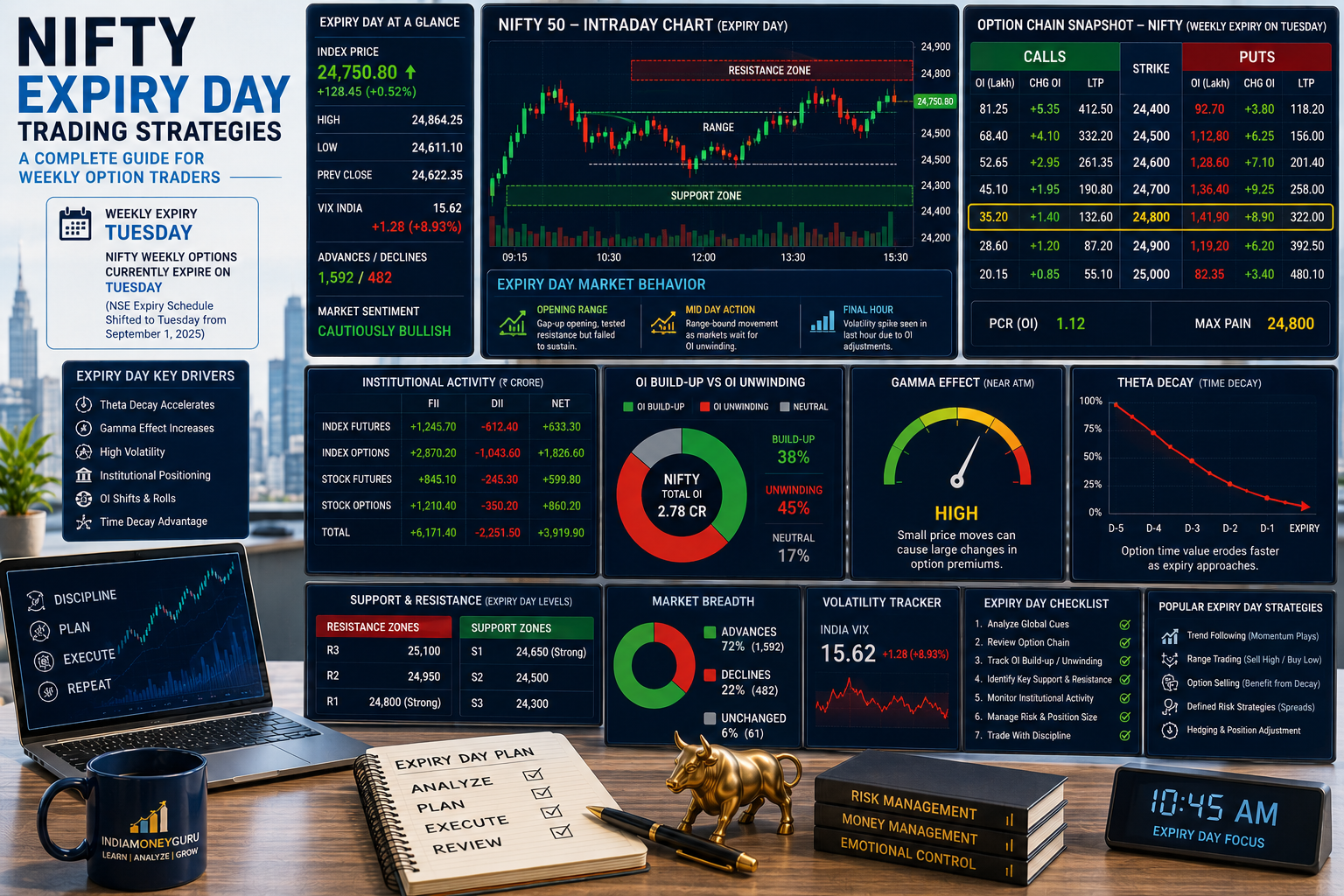
NIFTY weekly options expire every week on Tuesday.
On expiry day:
- Time value approaches zero.
- Option premiums decay rapidly.
- Open Interest shifts aggressively.
- Institutional positions are adjusted.
- Volatility often increases.
As a result, market behavior on expiry day differs significantly from normal trading sessions.
Why Expiry Day Is Different
Several forces become more influential as expiry approaches:
Theta Decay
Time value declines rapidly.
Gamma Effect
Option sensitivity increases.
Institutional Positioning
Large participants manage exposure.
Option Chain Migration
Support and resistance zones may shift.
Volatility Expansion
Price movements can accelerate unexpectedly.
These factors combine to create a unique trading environment.
Understanding Theta Decay
Theta represents time decay.
As expiry approaches:
- Option premiums lose value faster.
- Out-of-the-money options can become worthless quickly.
- Sellers often benefit from time decay.
This is why many professional traders focus on option-selling strategies during expiry week.
Understanding Gamma Effect
Gamma measures how quickly an option’s delta changes.
Near expiry:
- Gamma increases sharply.
- Small index moves can create large option premium moves.
- Option buyers can benefit from sudden directional moves.
- Risk increases for both buyers and sellers.
Gamma is one reason expiry-day trading can feel unusually volatile.
Role of Option Chain Analysis
Option chain analysis becomes even more important on expiry day.
Traders monitor:
- Highest Call Open Interest
- Highest Put Open Interest
- Fresh Call Writing
- Fresh Put Writing
- OI Shifting
- Put Call Ratio
These indicators help identify potential support and resistance zones.
Expiry Day Market Scenarios
Trend Day
Characteristics:
- Strong directional movement
- Limited pullbacks
- Sustained institutional participation
Trend days can create significant gains for directional traders.
Range-Bound Day
Characteristics:
- Price oscillates between support and resistance
- Option premiums decay rapidly
- Option sellers often benefit
This is one of the most common expiry-day environments.
Volatile Reversal Day
Characteristics:
- Sharp morning movement
- Sudden reversal
- Increased volatility
These sessions often trap traders who chase momentum.
Expiry Day and Support & Resistance
Support and resistance become critical.
Traders should identify:
- Major Put OI zones
- Major Call OI zones
- Option chain migration
- Previous day levels
- Psychological levels
Institutional activity often clusters around these zones.
Institutional Positioning on Expiry Day
Large traders frequently:
- Roll positions forward
- Close expiring contracts
- Hedge existing exposure
- Adjust risk
These activities can influence intraday market behavior.
Retail traders should focus on interpreting these shifts rather than predicting them.
Common Expiry Day Strategies
Trend Following
Used when market direction is clear.
Focus:
- Strong momentum
- Breakouts
- Trend continuation
Range Trading
Used when NIFTY remains between major support and resistance zones.
Focus:
- Defined risk
- Support-resistance reactions
- Controlled position sizing
Option Selling
Often benefits from theta decay.
Requires:
- Risk management
- Hedging
- Understanding of volatility
Defined-Risk Option Structures
Examples:
- Iron Condor
- Iron Fly
- Credit Spreads
These structures help control risk while benefiting from premium decay.
Common Mistakes Traders Make
Overtrading
Expiry-day volatility often encourages excessive trading.
Ignoring Risk Management
Large intraday swings can quickly damage trading capital.
Chasing Premium Movement
Premium spikes do not always indicate sustainable market direction.
Ignoring Option Chain Data
Institutional positioning often provides important clues.
Trading Without a Plan
A structured approach is essential.
Practical Expiry Day Framework
Step 1
Review overnight global cues.
Step 2
Identify major support and resistance levels.
Step 3
Analyse option chain positioning.
Step 4
Monitor OI shifts.
Step 5
Observe market breadth.
Step 6
Track institutional activity.
Step 7
Prepare bullish, bearish, and neutral scenarios.
Step 8
Trade only when risk-reward is favourable.
Relationship with NIFTY Analysis
Expiry-day trading should not be viewed in isolation.
It works best when combined with:
- NIFTY Trend Analysis
- Support and Resistance
- FII and DII Activity
- Gap Analysis
- Option Chain Interpretation
This broader framework helps traders avoid emotional decision-making.
Conclusion
NIFTY Expiry Day Trading Strategies require a different mindset than regular market sessions. Theta decay, gamma effects, institutional positioning, and option chain dynamics create unique opportunities as well as risks.
Successful traders focus on probability, discipline, and risk management rather than attempting to predict every market move. By combining option chain analysis, trend analysis, support and resistance, and structured trading plans, traders can navigate expiry sessions more effectively.
FAQs
What is NIFTY weekly expiry?
NIFTY weekly expiry occurs every Tuesday when weekly option contracts expire.
Why is expiry day volatile?
Because of theta decay, gamma effects, position adjustments, and institutional activity.
What is theta decay?
Theta decay represents the reduction in option premium due to the passage of time.
What is gamma effect?
Gamma measures how quickly option delta changes as the underlying price moves.
Is option chain analysis important on expiry day?
Yes. It helps identify support, resistance, and institutional positioning.
Are expiry-day trades risky?
Yes. Volatility and rapid premium movement increase risk.
Do option sellers benefit from expiry day?
Option sellers may benefit from accelerated time decay, but risk management remains essential.
What is the most important expiry-day skill?
Risk management and disciplined trade execution.
Should beginners trade expiry day?
Beginners should approach expiry trading cautiously and focus on education first.
Is expiry day part of NIFTY Analysis?
Yes. Expiry behavior is an important component of understanding NIFTY market dynamics.
References
Disclaimer
The information provided in this article is for educational purposes only and should not be considered investment advice. Trading and investing in financial markets involve risk. Always conduct your own research and consult a SEBI-registered investment adviser before making any investment decisions.
6 thoughts on “NIFTY Expiry Day Trading Strategies: A Complete Guide for Weekly Option Traders”