
Opening Hook
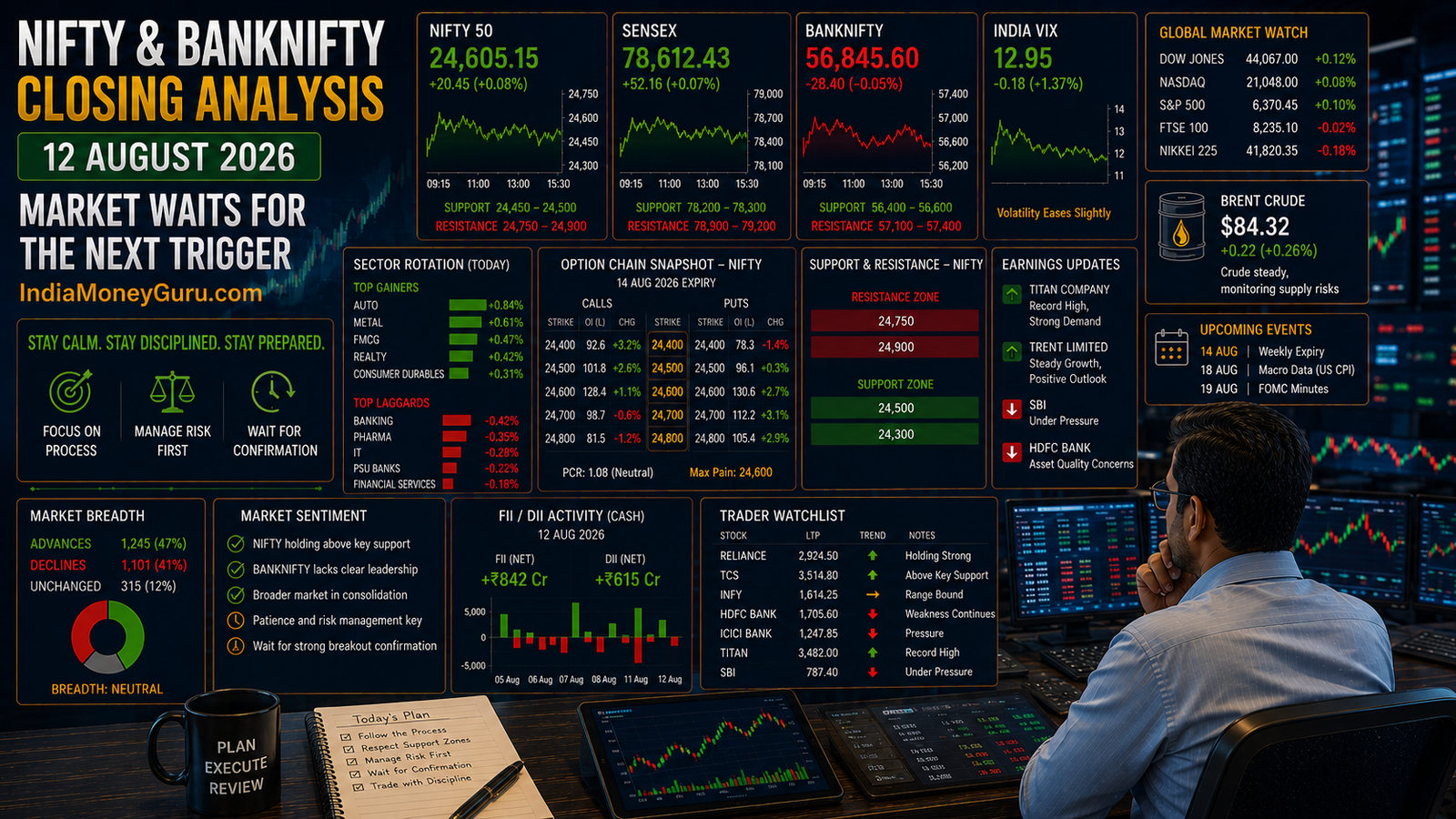
NIFTY BANKNIFTY Closing Analysis 12 August 2026: The market spent another day testing traders’ patience rather than their emotions.
There was no panic selling, but there was no aggressive buying either. Instead, the session reflected a market waiting for the next meaningful trigger while continuing to absorb recent earnings, global developments and higher crude oil prices.
Table of Contents
Today’s Market in Simple Words
Indian equities traded with a cautious but resilient tone.
NIFTY managed to hold its important support zone despite mixed global cues, while BANKNIFTY again underperformed due to the absence of broad-based participation from large private banks.
This session should be viewed alongside the NIFTY & BANKNIFTY Closing Analysis for 11 August 2026, where we discussed how the market had entered a consolidation phase instead of a fresh breakout.
NIFTY View
NIFTY continues respecting the 24,500 support region, which keeps the short-term trend constructive.
However, buyers are still hesitant to push the index decisively above the recent highs. Until that happens, traders should expect range-bound movement instead of a sustained rally.
For positional traders, the trend remains “buy on meaningful dips” rather than “buy every breakout”.
BANKNIFTY View
BANKNIFTY once again lagged behind NIFTY.
While public-sector banks remained relatively stable, private banking stocks failed to provide enough momentum to lift the index. Since financials carry significant weight in the benchmark indices, stronger participation from leading banks will be necessary for the next meaningful market move.
Until then, NIFTY may continue outperforming BANKNIFTY.
Sector & Market Breadth
The market continued rewarding stock selection instead of broad index buying.
- IT remained relatively resilient.
- Auto stocks maintained positive momentum.
- Capital goods and infrastructure stocks stayed firm.
- Banking and financials traded mixed.
- Broader markets showed selective participation.
Overall market breadth remained balanced, indicating healthy consolidation rather than widespread weakness.
Option Chain & India VIX
Option-chain positioning suggests traders continue expecting a broadly range-bound market.
India VIX remained under control, indicating that participants are not pricing in major near-term panic despite elevated crude oil prices and uncertain global sentiment.
Risk management remains the priority. Traders taking fresh derivative positions should continue using the Position Size Calculator before increasing exposure.
Support & Resistance
| Index | Support | Resistance |
|---|---|---|
| NIFTY | 24,500 / 24,420 | 24,700 / 24,820 |
| BANKNIFTY | 56,900 / 56,700 | 57,500 / 57,850 |
What Traders Should Watch Tomorrow
The next session will largely depend on three factors:
- Whether NIFTY can sustain above 24,500.
- Whether BANKNIFTY receives stronger participation from private banks.
- Global cues, especially crude oil prices and overseas equity markets.
Readers who want the broader context behind the recent market behaviour should also read the Weekly Market Wrap-Up for 7 August 2026, which explains the impact of RBI policy, CAS and sector rotation.
IndiaMoneyGuru Takeaway
Markets rarely move in a straight line.
The current phase appears to be one of consolidation rather than reversal. NIFTY continues to defend important support levels, while BANKNIFTY is still waiting for stronger leadership from financial stocks.
Patient traders often perform better during such phases than aggressive traders who chase every intraday move.
FAQs
Why is NIFTY outperforming BANKNIFTY?
Technology and other heavyweight sectors are supporting NIFTY, while private banks continue to trade without strong momentum.
Is the market still bullish?
The short-term structure remains constructive as long as NIFTY holds above key support.
What is the most important level to watch?
The 24,500 region remains the immediate support zone for NIFTY.
Should traders increase exposure now?
Fresh positions should be taken selectively with disciplined risk management rather than aggressive leverage.
Disclaimer
The information provided in this article is for educational purposes only and should not be considered investment advice. Trading and investing in financial markets involve risk. Always conduct your own research and consult a SEBI-registered investment adviser before making any investment decisions.
1 thought on “NIFTY & BANKNIFTY Closing Analysis – 12 August 2026”