
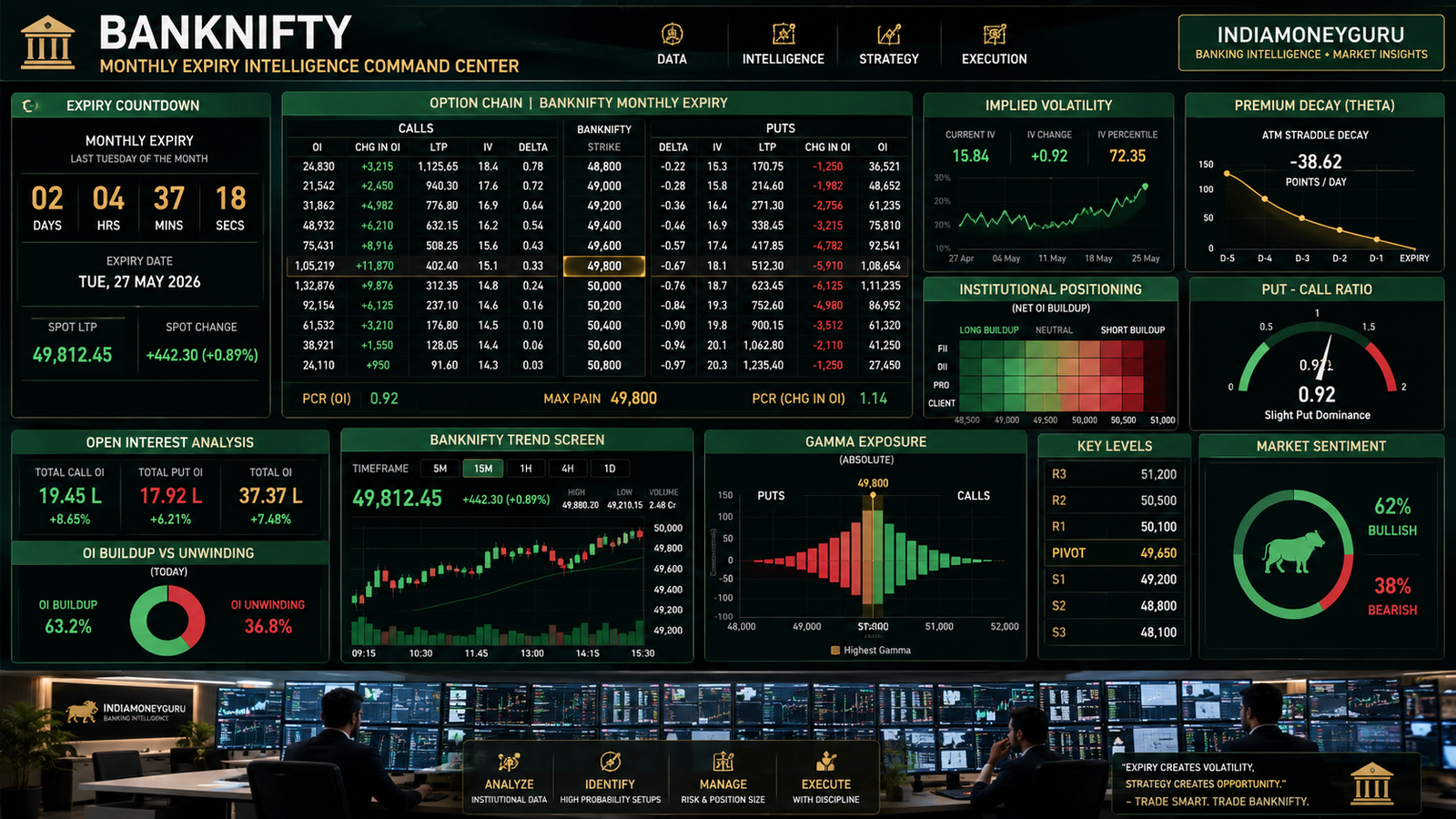
Expiry day is one of the most active sessions in the derivatives market. It attracts high trading volumes, increased volatility, and rapid option premium movements as traders close, adjust, or roll over their positions.
For BANKNIFTY traders, expiry day has become even more important after the market structure changes introduced by the National Stock Exchange (NSE). BANKNIFTY now has monthly option contracts that expire on the last Tuesday of the expiry month, while weekly BANKNIFTY options are no longer available.
Whether you are an option buyer, option seller, or positional trader, understanding expiry day behaviour can help you make better trading decisions and avoid common mistakes.
In this BANKNIFTY Expiry Day Trading Strategies (2026) guide, you’ll learn how BANKNIFTY behaves during monthly expiry, how professional traders prepare, and what factors deserve the most attention before entering an expiry-day trade.
Key Takeaways
- BANKNIFTY now follows monthly expiry instead of weekly expiry.
- Expiry day is characterised by higher volatility, rapid premium movement, and increased institutional activity.
- Time decay (Theta) accelerates significantly on the final trading day.
- Option Chain analysis becomes particularly useful during expiry sessions.
- Successful expiry trading depends more on discipline and risk management than predicting every market move.
- Combining price action with Option Chain analysis offers a more balanced trading approach.
Table of Contents
BANKNIFTY Expiry Day Trading Strategies: Introduction
Every BANKNIFTY option contract has a fixed expiry date.
Under the current NSE derivatives framework:
- BANKNIFTY options have only monthly expiries.
- The expiry takes place on the last Tuesday of the month.
- If the last Tuesday is a trading holiday, expiry shifts to the previous trading day.
As expiry approaches, traders either:
- Square off existing positions
- Roll positions into the next monthly series
- Allow options to expire
- Take fresh positions based on expected volatility
These activities significantly increase market participation and make expiry sessions different from regular trading days.
Why Expiry Day Is More Volatile
Several market participants become active simultaneously during expiry.
These include:
- Institutional investors
- Proprietary trading desks
- Option writers
- Option buyers
- Hedgers
- Algorithmic traders
As positions are adjusted throughout the day, BANKNIFTY can witness sharp intraday swings.
The major reasons include:
- Position unwinding
- Fresh Open Interest creation
- Contract rollovers
- Delta hedging
- Gamma adjustments
- Increased trading volumes
Unlike ordinary trading sessions, expiry day often experiences rapid changes in momentum within a short period.
Understanding Time Decay (Theta)
One of the defining characteristics of expiry trading is time decay, also known as Theta.
An option premium consists of:
- Intrinsic Value
- Time Value
As expiry approaches, the time value gradually decreases.
On the final trading day, this decay accelerates rapidly.
For option sellers, this works in their favour if the market remains within expectations.
For option buyers, time decay becomes a challenge because even a correct directional view may not generate sufficient profit if the move is small or delayed.
Understanding Theta is therefore essential before trading expiry.
Why Implied Volatility Matters
Another important factor is Implied Volatility (IV).
IV reflects the market’s expectation of future price movement.
Before major events or expiry sessions, uncertainty often increases, resulting in higher option premiums.
After uncertainty reduces, IV generally declines.
This reduction is known as IV Crush.
Many beginners focus only on BANKNIFTY’s price movement.
Professional traders, however, evaluate both:
- Price movement
- Change in Implied Volatility
An option premium depends on both factors.
Option Chain Becomes More Important on Expiry
The Option Chain provides valuable insight into institutional positioning during expiry.
Professional traders monitor:
- Highest Call Open Interest
- Highest Put Open Interest
- Fresh Call Writing
- Fresh Put Writing
- Call Unwinding
- Put Unwinding
- Put-Call Ratio (PCR)
- Max Pain
Instead of relying on one indicator, they observe how these values change throughout the trading session.
A sudden increase in Call Writing near resistance or aggressive Put Writing near support often provides clues about market sentiment.
However, option chain analysis should always be combined with price action and volume confirmation.
Common Behaviour of BANKNIFTY on Expiry Day
Although every expiry session is unique, some patterns are frequently observed.
High Volatility After Market Open
The first hour often witnesses aggressive price swings as traders react to overnight developments and adjust existing positions.
Mid-Session Consolidation
After the initial volatility, BANKNIFTY may trade within a range while institutions rebalance their portfolios.
False breakouts are common during this phase.
Afternoon Momentum
As expiry approaches, volatility may increase again due to position squaring and rollover activity.
Large directional moves sometimes occur during the final trading hours.
However, traders should remember that every expiry session is different, and no pattern guarantees future market behaviour.
Expiry Day Trading Strategies
Rather than searching for a “perfect strategy,” traders should focus on selecting an approach that matches the prevailing market conditions.
Range-Bound Market
If BANKNIFTY is trading within a defined range:
- Option sellers may benefit from time decay.
- Buyers should wait for confirmation before entering directional trades.
Trending Market
If BANKNIFTY breaks a major support or resistance level with strong volume:
- Momentum traders may look for continuation opportunities.
- Option buyers often prefer trading in the direction of the trend rather than against it.
Event-Based Expiry
If expiry coincides with major events such as RBI policy announcements, important economic data, or significant global developments, volatility can remain elevated throughout the session.
During such periods, disciplined risk management becomes more important than aggressive position sizing.
Risk Management on Expiry Day
Expiry sessions can produce rapid price movements.
To manage risk effectively:
- Trade only after confirming market direction.
- Avoid oversized positions.
- Use predefined stop-loss levels.
- Do not average losing trades.
- Understand option Greeks before trading leveraged positions.
- Avoid emotional decisions after sudden price swings.
- Focus on process rather than predicting every market move.
Successful traders survive expiry by controlling risk, not by attempting to capture every point.
Common Mistakes Traders Make
Some of the most common expiry-day mistakes include:
- Trading without understanding time decay.
- Ignoring implied volatility.
- Following social media tips without analysis.
- Entering trades immediately after market open.
- Taking oversized positions.
- Ignoring option chain data.
- Holding losing trades hoping for recovery.
- Trading without a predefined exit plan.
Avoiding these mistakes often contributes more to long-term success than finding a new trading strategy.
Conclusion
BANKNIFTY monthly expiry is one of the most dynamic trading sessions in the Indian derivatives market. While the opportunity for profit increases due to higher volatility and rapid premium movement, so does the level of risk.
Rather than viewing expiry day as a shortcut to quick profits, traders should approach it with preparation, discipline, and a sound understanding of option pricing, time decay, implied volatility, and institutional positioning.
Combining option chain analysis with price action, proper risk management, and patience can help traders make more informed decisions during BANKNIFTY monthly expiry sessions.
Frequently Asked Questions (FAQs)
When does BANKNIFTY monthly expiry take place?
BANKNIFTY monthly option contracts expire on the last Tuesday of the expiry month. If that day is a trading holiday, the expiry is shifted to the previous trading day.
Does BANKNIFTY still have weekly expiry?
No. Weekly BANKNIFTY option contracts have been discontinued. Currently, only monthly BANKNIFTY option contracts are available on the NSE.
Why is BANKNIFTY more volatile on expiry day?
Expiry day attracts institutional position adjustments, option writers, hedgers, and algorithmic traders. Combined with rapid time decay and higher trading volumes, these factors often increase intraday volatility.
Is expiry day suitable for beginners?
Expiry trading involves higher volatility and faster premium movement. Beginners should first understand option pricing, time decay, and risk management before actively trading expiry sessions.
Why do option premiums fall rapidly on expiry?
As expiry approaches, the time value (Theta) of options decreases quickly. Unless BANKNIFTY makes a strong directional move, option premiums generally lose value rapidly.
What is IV Crush?
IV Crush refers to the decline in Implied Volatility (IV) after uncertainty reduces. Even if BANKNIFTY moves in the expected direction, falling IV can reduce option premiums.
Which indicators are most useful on expiry day?
Professional traders commonly monitor:
– Option Chain
– Open Interest (OI)
– Put-Call Ratio (PCR)
– Implied Volatility (IV)
– Price Action
– Volume
– Key Support & Resistance levels
These indicators should be analysed together rather than individually.
Should traders rely only on Option Chain data?
No. Option Chain provides valuable information about market positioning, but it should always be confirmed using price action, volume, and overall market structure.
Is option selling safer than option buying on expiry?
Neither approach is inherently safer. Option sellers may benefit from time decay, while option buyers may benefit from strong directional moves. Both strategies require disciplined risk management.
What is the biggest mistake traders make on expiry day?
The most common mistakes include:
– Ignoring risk management
– Trading oversized positions
– Chasing sudden price movements
– Ignoring implied volatility
– Trading without a predefined exit plan
Disclaimer
The information provided in this article is for educational purposes only and should not be considered investment advice. Trading and investing in financial markets involve risk. Always conduct your own research and consult a SEBI-registered investment adviser before making any investment decisions.