

Table of Contents
IPO grey market premium and listing day performance: During every IPO boom on Indian stock exchanges, a familiar ritual plays out across financial forums and messaging groups.
As soon as a new company files its prospectus to go public, conversation quickly centers on a single metric: the Grey Market Premium (GMP). Rumors spread that a company’s shares are trading in the informal market at a 50% or 80% premium over the official issue price. Excited retail investors rush to apply for allotments, expecting instant listing gains.
Yet, on the listing morning at 10:00 AM, reality often delivers a surprise. Some stocks with high unofficial premiums list flat or quickly fall below their issue price, while other modestly hyped IPOs rally strongly post-listing.
Why does this condition happen? The answer is that the grey market is an unofficial, unregulated gauge of short-term sentiment, whereas long-term stock prices are governed by institutional valuation fundamentals, book-building mechanics, and post-listing liquidity.
To understand how IPO grey market premium and listing day performance really interact, we must look at how investment bankers set price bands, how anchor investors evaluate companies, and why retail investors should separate market buzz from balance sheet strength.
What Happened: November 2026 Mainboard IPO Trends
In November 2026, primary market activity across the BSE and NSE expanded significantly, with companies across clean energy, financial technology, and industrial engineering raising tens of thousands of Crores from public investors.
However, recent listing data revealed a critical divergence:
- High Retail Demand Driven by GMP: IPOs exhibiting elevated unofficial GMP quotes saw retail subscription numbers cross 50x to 100x, as individual investors bid for allotments based on expected listing pop.
- Selective Institutional Bidding: Qualified Institutional Buyers (QIBs) and Anchor Investors remained far more selective, applying heavily for companies priced at reasonable Price-to-Earnings (P/E) multiples while shying away from overvalued issues—regardless of grey market hype.
- Post-Listing Performance Realities: Companies with strong institutional anchor books and reasonable valuations maintained steady buying momentum after listing, whereas companies relying purely on retail hype suffered sharp profit-booking once anchor lock-in periods ended.
To see why an informal premium is not a guarantee of stock market success, let us walk through the complete journey of an IPO.
How IPO Grey Market Premium and Listing Day Performance Work in Practice
An Initial Public Offering is the process through which a private company sells new or existing shares to the public to list on recognized stock exchanges like the BSE and NSE.
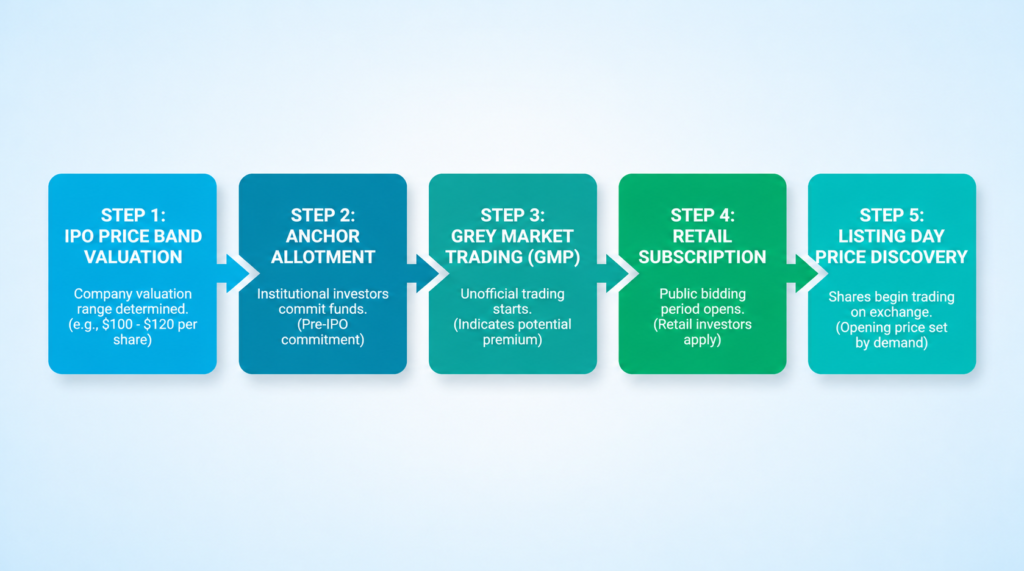
Here is how an IPO moves through five distinct real-world stages:
Stage 1: Price Band Valuation (Investment Bankers)
Merchant bankers evaluate the company’s historical earnings per share (EPS), cash flows, and peer comparisons to establish a Price Band (for example, ₹475 to ₹500 per share). This price band is published in the Red Herring Prospectus (RHP) filed with SEBI.
Stage 2: Anchor Investor Allotment (The Institutional Vote)
One day before the public issue opens, 60% of the QIB portion is opened for Anchor Investors (large institutional funds like mutual funds and sovereign wealth funds). Anchor investors commit capital at the top of the price band, signaling institutional confidence to the broader market.
Stage 3: Unofficial Grey Market Trading (GMP Formation)
Parallel to the official process, an informal, over-the-counter market operates where traders bet on expected listing prices. If the issue price is ₹500 and buyers informally offer ₹650, the Grey Market Premium (GMP) is quoted at ₹150 (30%).
Stage 4: Public Bidding & Subscription Aggregation
Over the 3-day bidding window, applications are collected across three official categories: Qualified Institutional Buyers (QIB), Non-Institutional Investors (NII/HNI), and Retail Individual Investors (RII).
Stage 5: Listing Day Price Discovery & Anchor Lock-In
On listing day, official price discovery occurs during the pre-open session (9:00 AM to 9:45 AM). Once trading begins, institutional buying or selling determines whether the stock sustains its listing price or faces profit-booking.
The Math Behind IPO Valuation and Listing Premiums
To determine whether an IPO’s price band is cheap or expensive, investors should look past the absolute share price (whether a share is ₹50 or ₹1,500) and examine valuation multiples:
Price-to-Earnings (P/E) Multiple = Upper Price Band / Annualized Earnings Per Share (EPS)
Let us break down a real-world comparison between two hypothetical IPOs:
- Company A (Strong Fundamental Value):
- Upper Price Band: ₹400 | Annual EPS: ₹20
- IPO P/E Ratio: 20x
- Listed Peer Group Average P/E: 32x
- Analysis: Company A is offered at a 37.5% discount to its listed industry peers. Even if unofficial GMP is low, institutional buyers will likely bid up the stock post-listing to match peer valuations.
- Company B (Overvalued Issue):
- Upper Price Band: ₹800 | Annual EPS: ₹8
- IPO P/E Ratio: 100x
- Listed Peer Group Average P/E: 35x
- Analysis: Company B is priced at a 185% premium to its listed peers. Even if unofficial GMP is quoted at +50% due to retail marketing, institutional buyers will avoid the stock, leaving retail investors vulnerable to steep selling once trading begins.
Understanding Grey Market Terms: GMP vs. Subject to Sauda
When reading unofficial IPO reports, retail investors often come across two key terms:
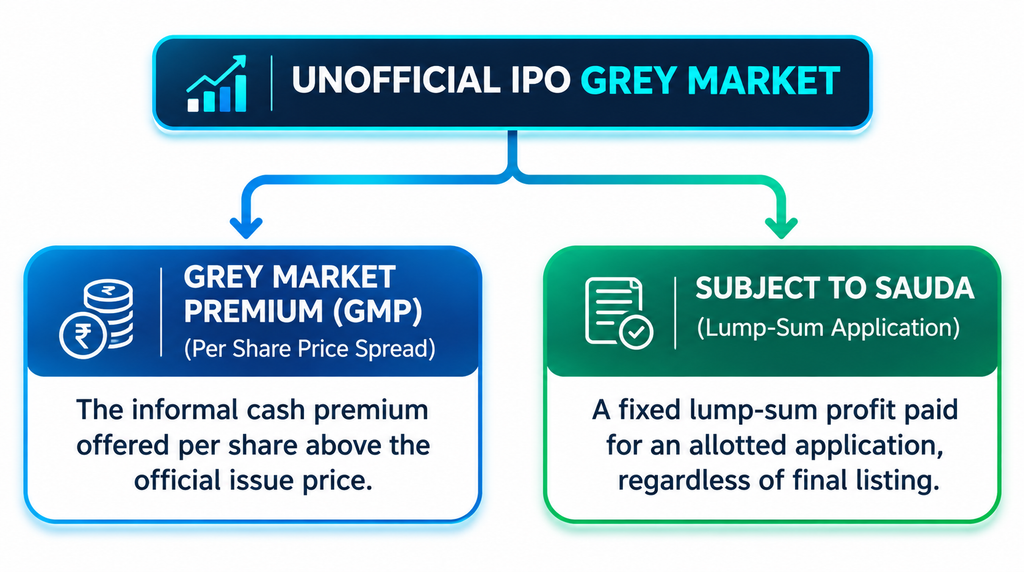
- Grey Market Premium (GMP): The estimated per-share profit expected at listing. If the issue price is ₹200 and GMP is ₹50, the estimated listing price is ₹250.
- Subject to Sauda (Kostak Rate): A fixed lump-sum profit agreed upon for trading an entire IPO application lot before allotment results are announced, shifting allotment risk to the buyer.
Important Risk Note: The grey market is completely unregulated by SEBI, operates on informal verbal commitments, and is prone to artificial manipulation by operators seeking to create fake demand during public bidding windows.
What Should Retail Investors Look For Before Applying?
Instead of relying on unofficial GMP quotes, disciplined investors focus on four verifiable factors in the Red Herring Prospectus (RHP):
- QIB Subscription Level: Always check the Qualified Institutional Buyer subscription on the final afternoon of the issue. High QIB oversubscription (e.g., >30x) indicates that professional fund managers have verified the company’s business model.
- Anchor Investor Quality: Review the list of anchor investors. Participation by reputed domestic mutual funds and global sovereign funds provides a strong vote of confidence.
- Fresh Issue vs. Offer for Sale (OFS): Check how the raised capital will be used. A high percentage of Fresh Issue means money goes into the company for growth and debt reduction. A high Offer for Sale (OFS) means existing promoters or private equity investors are selling their shares to exit.
- Anchor Lock-In Expiry Dates: Under SEBI guidelines, 50% of anchor investor shares are locked in for 30 days, while the remaining 50% are locked in for 90 days. Be aware that stock price volatility often increases near lock-in expiry dates.
Understanding how institutional orders execute during volatile listing sessions connects directly to SEBI’s updated 30-minute VWAP derivatives settlement framework, which governs end-of-day price discovery across equity markets.
To see how macro liquidity and interest rate cycles influence equity valuations across primary and secondary markets, explore our detailed guide on how rising crude oil and RBI rate hikes impact market valuations.
For insights into sector-specific financial evaluation, read our breakdowns of Indian IT deal wins and revenue growth and understanding Indian banking NIM and credit growth.
Furthermore, tracking institutional liquidity trends explains why strong domestic capital protects markets during choppy IPO cycles, as detailed in our post on how Indian mutual fund SIP inflows provide market resilience.
IndiaMoneyGuru Takeaway
Valuation creates value; premiums create noise. Unofficial Grey Market Premiums provide a temporary snapshot of retail market sentiment, but long-term listing performance is determined by corporate earnings, fair pricing bands, and institutional buying power. Never apply for an IPO based on grey market rumors alone—always evaluate the business fundamentals first.
Frequently Asked Questions (FAQs)
1. What is the Grey Market Premium (GMP) in an IPO?
Grey Market Premium (GMP) is the unofficial price premium at which an IPO’s shares are traded in an informal over-the-counter market before they are officially listed on stock exchanges like the BSE and NSE.
2. Is Grey Market Premium (GMP) regulated by SEBI?
No. The grey market is an unofficial, unregulated platform that operates outside SEBI oversight. GMP quotes are not official exchange data and can be subject to artificial manipulation or sudden sentiment shifts.
3. Why does a stock list below its issue price despite having a high GMP?
If an IPO is priced at an excessively high valuation multiple (P/E ratio) compared to listed peers, or if institutional buyers (QIBs) refrain from buying on listing day, heavy profit-booking can push the share price below the issue price despite high retail GMP expectations.
4. Is high GMP good?
A high Grey Market Premium (GMP) indicates strong short-term demand and bullish sentiment in the informal market, but it is not a guaranteed stamp of business quality. Because the grey market is unregulated and prone to artificial speculation or operator manipulation, a high GMP must always be verified against institutional QIB subscription numbers and fundamental valuation metrics (like the P/E ratio) before drawing conclusions.
5. What is a reasonable GMP percentage?
Generally, an informal GMP of 15% to 30% or higher over the upper price band is considered a healthy indicator of positive listing sentiment among market traders. However, a “good” GMP percentage only leads to sustainable post-listing gains if the company is reasonably valued compared to its listed industry peers and backed by strong anchor investor participation.
6. Is GMP and listing price the same?
No. GMP (Grey Market Premium) and the official listing price are entirely different. GMP is merely an informal, unregulated price estimate traded over-the-counter prior to listing. The official listing price is discovered on listing day during the NSE/BSE pre-open session (9:00 AM to 9:45 AM) based on actual institutional and retail buy/sell order matching.
Disclaimer
The information provided in this article is for educational purposes only and should not be considered investment advice. Trading and investing in financial markets involve risk. Always conduct your own research and consult a SEBI-registered investment adviser before making any investment decisions.