
Table of Contents
Having more money available in the banking system sounds like a good thing.
Banks have funds to lend. Borrowing conditions can become easier. Money-market rates can decline.
So why would the Reserve Bank of India deliberately try to remove hundreds of thousands of crores of rupees from banks?
India has provided an unusually clear real-world example in September 2026.
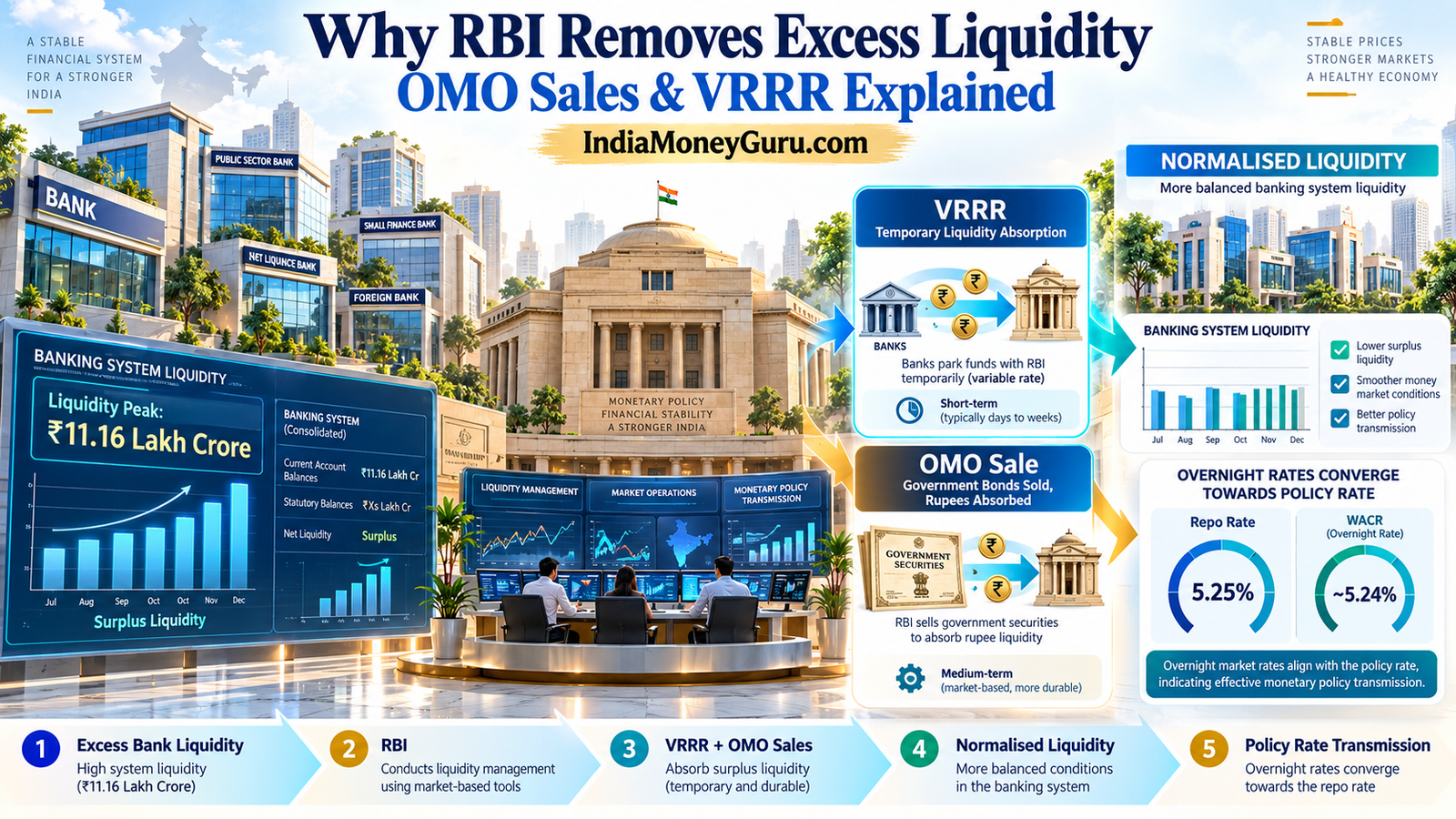
Earlier this month, enormous foreign-currency inflows, particularly through FCNR(B) deposits and subsequent swaps with RBI, flooded the banking system with rupee liquidity. At its peak on 6 September, the liquidity surplus reached approximately ₹11.16 lakh crore.
RBI then started pulling that excess money back.
By 22 September, the surplus had fallen to roughly ₹4.45 lakh crore.
To understand why, investors need to understand one of the least discussed but most important parts of monetary policy: RBI liquidity management.
Where Did All This Extra Liquidity Come From?
We explained the first half of this story in our guide to FCNR(B) deposits and bank liquidity.
Banks mobilised large amounts of foreign currency via FCNR(B) deposits. Eligible foreign currency was then swapped with RBI, providing banks with rupees.
The broad mechanism was:
Foreign currency enters banks
↓
Banks swap dollars with RBI
↓
RBI provides rupees
↓
Rupee liquidity enters the banking system
These actions helped strengthen India’s foreign-exchange position and provided banks with substantial domestic liquidity.
But successful liquidity injection created another challenge.
There was now too much money in the banking system.
Why Can Too Much Banking Liquidity Become a Problem?
Imagine that banks collectively have far more short-term cash than they currently need.
They have less reason to borrow from one another.
The interest rate, which is the price of very short-term money, can therefore fall.
Normally, that might sound beneficial.
But RBI uses the repo rate as an important signal for monetary conditions. If RBI’s policy rate is 5.25% while overnight market rates remain substantially below it because banks are overflowing with cash, monetary-policy transmission becomes weaker.
RBI may say:
Money should effectively cost around this level.
But the banking system may be saying:
We already have more money than we need.
This is why liquidity management and interest-rate policy cannot be completely separated.
RBI does not necessarily want maximum liquidity.
It wants liquidity conditions consistent with its monetary-policy objectives.
RBI Liquidity Management: How Does RBI Remove Excess Money?
Two tools have been particularly important during September:
Variable Rate Reverse Repo (VRRR) and Open Market Operation (OMO) sales.
They both absorb liquidity, but they work differently.
VRRR: Temporarily Parking Banks’ Excess Cash
Under a Variable Rate Reverse Repo operation, banks place surplus funds with RBI for a specified period.
Think of it as RBI telling banks:
“If you don’t need this money right now, park it with us and earn interest.”
Banks bid in the auction, and RBI absorbs the funds.
In September, RBI used VRRR operations repeatedly as surplus liquidity remained exceptionally high.
For example, on 23 September it absorbed approximately ₹75,026 crore through an overnight VRRR at a weighted-average rate of 5.24%.
Earlier operations were considerably larger.
The important characteristic is that VRRR is primarily a temporary liquidity-absorption mechanism.
When the operation matures, the funds return to the banking system unless the RBI takes further action.
OMO Sales: Taking Liquidity Out Through Government Bonds
An OMO sale works differently.
RBI sells government securities to banks and other market participants.
The buyers pay RBI for those bonds.
That payment removes rupees from the banking system.
The mechanism is:
RBI sells government securities
↓
Banks/investors pay RBI
↓
Cash leaves the banking system
↓
Surplus liquidity declines
RBI announced ₹1 lakh crore of OMO sales for September in three tranches:
₹50,000 crore – 17 September
₹25,000 crore – 21 September
₹25,000 crore – scheduled for 28 September
Compared with an overnight VRRR, an OMO sale can remove liquidity more durably because RBI is selling an asset rather than merely accepting temporary deposits.
Why Does Liquidity Affect the Repo Rate?
This aspect is where the story becomes particularly useful for ordinary investors.
The repo rate receives enormous attention whenever the RBI’s Monetary Policy Committee meets.
But announcing a repo rate is only part of monetary policy.
RBI also needs market interest rates to respond appropriately.
One important indicator is the Weighted Average Call Rate (WACR), the average rate at which banks borrow unsecured overnight money from one another.
As the RBI withdrew excess liquidity during September, the WACR moved to approximately 5.24%, which is very close to the 5.25% repo rate.
That is not a coincidence.
RBI’s liquidity operations help keep overnight money-market rates aligned with the policy rate.
In simplified form:
Too much liquidity
↓
Overnight rates fall
↓
RBI absorbs liquidity
↓
Overnight rates move towards repo rate
↓
Monetary-policy transmission improves
This study explains why liquidity management can matter even when the RBI has not changed the headline repo rate.
Does RBI Liquidity Withdrawal Mean Banks Have No Money to Lend?
No.
This is an important distinction.
A liquidity surplus means the banking system has more short-term cash than required under prevailing conditions.
Reducing an unusually large surplus does not automatically mean creating a liquidity shortage.
RBI’s objective is generally to keep financial conditions consistent with monetary policy and financial stability.
Think of it less as:
“RBI is taking money away from banks.”
and more as:
“RBI is adjusting the amount of money circulating through the banking system.”
The difference matters.
How Can OMO Sales Affect Bond Yields?
OMO sales also interact with India’s government-bond market.
When RBI sells government securities, additional bond supply enters the market.
If supply increases while demand does not rise proportionately, bond prices can come under pressure.
And because:
Bond price ↓ = Bond yield ↑
OMO sales can place upward pressure on yields.
This scenario becomes particularly important when government borrowing is already large or global bond yields are elevated.
So one RBI action can influence several connected markets:
OMO sale → Liquidity declines → Money-market rates adjust → Bond supply increases → Bond yields can respond
That is why liquidity operations matter to banks, debt-fund investors, bond traders and equity investors, not merely economists.
Domestic bond yields do not move in isolation. Investors should also understand how US bond yields affect the Indian stock market, because changes in global yields can influence foreign capital flows, the rupee, Indian bond yields and equity valuations, sometimes reinforcing the effects of RBI’s domestic liquidity operations.
Why Not Remove All the Surplus Immediately?
This is because liquidity management requires balance.
Removing too little liquidity could leave overnight rates below the policy rate and weaken monetary transmission.
Removing too much could unnecessarily tighten financial conditions, increase funding costs and disrupt credit markets.
RBI therefore watches variables such as:
- banking-system liquidity;
- overnight money-market rates;
- credit growth;
- government cash flows;
- currency demand;
- inflation;
- bond yields;
- foreign-exchange conditions.
Liquidity management is therefore not simply about whether money is being injected or withdrawn.
It is about how much liquidity the financial system needs under prevailing economic conditions.
Inflation is another important part of this policy equation, particularly for an oil-importing economy such as India. Understanding how rising crude oil affects inflation and Indian markets helps connect higher import costs with the rupee, inflation expectations, interest rates and the broader monetary-policy environment RBI must consider while managing liquidity.
IndiaMoneyGuru Takeaway
September 2026 provides an excellent real-world lesson in how central banking actually works.
First, large FCNR(B)-linked foreign-currency inflows created an extraordinary amount of rupee liquidity.
Then RBI began removing part of that liquidity through VRRR auctions, OMO bond sales and other market operations.
These are not contradictory policies.
They are two sides of liquidity management.
The RBI can provide liquidity when the financial system needs it and absorb liquidity when excess cash begins to interfere with monetary-policy transmission or financial stability.
The durable lesson for investors is simple:
The repo rate tells you the direction of monetary policy. Liquidity conditions help determine how effectively that policy reaches the financial system.
Watching both provides a much deeper understanding of RBI policy than watching the repo rate alone.
FAQs
What is liquidity in the banking system?
Banking-system liquidity broadly refers to the availability of short-term funds within the banking system relative to its requirements. A surplus means banks collectively have excess funds, while a deficit indicates greater funding needs.
What is a VRRR?
VRRR stands for Variable Rate Reverse Repo. RBI uses VRRR auctions to absorb surplus funds from banks for a specified period while paying an auction-determined interest rate.
What is an RBI OMO sale?
In an Open Market Operation sale, the RBI sells government securities to market participants. Buyers pay RBI for those securities, removing rupee liquidity from the banking system.
What is the difference between VRRR and OMO?
VRRR generally absorbs liquidity temporarily because funds return when the operation matures. OMO sales can have a more durable liquidity impact because RBI sells government securities in exchange for cash.
Why does RBI want the call rate near the repo rate?
The repo rate represents RBI’s key policy-rate signal. Keeping overnight money-market rates reasonably aligned with it helps monetary-policy decisions transmit through the financial system.
Disclaimer
The information provided in this article is for educational purposes only and should not be considered investment advice. Trading and investing in financial markets involve risk. Always conduct your own research and consult a SEBI-registered investment adviser before making any investment decisions.