
Executive Summary
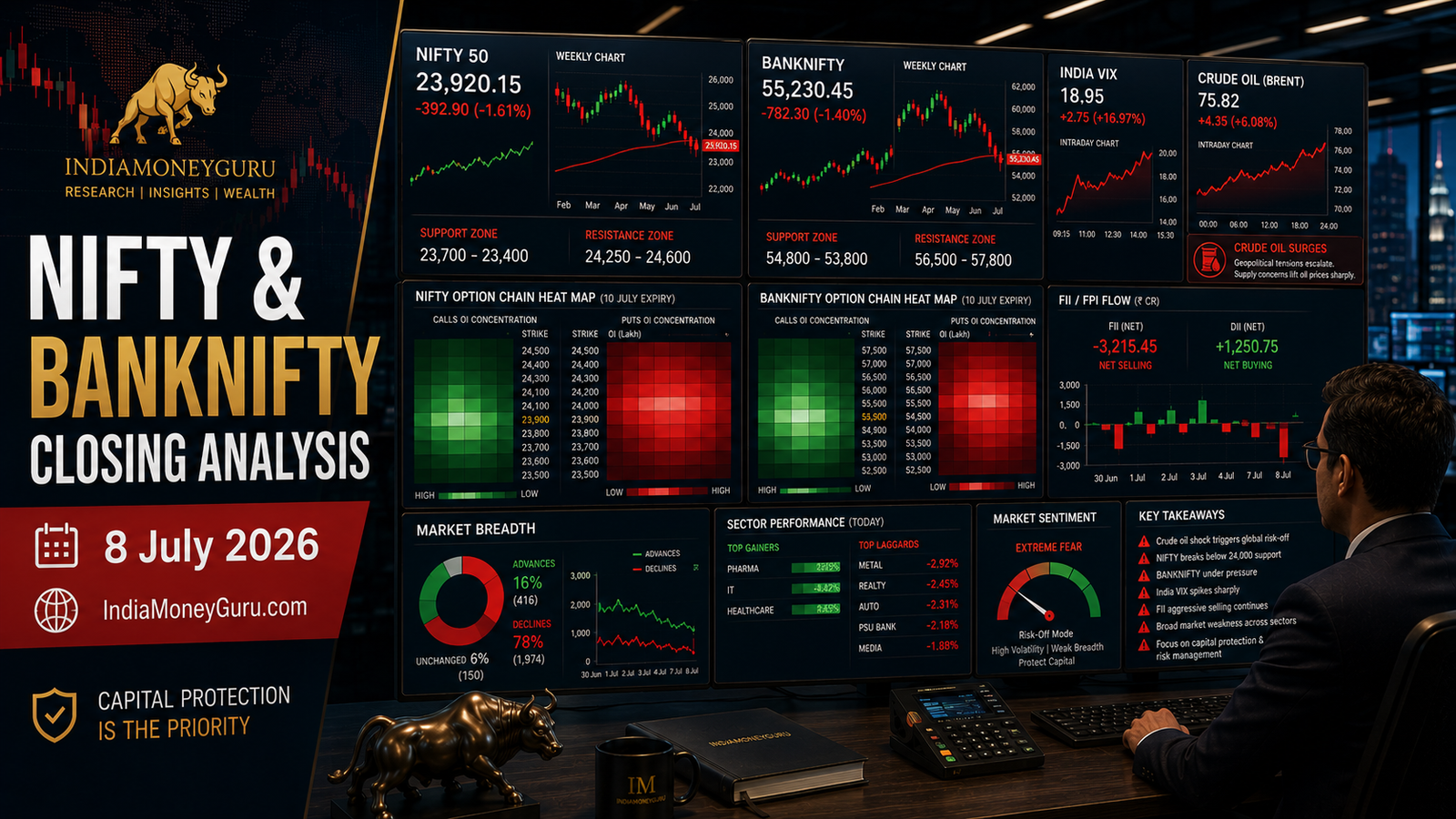
NIFTY & BANKNIFTY Closing Analysis – 8 July 2026: Indian equity markets witnessed a sharp risk-off session on Wednesday, 8 July 2026, as renewed U.S.-Iran tensions triggered a sudden spike in crude oil prices and pressured global risk assets. The NIFTY 50 fell 2.12% to 23,882.05, logging its worst session in more than three months. The sell-off was broad-based, with financials, IT, oil & gas, auto and FMCG all under pressure.
BANKNIFTY also came under heavy pressure as the banking and financial space, which had recently attracted renewed foreign inflows, faced aggressive profit booking. Nifty Bank, FMCG and Oil & Gas were among the sectoral indices that fell more than 2%, while all 16 major sectors closed lower.
The most important shift was in volatility. India VIX jumped about 26% to 14.68, showing that traders suddenly moved from a low-volatility comfort zone into a fear-driven protection-seeking environment.
Today’s session is important because it changed the short-term character of the market. Until Tuesday, the market looked like it was pausing after a rally. On Wednesday, the pause became a broad risk-off reversal.
Table of Contents
Market Intelligence Scorecard
| Indicator | Status | Interpretation |
|---|---|---|
| NIFTY Trend | 🔴 Bearish Short-Term | Sharp fall below 24,000 |
| BANKNIFTY Trend | 🔴 Weak | Banking and financials faced heavy selling |
| India VIX | 🔴 Risk Elevated | VIX surged sharply to 14.68 |
| Market Breadth | 🔴 Very Weak | Declines strongly outnumbered advances |
| Sector Participation | 🔴 Broad-Based Selling | All major sectors closed lower |
| Institutional Mood | 🟠 Cautious | Crude spike may trigger fresh foreign selling |
| Option Writers | 🟠 Defensive | Higher volatility increases adjustment risk |
| Overall Bias | Bearish to Cautious | Avoid aggressive dip buying without confirmation |
Previous Session vs Today
| Parameter | 7 July 2026 | 8 July 2026 | Interpretation |
|---|---|---|---|
| NIFTY 50 | Around 24,399 | 23,882.05 | Breakdown below 24,000 |
| BANKNIFTY | Mildly weak | Sharp weakness | Financials sold off |
| India VIX | 11.76 | 14.68 | Fear returned quickly |
| Market Breadth | Weak | Extremely weak | Selling broadened |
| Sector Trend | Mixed | All sectors negative | Risk-off session |
| Primary Driver | Profit booking | Crude + geopolitical shock | Macro risk returned |
Market Snapshot
| Index / Indicator | Closing / Reading | Market Message |
|---|---|---|
| NIFTY 50 | 23,882.05 | Worst session in over three months |
| BANKNIFTY | Weak; Nifty Bank fell more than 2% | Banking leadership broke down for the day |
| India VIX | 14.68 | Volatility risk sharply higher |
| Nifty Midcap 100 | Down around 1.6% | Broader market pressure |
| Nifty Smallcap 100 | Down around 2.2% | High-beta selling intensified |
| Market Breadth | 699 advances vs 2,633 declines | Sharp negative breadth |
Market Overview
Wednesday’s market action was driven by a sudden macro shock rather than routine profit booking. The immediate trigger was the escalation in U.S.-Iran tensions after comments that the peace accord with Iran was “over.” This pushed Brent crude up more than 6% toward the $79 per barrel region and hit sentiment across global markets.
For India, crude oil is not just a commodity price. It directly affects inflation expectations, the rupee, bond yields, import costs and corporate margins. Reuters noted that higher oil prices hurt India by widening the import bill, stoking inflation and squeezing growth.
The sell-off accelerated in the second half of trade. NIFTY broke below 24,000 and closed near 23,882. BANKNIFTY also weakened sharply as financial stocks faced selling pressure. The weakness in banks matters because financials had been one of the biggest supports for the recent rally.
The broader market confirmed the seriousness of the fall. Midcaps and smallcaps declined sharply, and all 16 major sectors closed lower. This was not a narrow index correction. It was a full risk-off session.
IndiaMoneyGuru Unique Insight
The most important lesson from today’s session is:
When crude becomes the trigger, technical levels break faster than usual.
In normal profit-booking sessions, support zones often work because traders are still willing to buy dips. But when the trigger is macro risk, especially crude oil and geopolitical tension, institutional behaviour changes. Traders stop asking, “Is this a good technical dip?” and start asking, “How much macro risk is still unpriced?”
This is why today’s fall was sharper than Tuesday’s weakness. On Tuesday, breadth warned that participation was weakening. On Wednesday, the macro trigger converted that weakness into a broad-based sell-off.
For IndiaMoneyGuru readers, the practical takeaway is simple: do not treat every fall as a buying opportunity. When India VIX rises sharply and crude jumps together, traders should first wait for stabilization, not immediately average positions.
NIFTY Analysis
NIFTY’s fall below 24,000 is a meaningful short-term breakdown. The index had recently been holding above key momentum zones, but Wednesday’s close at 23,882.05 shows that sellers regained control.
The character of the move is important. This was not a slow decline. It was a sharp sell-off accompanied by a volatility spike, weak breadth and global risk aversion. Such moves usually require time to stabilize.
For NIFTY, the next one or two sessions are crucial. If the index quickly reclaims 24,000 and sustains above it, the fall may be treated as a macro-shock correction. But if NIFTY remains below 24,000 and selling continues, traders should prepare for deeper retesting of lower support zones.
The best approach is to avoid aggressive long trades until either price stabilizes or volatility cools.
BANKNIFTY Analysis
BANKNIFTY had recently shown signs of leadership due to renewed interest in private banks and improving foreign flows into financials. Foreign portfolio investors bought ₹146.34 billion of banking stocks in the second half of June, the strongest fortnightly inflow into the sector in 14 months, according to NSDL data reported by Reuters.
Wednesday’s session damaged that near-term momentum. Nifty Bank was among the sectoral indices that fell more than 2%. This matters because banks are highly sensitive to foreign flows, bond yields, liquidity expectations and macro risk.
The fall does not mean the banking investment case has collapsed. Recent policy support and FPI inflows into banks remain important medium-term positives. However, short-term traders should now wait for confirmation before assuming BANKNIFTY leadership will resume immediately.
BANKNIFTY must stabilize first. If banking heavyweights stop falling and private banks start absorbing selling pressure, the index can recover. But if financials continue to weaken, BANKNIFTY may remain the biggest drag on NIFTY.
Option Chain Intelligence
Today’s derivatives message changed sharply from the previous low-volatility environment.
The key signal is the India VIX spike. A 26% jump in VIX means option premiums expanded sharply and option writers had to reprice risk. In such conditions, previous support zones based on Put writing can weaken quickly because writers may unwind positions when spot breaks important levels.
For NIFTY, the break below 24,000 suggests that Put writers at higher strikes likely came under pressure. Call writers are now likely to become more active near overhead resistance zones unless the index quickly recovers.
For BANKNIFTY, the setup has turned more defensive. When banks lead downside, weekly and monthly option sellers need to avoid assuming range-bound behaviour too early. Volatility expansion can make even defined-risk spreads uncomfortable if entry levels are poorly selected.
The option-chain message is no longer “comfortable premium decay.” It is now risk repricing.
Institutional Activity
The recent improvement in FII behaviour had been one of the positive supports for the market. Reuters reported that foreign investors had invested a net $401 million into Indian equities during the first five trading sessions of July.
However, today’s crude-led sell-off creates a fresh test for those flows. Rising crude prices can revive concerns about India’s import bill, inflation, rupee weakness and bond yields. Reuters also reported that traders linked the late-session slide to likely foreign selling after earlier inflows.
DIIs and domestic retail flows remain important structural supports for Indian equities. But during sharp macro shocks, domestic liquidity may cushion the market; it may not immediately reverse panic selling.
India VIX Analysis
India VIX surged about 26% to 14.68, marking one of the clearest warning signs of the session.
A rising VIX during a falling market tells us that traders are buying protection and repricing risk. This is very different from the previous few sessions where VIX remained low despite mild market weakness.
For equity traders, rising VIX means stop-losses should be respected more strictly. For option buyers, premium expansion can help if direction is right, but late entries become expensive. For option sellers, this is a warning to reduce position size, use hedges and avoid naked exposure.
The market can still recover from a VIX spike, but the first requirement is stabilization. Until VIX cools or stops rising, aggressive option selling should be avoided.
Sector Rotation
| Sector | Trend | Interpretation |
|---|---|---|
| Banking / Financials | Weak | Foreign investor favourites faced selling |
| IT | Weak | Fell despite earlier leadership |
| Oil & Gas | Weak | Crude-sensitive pressure |
| Auto | Weak | Higher crude and inflation risk weighed |
| FMCG | Weak | Margin concerns from crude and input costs |
| Realty | Weak | Risk appetite declined |
| Midcaps | Weak | High-beta selling visible |
| Smallcaps | Very Weak | Retail risk appetite weakened sharply |
This was not normal sector rotation. This was a broad risk-off day. In healthy rotation, some sectors rise while others fall. Today, all major sectors closed lower, showing that traders reduced risk across the board.
Support and Resistance
| Index | S1 | S2 | S3 | R1 | R2 | R3 |
|---|---|---|---|---|---|---|
| NIFTY | 23,800 | 23,650 | 23,500 | 24,000 | 24,200 | 24,400 |
| BANKNIFTY | 56,800 | 56,300 | 55,800 | 57,700 | 58,000 | 58,500 |
You can learn more about how support and resistance works in market by exploring our article “How to Identify Support and Resistance Using Option Chain Analysis“.
Trading Plan for Next Session
The next session should be approached with caution.
For bullish traders, the first sign of recovery would be NIFTY reclaiming 24,000 and sustaining above it. A gap-up without follow-through should not be trusted immediately because volatility is high.
For bearish traders, the trend is currently in their favour, but fresh shorts after a large fall should be managed carefully. Sharp short-covering rallies are common after panic sessions.
For BANKNIFTY traders, confirmation from heavyweight private banks is essential. If banks continue to remain weak, BANKNIFTY may underperform NIFTY. If banking stabilizes first, it may become the early recovery signal.
For option sellers, this is not the best environment for aggressive naked selling. Defined-risk spreads, lower quantity and wider safety margins are more appropriate.
Risk Factors to Watch
Key risks for the next session include:
- Brent crude movement near the $79–80 region
- U.S.-Iran geopolitical developments
- Rupee weakness
- Bond yield movement
- FII selling or reversal of recent inflows
- India VIX sustaining above 14
- Follow-through selling in banks and broader markets
The biggest risk is not just price decline. The bigger risk is uncertainty. When markets do not know how far a geopolitical event can escalate, volatility remains elevated.
Trading Lessons
Today’s session offers three important lessons.
First, macro shocks can override technical setups. Support levels matter, but they are less reliable when crude and geopolitics dominate.
Second, low VIX can change quickly. Traders who built aggressive short-option positions during calm sessions may face sudden mark-to-market pressure when volatility expands.
Third, breadth is an early warning system. Tuesday’s weak breadth warned that the market was becoming fragile. Wednesday’s macro trigger exposed that weakness.
Key Takeaways
For equity investors, today’s fall is a reminder to avoid overexposure in overheated stocks. Quality companies can be accumulated only after stabilization, not during panic.
For swing traders, the market has shifted from buy-on-dips to wait-for-confirmation.
For option sellers, risk management is now more important than premium collection.
For intraday traders, volatility can create opportunity, but only with strict position sizing and fast execution discipline.
Editorial Conclusion
Indian markets suffered a sharp setback on 8 July 2026 as renewed U.S.-Iran tensions triggered a spike in crude oil and pushed investors into risk-off mode. NIFTY broke below 24,000, BANKNIFTY weakened sharply, India VIX surged, and market breadth deteriorated significantly.
The market’s medium-term story is not over, but the short-term tone has clearly changed. Until crude stabilizes, VIX cools and NIFTY reclaims important levels, traders should avoid aggressive dip buying.
IndiaMoneyGuru View:
The market has moved from a comfortable bullish structure to a cautious risk-management phase. Protect capital first. Fresh buying should wait for price stabilization, lower volatility and recovery in banking leadership.
Related Articles
- Nifty & BankNifty Closing Analysis 7 July 2026
- Nifty & BankNifty Closing Analysis 6 July 2026
- NIFTY and BANKNIFTY Weekly Market Wrap-Up – Week Ending 3 July 2026
- Option Interest Trading Guide
FAQs
Why did the Indian stock market fall sharply today?
The market fell due to renewed U.S.-Iran tensions, a sharp spike in crude oil prices, weak global cues, rupee weakness and broad-based risk-off selling.
What was the NIFTY closing level on 8 July 2026?
NIFTY 50 closed at 23,882.05, down 2.12%.
Why is crude oil important for Indian markets?
India is a major crude oil importer. Higher crude can increase inflation, widen the import bill, pressure the rupee and hurt corporate margins.
Is BANKNIFTY bearish now?
BANKNIFTY has turned weak in the short term after the broad sell-off. It needs stabilization in private banking heavyweights before leadership can resume.
What does the India VIX spike mean?
The VIX spike means traders are pricing higher volatility and buying protection. It is a warning sign for aggressive option sellers.
Should traders buy the dip now?
Traders should wait for stabilization. Buying immediately after a macro-driven fall can be risky if crude and geopolitical concerns remain unresolved.
What should option sellers do?
Option sellers should reduce position size, use hedges and avoid naked exposure until volatility cools.
What is the key level for NIFTY now?
The 24,000 level is the first major reclaim zone. Below that, NIFTY remains vulnerable to further pressure.
Disclaimer
The information provided in this article is for educational purposes only and should not be considered investment advice. Trading and investing in financial markets involve risk. Always conduct your own research and consult a SEBI-registered investment adviser before making any investment decisions.