
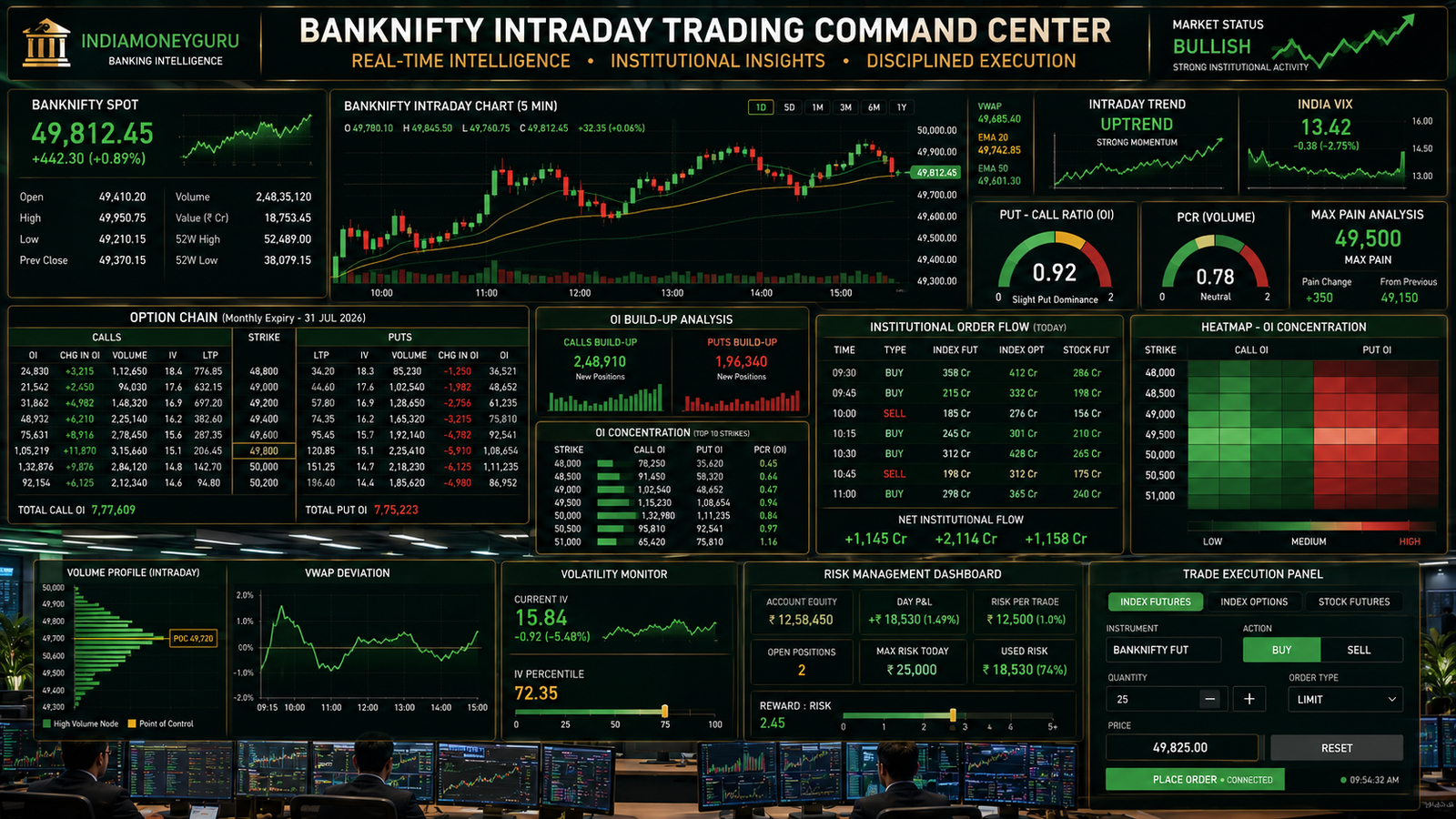
BANKNIFTY Intraday Trading Guide is designed for traders who want to understand how professional participants approach one of India’s most actively traded indices. BANKNIFTY is known for its high liquidity, strong price movements, and rapid intraday swings, making it attractive to both experienced traders and beginners.
Unlike positional trading, intraday trading focuses on capturing opportunities within a single trading session. Positions are opened and closed on the same day, reducing overnight risk while demanding greater discipline, preparation, and risk management.
This guide explains how traders can prepare for the trading day, identify high-probability setups, and manage risk while trading BANKNIFTY.
Key Takeaways
- BANKNIFTY is one of India’s most liquid indices for intraday trading.
- Preparation before the market opens is as important as trade execution.
- Option Chain analysis provides valuable insight into market positioning.
- Price action and trend confirmation should guide entries.
- Consistent risk management is more important than predicting every market move.
- Successful traders focus on probability, discipline, and capital preservation rather than excitement.
Table of Contents
Why BANKNIFTY Is Popular for Intraday Trading
BANKNIFTY consists of leading banking stocks listed on the National Stock Exchange (NSE). Because banking stocks react quickly to domestic and global developments, the index often exhibits significant price movement during market hours.
Some reasons why traders prefer BANKNIFTY include:
- High liquidity
- Active options market
- Well-defined intraday trends
- Strong institutional participation
- Good availability of technical data
- Suitable for both futures and options traders
These characteristics create opportunities but also increase risk, making preparation essential.
Preparing Before the Market Opens
Successful intraday trading begins before the opening bell.
Professional traders typically review:
- Global market performance
- Gift Nifty indications
- Major banking news
- RBI announcements (when applicable)
- Economic events scheduled for the day
- Previous day’s high, low and closing price
- Key support and resistance levels
- BANKNIFTY Option Chain
- India VIX
Rather than predicting the market, they prepare multiple scenarios and decide how to respond if those scenarios develop.
Identifying the Intraday Trend
Trading with the prevailing trend generally provides a higher probability than constantly attempting to trade reversals.
Common methods used to identify trend include:
- Higher highs and higher lows
- Lower highs and lower lows
- Moving averages
- Trendlines
- Price structure
- Volume confirmation
Once the trend is identified, traders look for opportunities that align with that direction. Check out this comprehensive Bank Nifty Swing Trading Guide to find how Intraday trade differs from a swing trade.
Using Option Chain Before Taking a Trade
One of the biggest advantages available to BANKNIFTY traders is access to real-time Option Chain data.
Before entering a trade, many experienced traders analyse:
- Highest Call Open Interest
- Highest Put Open Interest
- Fresh Call Writing
- Fresh Put Writing
- Open Interest changes
- Put-Call Ratio (PCR)
- Implied Volatility
This information helps estimate where institutional participants are actively positioning themselves.
Option Chain analysis should support a trading decision rather than replace technical analysis.
High-Probability Intraday Setups
Instead of trading every market movement, disciplined traders wait for predefined setups.
Some commonly observed setups include:
Opening Range Breakout
The first 15 – 30 minutes often establish an important trading range.
A breakout above or below this range, supported by strong volume and market participation, may indicate intraday momentum.
Trend Continuation
When BANKNIFTY is already trending, traders often wait for pullbacks toward support before considering continuation opportunities.
This approach generally offers a better risk-to-reward ratio than chasing price after an extended move.
Support and Resistance Bounce
If BANKNIFTY approaches a significant support or resistance level and price action confirms a reversal, some traders consider trading in the opposite direction of the move.
Confirmation is essential because strong trends can break important levels.
Combining Price Action with Option Chain
Neither price action nor Option Chain should be used independently.
Professional traders combine:
- Market trend
- Price action
- Support and resistance
- Option Chain analysis
- Volume
- Risk management
When multiple factors point in the same direction, confidence in the trade generally increases.
Risk Management Comes First
Intraday trading offers opportunities but also exposes traders to rapid price movement.
Some important principles include:
- Define risk before entering a trade.
- Use appropriate position sizing.
- Avoid averaging losing positions.
- Respect predefined stop-loss levels.
- Do not increase risk after consecutive losses.
- Focus on consistency instead of chasing large profits.
Professional traders concentrate on protecting capital first and generating returns second.
Common Mistakes in Intraday Trading
Many new traders struggle because of avoidable mistakes.
Some of the most common include:
- Trading without a plan.
- Ignoring the prevailing trend.
- Entering trades based on rumours.
- Overtrading.
- Trading immediately after the market opens without confirmation.
- Ignoring Option Chain data.
- Holding losing positions hoping for recovery.
- Risking too much on a single trade.
Avoiding these mistakes often improves trading performance more than constantly searching for new strategies.
Conclusion
BANKNIFTY Intraday Trading Guide is not about finding a perfect strategy. It is about building a structured trading process that combines preparation, market analysis, disciplined execution, and effective risk management.
Traders who consistently analyse trend, Option Chain, support and resistance, and price action while controlling risk are generally better positioned to make informed intraday trading decisions.
Frequently Asked Questions (FAQs)
What is the BANKNIFTY Intraday Trading Guide?
The BANKNIFTY Intraday Trading Guide explains how traders prepare, analyse, execute, and manage trades within a single trading session. It covers trend analysis, Option Chain interpretation, trade setups, and risk management.
Is BANKNIFTY suitable for beginners?
BANKNIFTY is highly liquid but also highly volatile. Beginners should first understand price action, Option Chain analysis, and risk management before trading with real capital.
What is the best timeframe for BANKNIFTY intraday trading?
Many traders analyse the broader trend using the 15-minute or 30-minute charts and use lower timeframes such as 5-minute or 3-minute charts for trade execution. The choice depends on the trader’s strategy and experience.
Should I trade with the trend or against it?
Trading in the direction of the prevailing trend generally provides a higher probability than attempting to trade every reversal. Trend confirmation should be supported by price action and volume.
Why is Option Chain important for intraday trading?
The Option Chain helps traders understand institutional positioning through Open Interest, fresh Call and Put writing, and Put-Call Ratio (PCR). It should be used alongside technical analysis rather than as a standalone trading signal.
Which indicators should I monitor before entering a BANKNIFTY trade?
Professional traders commonly monitor:
– Trend
– Support and Resistance
– Option Chain
– Open Interest (OI)
– Price Action
– Volume
– India VIX
– Important economic or banking-related news
How much capital is required for BANKNIFTY intraday trading?
There is no fixed amount. The appropriate capital depends on the trading instrument (options or futures), position sizing, broker margin requirements, and individual risk tolerance. Traders should never risk more than they can afford to lose.
What is the biggest mistake made by intraday traders?
Overtrading, ignoring stop-losses, increasing position size after losses, and trading without a predefined plan are among the most common mistakes.
Can I hold a BANKNIFTY intraday position overnight?
An intraday trade is intended to be closed before the market closes. Holding a position overnight changes it into a positional trade and exposes the trader to overnight news and gap risk.
Is risk management more important than strategy?
Yes. Even a good trading strategy can produce losses if risk is not managed properly. Consistent position sizing, predefined stop-losses, and disciplined execution are fundamental to long-term trading success.
Disclaimer
The information provided in this article is for educational purposes only and should not be considered investment advice. Trading and investing in financial markets involve risk. Always conduct your own research and consult a SEBI-registered investment adviser before making any investment decisions.
1 thought on “BANKNIFTY Intraday Trading Guide (2026): Strategies, Setups & Risk Management”