
Executive Summary
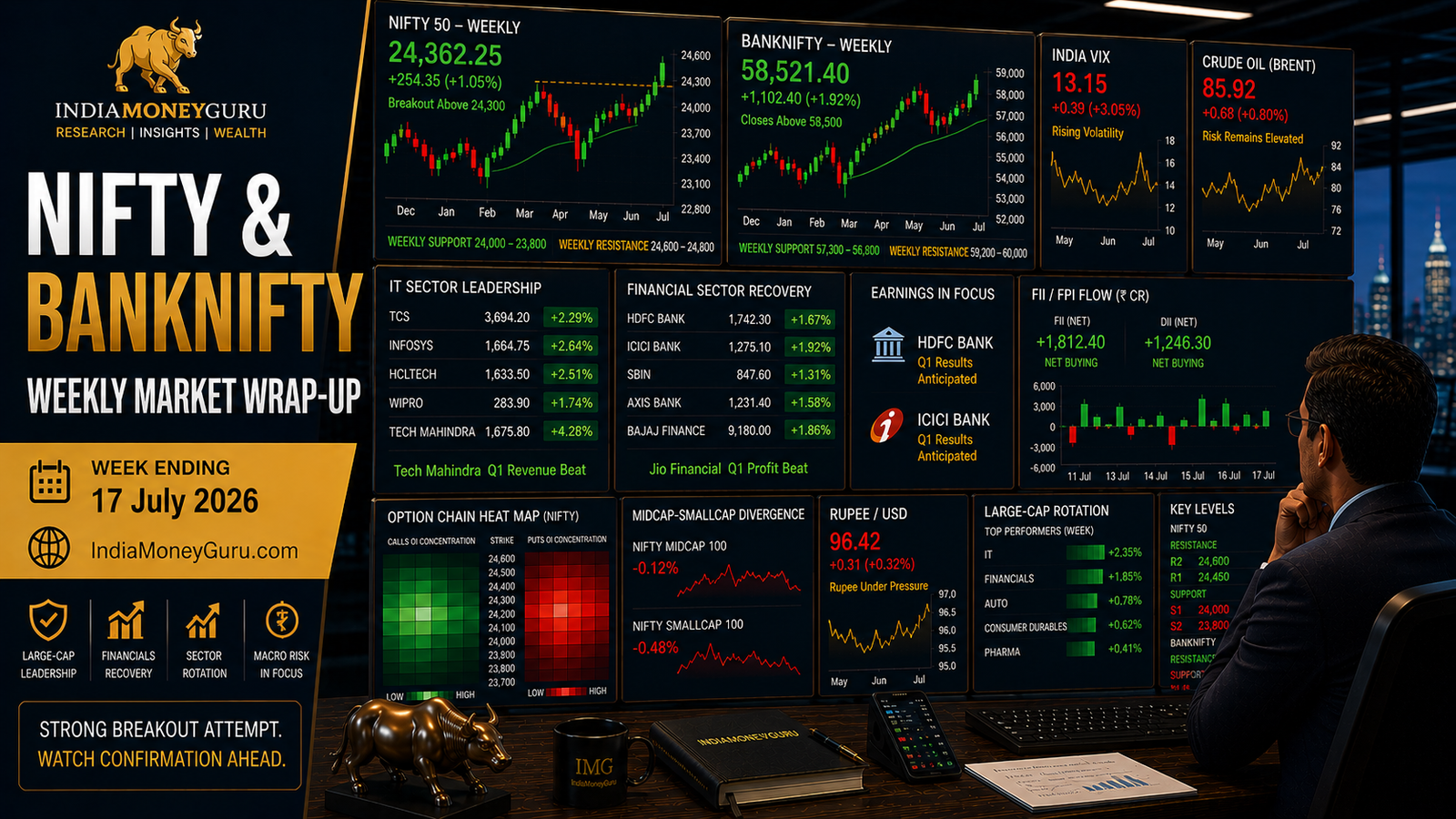
NIFTY BANKNIFTY Weekly Market Wrap-Up 17 July 2026: Indian equity markets ended the week ending 17 July 2026 with a strong large-cap recovery, despite a volatile start dominated by crude oil, rupee weakness and Middle East tensions. The week began with NIFTY defending the 24,000 zone, moved through a crude-led risk-off phase, stabilised through financial-sector support, consolidated on Thursday, and finally broke higher on Friday as IT and banking stocks led the market.
The headline move came on Friday. The NIFTY 50 closed at 24,334.30, up 1.09%, while the Sensex closed at 78,151.45, up 1.25%. The rally helped Indian benchmarks swing to weekly gains despite trading in one of their tightest ranges of the year.
BANKNIFTY delivered the most important confirmation of the week. The Nifty Bank index closed at 58,521.40, up 939.15 points or 1.63% on Friday, after a strong recovery in private banks and financial stocks. This was a major shift from Thursday, when financials were the weak link and NIFTY depended mainly on IT to hold support.
IT and financials led the index recovery. Nifty IT gained strongly on Friday and delivered a powerful weekly performance, helped by TCS, HCLTech and Tech Mahindra. TCS gained sharply during the week, while Tech Mahindra’s revenue beat improved sentiment toward the IT pack.
However, the rally was not fully broad-based. Mid-caps and small-caps lagged on the week. NIFTY traded in a narrow weekly band of roughly 24,000 to 24,368, showing that the market was still controlled by selective large-cap buying rather than broad participation.
The macro backdrop remained challenging. Brent crude moved near the $86–87 zone during the week due to renewed U.S.-Iran tensions, while the rupee weakened and remained near multi-week lows. India VIX ended at 13.15, rising even on Friday’s strong rally, which shows that traders are still pricing event risk.
IndiaMoneyGuru Weekly View:
The week ending 17 July 2026 shifted the market from supporting defence to a breakout attempt. NIFTY has reclaimed 24,300 and BANKNIFTY has crossed 58,500, but the next leg depends on whether large-cap strength broadens beyond IT and financials.
Table of Contents
Weekly Market Snapshot
| Indicator | Weekly Reading | Interpretation |
|---|---|---|
| NIFTY 50 Weekly Close | 24,334.30 | Breakout above recent consolidation |
| BANKNIFTY Weekly Close | 58,521.40 | Strong financial-sector confirmation |
| Sensex Weekly Close | 78,151.45 | Strong Friday rally lifted weekly tone |
| India VIX | 13.15 | Volatility rose despite rally |
| NIFTY Weekly Range | 24,000–24,368 | Tight weekly range despite Friday breakout |
| Key Leadership | IT + Financials | Large-cap-led recovery |
| Broader Market | Weak / Divergent | Mid-caps and small-caps lagged |
| Macro Risk | Elevated | Crude and rupee pressure persisted |
Week at a Glance
| Date | Market Tone | Key Message |
|---|---|---|
| 13 July 2026 | IT-led support defence | NIFTY recovered from intraday weakness as IT stocks cushioned the index |
| 14 July 2026 | Crude-led risk-off | Oil spike and rupee weakness pressured NIFTY, BANKNIFTY and autos |
| 15 July 2026 | Finance-led stabilization | BANKNIFTY and financials helped NIFTY stay above 24,000 |
| 16 July 2026 | Regular Thursday consolidation | IT offset financial weakness; NIFTY held 24,050 |
| 17 July 2026 | Large-cap breakout attempt | NIFTY crossed 24,300; BANKNIFTY surged above 58,500 |
What Happened This Week?
The week began with volatility. On Monday, 13 July, Indian benchmarks recovered from a near-1% intraday fall as IT stocks surged and helped offset renewed Middle East concerns. The recovery showed that buyers were still willing to defend the NIFTY 24,000 zone, but the rally was narrow and heavily dependent on IT.
Tuesday, 14 July, was the weakest macro session of the week. Brent crude moved sharply higher, the rupee weakened past 96 per dollar, and Indian equities came under pressure. This was not just normal profit booking. It was a macro-risk session where crude, currency and inflation concerns affected sentiment together.
Wednesday, 15 July, brought stabilisation. Financials and BANKNIFTY helped repair sentiment after Tuesday’s crude-led pressure. NIFTY closed slightly higher at 24,078.50, while Nifty Bank gained nearly 1%, supported by HDFC Bank, SBI and IndusInd Bank. However, crude and rupee pressure capped the upside.
Thursday, 16 July, was a regular consolidation session, not an expiry-day session. NSE weekly expiry now happens on Tuesday, and monthly expiry happens on the last Tuesday of the expiry month unless Tuesday is a trading holiday. The NIFTY closed almost flat at 24,072.75, while IT gains offset financial weakness. India VIX cooled to 12.88, and option-chain support remained visible around the 24,000 zone.
Friday, 17 July, changed the weekly structure. NIFTY jumped 1.09% to 24,334.30, and Sensex gained 1.25%. IT and financial stocks led the rally after positive earnings-related triggers from Tech Mahindra and Jio Financial. BANKNIFTY surged to 58,521.40, confirming financial-sector strength and giving the market its strongest signal of the week.
IndiaMoneyGuru Weekly Insight
The most important insight from the week is the following:
This was not a broad-market breakout. It was a large-cap leadership breakout.
That distinction is critical.
NIFTY broke above its recent consolidation zone. BANKNIFTY regained leadership. IT stocks delivered strong weekly gains. Financials recovered sharply on Friday. But midcaps and smallcaps did not confirm the same strength.
This tells us that institutional money is becoming selective. Instead of chasing the entire market, money moved toward liquid, large-cap names with better earnings visibility: TCS, HCLTech, Tech Mahindra, HDFC Bank, ICICI Bank, Jio Financial and Reliance.
For IndiaMoneyGuru readers, the framework is simple:
- NIFTY above 24,300 is positive.
- BANKNIFTY above 58,500 confirms financial strength.
- IT leadership has improved the index structure.
- Broader-market divergence remains a warning.
- Crude and rupee risk can still disturb sentiment.
- Next week’s earnings reaction will decide whether the breakout sustains.
The market has improved, but traders should not confuse large-cap strength with universal bullishness.
NIFTY Weekly Technical Analysis
NIFTY started the week near the 24,000 support zone and ended above 24,300. This is a meaningful technical improvement.
For most of the week, the index was trapped between support near 24,000 and resistance near 24,250–24,300. Thursday’s close at 24,072.75 showed that support was intact but leadership was missing. Friday’s rally solved that problem by bringing both IT and financials into the move.
The move above 24,300 indicates that NIFTY has broken out of its short-term consolidation zone. The index now needs to hold above 24,200 for the breakout to remain valid.
If NIFTY sustains above 24,200, the next upside zones are 24,500, 24,650 and 24,800. If the index slips below 24,200 quickly, the breakout may weaken and the market may again return to the 24,000 support zone.
The weekly structure has shifted from neutral to positive, but the breakout still needs follow-through.
BANKNIFTY Weekly Technical Analysis
BANKNIFTY was the key confirmation index this week.
Early in the week, banking participation was uneven. Tuesday’s crude-led pressure hurt banks and financials. Wednesday brought a recovery, but Thursday again saw financial-stock weakness. Friday changed the picture sharply as Nifty Bank surged 939.15 points to close at 58,521.40.
This move is important because BANKNIFTY had been the missing confirmation for NIFTY’s previous recovery attempts. A NIFTY rally without BANKNIFTY is usually fragile. A NIFTY rally with BANKNIFTY leadership is more credible.
The 58,500 zone is now the key weekly reference. If BANKNIFTY sustains above 58,500 next week, the index can attempt 58,700, 59,000 and 59,300. If it fails to hold above 58,200–58,500, the rally may return to consolidation.
For the next week, BANKNIFTY leadership depends heavily on earnings reactions from HDFC Bank, ICICI Bank, Axis Bank and Kotak Mahindra Bank. Private-bank participation will decide whether BANKNIFTY becomes a durable leader or only a one-day recovery trade.
Option Chain Intelligence
The weekly option-chain message evolved meaningfully.
At the start of the week, the key NIFTY level was 24,000. This level acted as the primary support zone through Monday, Tuesday, Wednesday and Thursday. The market repeatedly defended this area, confirming that Put writers and support buyers were active near 24,000.
By Friday, NIFTY closed above 24,300. This shifts the immediate support reference higher. For the next week, 24,200 becomes the first important support, while 24,000 remains the strong base.
On the upside, 24,500 is the next resistance. If NIFTY crosses 24,500 with BANKNIFTY participation, the index can move toward 24,650 and 24,800.
For BANKNIFTY, 58,500 is now the decisive zone. A sustained move above 58,500 can encourage Put writing around 58,000–58,500. But a quick fall below 58,200 would weaken the structure.
Following is the weekly derivatives’ message:
Support has shifted higher, but breakout confirmation still depends on follow-through.
Institutional Activity
Institutional behaviour this week looked selective rather than broad-based.
The headline indices finished the week positively because large-cap buying was strong enough to lift NIFTY, Sensex and BANKNIFTY. However, broader markets did not show the same strength. This suggests that institutions were not aggressively buying across the full market.
The likely institutional preference was toward large caps with better visibility and stronger liquidity. That explains the strong moves in IT, private banks, financials and index heavyweights.
This was also visible in the divergence between benchmark indices and broader-market segments. NIFTY and BANKNIFTY improved sharply by Friday, while midcaps and smallcaps stayed weak on a weekly basis.
The rupee remained an important institutional risk. A weak rupee can make foreign investors more cautious because equity returns may be affected by currency depreciation. Crude oil near the mid-$80 zone added another layer of macro risk.
The institutional message is therefore mixed:
- Large-cap buying improved.
- IT and financials attracted strong flows.
- Midcaps and smallcaps saw relative weakness.
- Rupee and crude risks kept foreign-flow sensitivity alive.
Sector Rotation
| Sector / Theme | Weekly Behaviour | Interpretation |
|---|---|---|
| IT | Strong | TCS, HCLTech and Tech Mahindra supported the index |
| BANKNIFTY / Banks | Strong by Friday | Private banks confirmed the breakout attempt |
| Financial Services | Strong on Friday | Jio Financial and large lenders lifted sentiment |
| Reliance / Large-cap Energy | Positive | Reliance gained ahead of the results. |
| Midcaps | Weak / Divergent | Did not confirm index-level strength |
| Small caps | Weak / Divergent | Risk appetite remained selective |
| Autos | Pressure early week | Crude and inflation concerns weighed |
| Realty | Weak in parts | Rate and risk sensitivity persisted |
| Consumer Durables | Selective strength | Stock-specific buying visible |
The most important rotation was from broad uncertainty to large-cap leadership. This is a healthier setup than narrow IT-only support, but still not a complete risk-on market.
Winners and Losers of the Week
Key Winners
| Stock / Segment | Reason |
|---|---|
| TCS | Strong weekly gain after revenue growth and IT re-rating |
| Tech Mahindra | Revenue beat triggered strong buying |
| HCLTech | IT-sector earnings support |
| Jio Financial | Profit beat supported financial-sector sentiment |
| HDFC Bank | Buying ahead of Q1 earnings |
| ICICI Bank | Buying ahead of Q1 earnings |
| BANKNIFTY | Friday’s strong financial-sector recovery |
Key Laggards
| Segment | Reason |
|---|---|
| Midcaps | Weekly weakness despite headline-index recovery |
| Small caps | Risk appetite did not broaden |
| Autos | Crude and inflation worries pressured sentiment |
| Financials on Thursday | Insurance earnings and margin pressure hurt sentiment |
| Rupee-sensitive importers | Currency weakness remained a concern |
Market Breadth Analysis
Market breadth was the biggest weakness of the week.
Friday’s rally looked strong at the index level, but broader markets did not fully confirm. Midcaps and smallcaps remained weak on a weekly basis even as NIFTY and BANKNIFTY improved. This divergence is important because sustainable rallies usually need broader participation.
If only large caps move, the index can rise, but stock-level participation remains uneven. That kind of market rewards selective stock picking and punishes blind broad-market buying.
For next week, traders should watch whether midcaps and smallcaps recover. If broader markets join, the breakout becomes stronger. If they continue to lag, the rally remains selective, and stock-picking becomes more important than index-level bullishness.
India VIX Analysis
India VIX ended the week at 13.15, rising on Friday despite the strong market rally.
This is a critical signal. A rising VIX during a rally means traders are still pricing risk. The market may be bullish in price but not complacent in volatility.
The reasons are clear:
- Heavyweight earnings are still active.
- Reliance results reaction is pending.
- HDFC Bank and ICICI Bank earnings reactions matter.
- Crude oil remains elevated.
- Rupee weakness continues.
- U.S.-Iran tensions remain active.
- Broader markets have not confirmed the rally.
For option sellers, this means premiums may remain active but risk must be controlled. Hedged structures are safer than aggressive naked selling.
For directional traders, rising VIX means follow-through can be sharp, but reversals can also be fast.
Weekly Trading Lessons
This week offers five important lessons.
First, support defence can create the foundation for a breakout. NIFTY defended 24,000 repeatedly before finally moving above 24,300.
Second, BANKNIFTY confirmation matters. NIFTY’s earlier attempts were fragile when financials were weak. Friday’s rally became credible because BANKNIFTY surged.
Third, IT can cushion the market, but banks must confirm the next leg. IT supported Monday and Thursday, but Friday’s breakout needed financial-sector participation.
Fourth, broader-market divergence must not be ignored. Index strength does not automatically mean all stocks are strong.
Fifth, macro risk can return quickly. Crude and rupee pressure remained active throughout the week.
Outlook for Next Week
The next week begins with a constructive but selective setup.
The market has improved technically because NIFTY closed above 24,300 and BANKNIFTY closed above 58,500. But the breakout must be sustained. The first trading session of next week will be important because it will show whether institutions add fresh positions after the Friday rally or book profits near higher levels.
Bullish Scenario
The bullish scenario becomes active if NIFTY holds above 24,200 and BANKNIFTY holds above 58,200–58,500. In this case, NIFTY can move toward 24,500, 24,650 and 24,800, while BANKNIFTY can attempt 58,700, 59,000 and 59,300.
This scenario needs earnings support from Reliance, HDFC Bank, ICICI Bank and other large-cap financials.
Neutral Scenario
The neutral scenario plays out if NIFTY trades between 24,200 and 24,500 while BANKNIFTY remains between 58,200 and 59,000. This would mean the market is digesting Friday’s rally.
In this scenario, option sellers may prefer range-based hedged strategies.
Bearish Scenario
The bearish scenario begins if NIFTY falls below 24,200 and BANKNIFTY falls below 58,200. That would weaken the breakout attempt and bring 24,000 back into focus.
This scenario can be triggered by poor earnings reaction, crude oil spikes, rupee weakness or renewed global risk-off sentiment.
Support and Resistance for Next Week
| Index | S1 | S2 | S3 | R1 | R2 | R3 |
|---|---|---|---|---|---|---|
| NIFTY | 24,200 | 24,000 | 23,800 | 24,500 | 24,650 | 24,800 |
| BANKNIFTY | 58,200 | 57,800 | 57,500 | 58,700 | 59,000 | 59,300 |
Key Risks for Next Week
Key risks for next week include the following:
- NIFTY failing to hold 24,200
- BANKNIFTY slipping below 58,200
- Reliance earnings reaction
- HDFC Bank and ICICI Bank earnings reaction
- Crude oil staying near or above $86–87
- Rupee weakness continuing
- India VIX rising above 13.5
- Midcap and smallcap underperformance
- U.S.-Iran escalation
- False breakout after Friday’s rally
The biggest risk is a failed breakout. If NIFTY falls back below 24,200 quickly, traders may treat Friday’s move as a one-day earnings-led rally rather than a sustainable trend shift.
FAQs
What was the NIFTY closing level for the week ending 17 July 2026?
NIFTY 50 closed the week at 24,334.30.
What was the BANKNIFTY closing level for the week ending 17 July 2026?
BANKNIFTY closed at 58,521.40, gaining 939.15 points on Friday.
What drove the market this week?
IT and financial stocks drove the weekly recovery, especially on Friday. Tech Mahindra, TCS, HCLTech, Jio Financial, HDFC Bank and ICICI Bank supported sentiment.
Did NIFTY break out this week?
Yes. NIFTY broke above the 24,250–24,300 resistance area and ended the week at 24,334.30.
Is the market rally broad-based?
No. The rally was large-cap led. Midcaps and smallcaps remained weak on a weekly basis.
What is the key NIFTY support for next week?
The immediate support is 24,200, followed by 24,000 and 23,800.
What is the key BANKNIFTY support for next week?
The immediate support is 58,200, followed by 57,800 and 57,500.
What should traders watch next week?
Traders should watch earnings reactions from Reliance, HDFC Bank, ICICI Bank and other financial heavyweights, along with crude oil, rupee movement and India VIX.
Editorial Conclusion
The week ending 17 July 2026 was a turning-point week for Indian markets. NIFTY defended 24,000 repeatedly, absorbed crude and rupee pressure, consolidated through Thursday, and finally broke above 24,300 on Friday. BANKNIFTY confirmed the move by closing above 58,500.
The improvement is real, but selective. IT and financials are leading. Large caps are attracting money. But midcaps and smallcaps have not confirmed the rally, and India VIX remains elevated.
IndiaMoneyGuru Weekly View:
The market has shifted from consolidation to a breakout attempt. NIFTY must now hold 24,200, and BANKNIFTY must sustain above 58,200–58,500. If both conditions hold, the next week can open the door toward NIFTY 24,500–24,800 and BANKNIFTY 59,000–59,300. If not, the market may return to range-bound trading.
Disclaimer
The information provided in this article is for educational purposes only and should not be considered investment advice. Trading and investing in financial markets involve risk. Always conduct your own research and consult a SEBI-registered investment adviser before making any investment decisions.