
Executive Summary
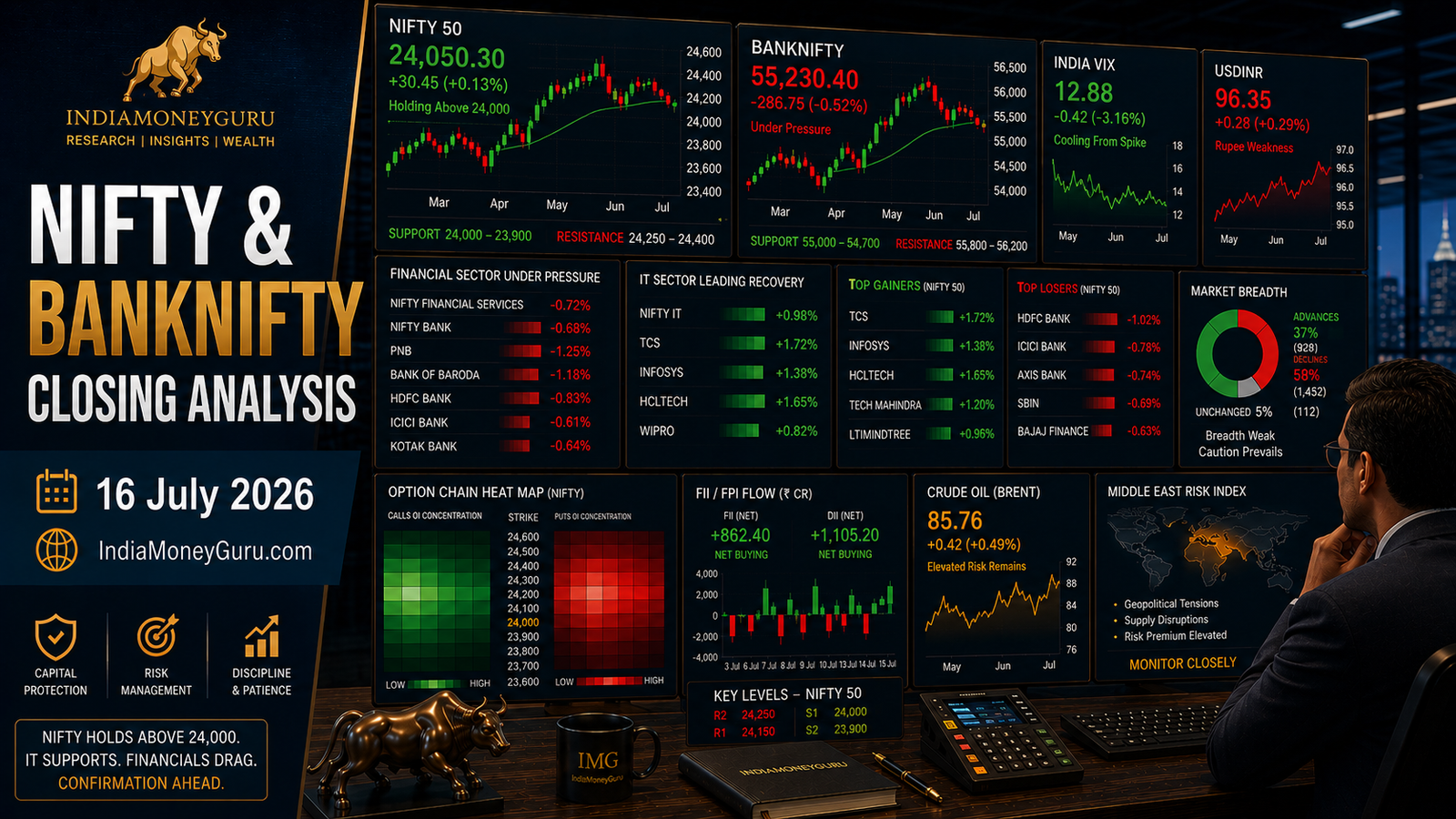
NIFTY & BANKNIFTY Closing Analysis – 16 July 2026: Indian equity markets ended today almost unchanged as IT-sector strength balanced weakness in financial stocks. The NIFTY 50 slipped 0.02% to 24,072.75, while the Sensex closed nearly flat at 77,186.87. The session reflected a market waiting for stronger triggers, with investors cautious because of continuing U.S.-Iran tensions and the ongoing Q1 earnings season.
The key positive was that NIFTY continued to hold above the 24,050–24,000 support band. This shows that sellers are not yet in full control, despite repeated macro pressure from crude oil, rupee weakness, and geopolitical uncertainty. However, the index also failed to reclaim the 24,200–24,300 resistance zone, confirming that the market remains range-bound.
BANKNIFTY and financial stocks were the weak link of the day. Reuters reported that heavyweight financials fell around 0.5%, while Economic Times noted that Nifty Financial Services and Realty declined nearly 1%. ICICI Lombard fell sharply after weak earnings and persistent margin-pressure concerns, while ICICI Prudential Life also declined.
IT stocks provided the cushion. The Nifty IT index gained around 0.7% after two days of decline, supported by Wipro and Tech Mahindra ahead of their results. However, analysts still highlighted demand slowdown concerns across the IT sector, so this was more of a stabilizing move than a broad sector breakout.
India VIX cooled nearly 3% to 12.88, which gave some comfort to option sellers. But the rupee weakened to 96.3450 per dollar, close to its weakest level in nearly two months, showing that currency pressure remains a key macro risk.
The session’s message is clear: NIFTY is holding support, but BANKNIFTY and financials must recover for the next meaningful upside move.
Table of Contents
Market Intelligence Scorecard
| Indicator | Status | Interpretation |
|---|---|---|
| NIFTY Trend | 🟡 Range-Bound | Held 24,050 but failed to reclaim resistance |
| BANKNIFTY Trend | 🔴 Weak | Financial stocks dragged sentiment |
| India VIX | 🟢 Cooling | Fell to 12.88, reducing immediate panic |
| IT Sector | 🟢 Supportive | IT gained 0.7% after two weak sessions |
| Financials | 🔴 Weak | Insurance and financial services sold off |
| Rupee | 🔴 Weak | Closed near 96.3450/USD |
| Broader Markets | 🟠 Weak | Midcaps and smallcaps declined |
| Overall Bias | Neutral-Cautious | Support held, but leadership is missing |
Previous Session vs Today
| Parameter | 15 July 2026 | 16 July 2026 | Interpretation |
|---|---|---|---|
| NIFTY 50 | 24,078.50 | 24,072.75 | Almost unchanged; consolidation |
| BANKNIFTY / Financials | Led recovery | Financials declined | Leadership faded |
| India VIX | Volatility-sensitive | 12.88 | Fear cooled modestly |
| Rupee | 96.2550/USD | 96.3450/USD | Currency weakened further |
| Sector Leader | Banks / Financials | IT | Leadership rotated |
| Market Tone | Financial-led recovery | Normal consolidation | Rally lacked follow-through |
Market Snapshot
| Index / Indicator | Closing / Reading | Market Message |
|---|---|---|
| NIFTY 50 | 24,072.75 | Down 0.02%; held above 24,050 |
| Sensex | 77,186.87 | Nearly flat |
| BANKNIFTY / Financials | Weak | Financials dragged market sentiment |
| India VIX | 12.88 | Down nearly 3%, volatility cooled |
| Nifty IT | Up around 0.7% | IT-cushioned index |
| Nifty Midcap 100 | Down around 0.4% | Broader market softened |
| Nifty Smallcap 100 | Down around 0.1% | Risk appetite remained selective |
| Rupee | 96.3450/USD | Near weakest level in almost two months |
Market Overview
Thursday’s market was a consolidation session. The NIFTY 50 closed nearly unchanged at 24,072.75, holding above 24,050 but failing to show decisive strength. Reuters reported that gains in IT stocks offset weakness in financials, while Middle East uncertainty kept investors from taking aggressive positions.
The market had reasons to stay cautious. The Iran-U.S. conflict remained unresolved, crude oil risk was still present, and the rupee weakened further despite Brent crude dipping below $85 per barrel. Reuters reported that the rupee closed at 96.3450 per dollar, down 0.1% and close to its weakest level in nearly two months. A weak rupee can make foreign investors more selective and can increase imported inflation concerns.
Sector action was mixed. Nine of sixteen major sectors gained, but broader-market participation was weak. Midcaps and smallcaps slipped, showing that traders were not broadly increasing risk. The narrow nature of the market was also visible in the contrast between IT gains and financial-stock weakness.
IT stocks recovered after two weak sessions, but the recovery came with a warning. Wipro and Tech Mahindra gained ahead of results, while TCS and HCLTech had already beaten revenue estimates. However, analysts cited by Reuters continued to highlight a demand slowdown and lack of visible revival in client spending.
Financials were the drag. ICICI Lombard fell sharply after earnings concerns, while ICICI Prudential Life also declined. Economic Times reported that Nifty Financial Services and Realty were among the leading sectoral losers. This weakened the confirmation from Wednesday’s BANKNIFTY-led recovery.
IndiaMoneyGuru Unique Insight
The most important insight from today’s session is the following:
NIFTY is surviving because support is strong, not because leadership is strong.
This distinction matters.
A healthy rally usually needs three things: index support, sector leadership, and broad participation. Today, the market had only the first condition. NIFTY held the 24,050–24,000 zone, but leadership was fragmented. IT helped the index; financials dragged, and broader markets slipped.
This means the market is not breaking down, but it is also not ready for a clean breakout.
For IndiaMoneyGuru readers, the practical interpretation is:
- NIFTY holding 24,000 is constructive.
- BANKNIFTY weakness is a warning.
- IT support is useful but not enough.
- Broader-market weakness shows risk appetite is selective.
- Rupee weakness keeps macro pressure alive.
Today was not a bearish collapse. It was a leadership vacuum. Until BANKNIFTY and financials recover, NIFTY may continue moving sideways between support and resistance.
NIFTY Analysis
NIFTY closed at 24,072.75, almost unchanged from the previous session. The positive point is that the index again held above the 24,000 support area. This confirms that the market is not willing to break down easily despite geopolitical uncertainty and rupee pressure.
However, NIFTY’s inability to move above the 24,200–24,300 zone remains a concern. Reuters cited Axis Securities as saying that a decisive breakout above 24,500 is needed for bulls to regain control, while strong support exists near 23,800. Economic Times also cited technical analysts pointing to support in the 23,950–24,000 range and immediate resistance near 24,250–24,300.
This means NIFTY is currently trapped in a consolidation band. The lower end of the band is protected by Put writing and support buying. The upper end is capped by weak leadership and lack of aggressive risk appetite.
For traders, the strategy remains buy near support and reduce exposure near resistance until a decisive breakout or breakdown occurs.
BANKNIFTY Analysis
BANKNIFTY did not confirm Wednesday’s finance-led recovery. Financial services weakened, insurance stocks sold off, and heavyweight financials dragged the market. Reuters reported that heavyweight financials declined around 0.5%, while ICICI Lombard plunged after earnings concerns and ICICI Prudential Life also fell.
This matters because BANKNIFTY is essential for a durable NIFTY recovery. On 15 July, BANKNIFTY had repaired sentiment. On 16 July, that leadership faded. This tells us that the market is not yet getting consistent support from financials.
Banking stocks also remain sensitive to earnings expectations, foreign flows, rupee movement, and bond-yield pressure. With the rupee near its weakest level in nearly two months, foreign institutional behaviour can become more selective. That can affect large private banks and financial services stocks.
For BANKNIFTY to regain leadership, heavyweight banks such as HDFC Bank, ICICI Bank, Axis Bank, SBI, Kotak Mahindra Bank, and IndusInd Bank must show broader participation. Until then, BANKNIFTY remains a caution signal rather than a leadership signal.
Option Chain Intelligence
The option-chain message remains range-bound.
Economic Times reported that option-chain data showed the highest Put writing at the 24,000 strike, reinforcing 24,000 as a key support level. This matches the price action, where NIFTY continued to hold above the 24,050–24,000 band.
However, resistance remains visible near 24,250–24,300, with a broader hurdle near 24,500. Unless NIFTY clears this resistance zone, Call writers may continue to control the upside.
For NIFTY option sellers, this creates a range-trading environment. But because the market remains exposed to geopolitical and currency risks, aggressive naked selling should still be avoided.
For BANKNIFTY, weak financials reduce confidence. Option sellers should wait for clearer banking participation before assuming that Put writers have full control.
The derivative’s message is ‘Support is visible, but upside conviction is missing.’
Institutional Activity
Institutional sentiment remains mixed but not negative. Reuters reported that HSBC upgraded Indian equities to “neutral” from “underweight“, citing softer crude prices and rupee-stabilising measures that have revived foreign inflows. This is a positive medium-term signal because it suggests that global investors may be gradually reassessing Indian equities.
However, the rupee remains a near-term concern. Reuters reported that the rupee closed at 96.3450 per dollar, close to its weakest level in nearly two months. The currency did not benefit much from firmer Asian currencies or the dip in oil, because dollar demand from maturing non-deliverable forward contracts and merchant demand kept pressure on the rupee.
This creates a two-sided institutional picture. On one side, foreign inflow conditions have improved compared with earlier periods. On the other side, rupee weakness and Middle East uncertainty can keep foreign investors selective.
For BANKNIFTY, this matters because financial stocks are heavily influenced by institutional flows. Continued rupee weakness can make financial leadership harder to sustain.
India VIX Analysis
India VIX cooled nearly 3% to 12.88. This is a constructive signal because it shows that traders did not increase panic hedging despite the flat market and geopolitical uncertainty.
A cooling VIX helps option sellers and reduces the probability of sudden extreme intraday moves. However, VIX cooling alone is not enough to create a bullish market. Price and leadership must also confirm.
Today, NIFTY held support, but BANKNIFTY weakened and broader markets slipped. That means lower VIX should be treated as support for range trading, not as a signal for aggressive directional bullishness.
For option sellers, the environment is better than during the earlier crude-led volatility spike, but defined-risk strategies are still preferable because macro headlines can change quickly.
Sector Rotation
| Sector | Trend | Interpretation |
|---|---|---|
| IT | Positive | Gained around 0.7%; cushioned NIFTY |
| Financial Services | Weak | Dragged by insurance and financial stocks |
| BANKNIFTY / Banks | Weak to Mixed | Leadership faded after Wednesday’s rebound |
| Realty | Weak | Declined nearly 1% |
| Consumer Durables | Strong | Gained around 1.5% |
| Midcaps | Weak | Down around 0.4%; risk appetite selective |
| Small caps | Mild Weak | Down around 0.1%; no broad momentum |
| Export / Manufacturing Themes | Selective | Dixon Technologies gained after policy support |
Today’s sector rotation was mixed. IT helped; consumer durables stood out, but financials and realty weakened. This is not a broad risk-on setup. It is a selective, earnings-driven market.
Support and Resistance
| Index | S1 | S2 | S3 | R1 | R2 | R3 |
|---|---|---|---|---|---|---|
| NIFTY | 24,000 | 23,950 | 23,800 | 24,250 | 24,300 | 24,500 |
| BANKNIFTY | 57,500 | 57,000 | 56,500 | 58,500 | 59,000 | 59,500 |
Trading Plan for Next Session
The next session should be approached as a range-confirmation day.
For bullish traders, NIFTY must continue holding above 24,000 and then move above 24,250–24,300. Without this breakout, the upside may remain capped.
For BANKNIFTY traders, the key is whether financials recover from today’s weakness. If heavyweight banks and financial services stocks regain strength, NIFTY can attempt a stronger move. If financials remain weak, the market may stay sideways.
For option sellers, range strategies may work as long as NIFTY remains between 24,000 and 24,300. However, hedges are necessary because geopolitical headlines, currency movement and earnings reactions can create sudden moves.
For intraday traders, avoid overtrading the middle of the range. Better opportunities may come near support or resistance.
Risk Factors to Watch
Key risks for the next session include:
- NIFTY breaking below 24,000
- BANKNIFTY failing to regain leadership
- Financial services weakness continuing
- Rupee weakening further beyond 96.35/USD
- Middle East conflict escalation
- Crude oil moving back above $85–86
- Weak earnings from IT or financial companies
- Broader markets continuing to underperform
- India VIX reversing higher
The biggest risk is that NIFTY remains supported by only one sector at a time. Without synchronised leadership from BANKNIFTY, IT and broader markets, a sustained rally becomes difficult.
Trading Lessons
Today’s session offers three important trading lessons.
First, support and leadership are different. NIFTY held support, but leadership was not strong.
Second, today’s moves can be misleading. A flat close near support does not confirm bullishness unless the next session provides follow-through.
Third, financial weakness matters. BANKNIFTY and financial services must participate for a durable NIFTY move.
Key Takeaways
For equity investors, the market remains selective and earnings-driven. Avoid broad assumptions and focus on quality names with clear earnings visibility.
For swing traders, fresh longs should wait for NIFTY to clear 24,300 or retest support with strong breadth.
For option sellers, NIFTY 24,000 remains the key support reference, but hedged structures are preferable.
For BANKNIFTY traders, the next session must confirm whether today’s financial weakness is temporary or the start of renewed underperformance.
Editorial Conclusion
Indian markets ended almost flat on 16 July 2026 as IT-sector gains offset financial-stock weakness. NIFTY closed at 24,072.75, holding above 24,050, while India VIX cooled to 12.88. However, financial services weakened, broader markets slipped, and the rupee remained under pressure near its weakest level in nearly two months.
The market is not weak enough to break down but not strong enough to break out. NIFTY continues to respect the 24,000 support zone, but BANKNIFTY and financials must recover for a stronger upside move.
IndiaMoneyGuru View:
This is a range-bound, leadership-sensitive market. NIFTY support is intact, but BANKNIFTY confirmation is missing. Traders should stay selective, respect 24,000 support, and avoid aggressive bullish positions until NIFTY clears 24,300 with financial sector participation.
FAQs
What was the NIFTY closing level on 16 July 2026?
NIFTY 50 closed at 24,072.75, down 0.02%.
Did BANKNIFTY support the market today?
No. BANKNIFTY and financial services were weak, which prevented a stronger index recovery.
Why did the market end flat today?
IT stocks supported the market, but weakness in financial stocks and geopolitical uncertainty capped gains.
What happened to India VIX today?
India VIX fell nearly 3% to 12.88, indicating reduced immediate panic.
What is the key NIFTY support now?
The key support is the 24,000 zone, with 23,950 and 23,800 as deeper support levels.
What is the key NIFTY resistance now?
The immediate resistance zone is 24,250–24,300, with 24,500 as a broader hurdle.
Why is rupee weakness important?
A weak rupee can affect foreign flows, import inflation and investor sentiment, especially when crude oil and geopolitical risks are active.
What should option sellers do now?
Option sellers can consider range-based strategies, but hedged and defined-risk positions remain preferable due to earnings and geopolitical risks.
References
Disclaimer
The information provided in this article is for educational purposes only and should not be considered investment advice. Trading and investing in financial markets involve risk. Always conduct your own research and consult a SEBI-registered investment adviser before making any investment decisions.