
Introduction
Open Interest (OI) is one of the most powerful tools available to options traders. However, simply looking at Open Interest numbers is not enough. The real edge comes from understanding how Open Interest changes alongside price movement.
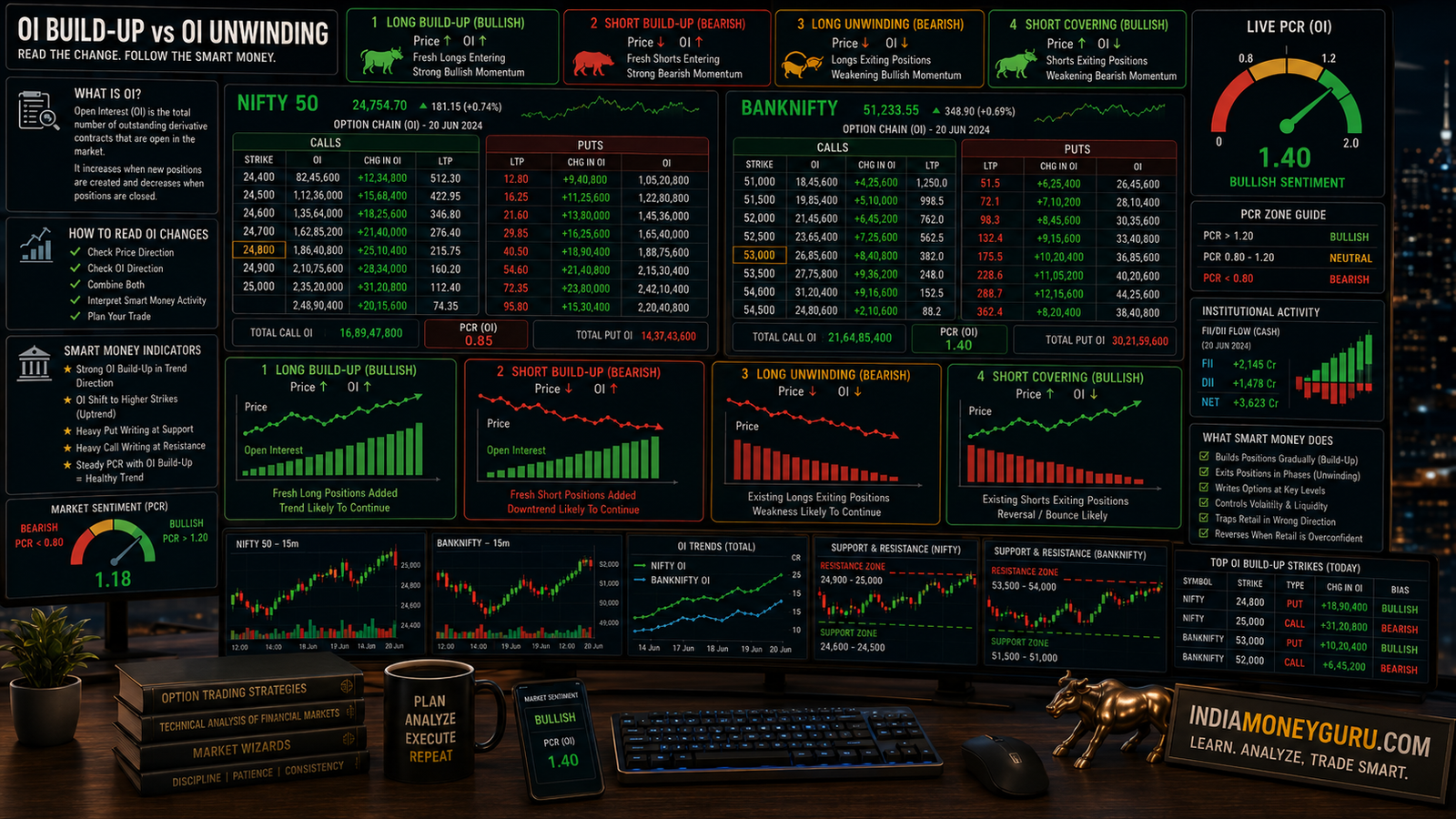
This is where concepts such as Long Build-Up, Short Build-Up, Long Unwinding, and Short Covering become extremely important.
Professional traders use these concepts daily to interpret market sentiment, identify trend strength, and track institutional activity in NIFTY and BANKNIFTY.
In this guide, we will learn how OI Build-Up and OI Unwinding work and how traders use them to understand smart money behavior.
Table of Contents
What Is OI Build-Up?
OI Build-Up occurs when traders add fresh positions to the market, causing Open Interest to increase.
However, an increase in Open Interest alone does not reveal whether traders are bullish or bearish.
To understand the market’s intent, traders compare Open Interest changes with price movement.
This combination provides valuable insight into market positioning.
What Is OI Unwinding?
OI Unwinding occurs when existing positions are closed, causing Open Interest to decrease.
Unwinding can happen when traders:
- Book profits
- Exit losing trades
- Reduce risk before major events
- Adjust institutional positions
Understanding whether unwinding is happening in long positions or short positions helps traders interpret market sentiment more accurately.
The Four Important OI Signals
Every trader should understand these four market conditions.
1. Long Build-Up
Price ↑ + Open Interest ↑
Interpretation:
Fresh bullish positions are entering the market.
This is generally considered a bullish signal.
Example:
NIFTY rises from 25,000 to 25,150 while Open Interest increases significantly.
This suggests traders are adding new long positions and expecting further upside.
2. Short Build-Up
Price ↓ + Open Interest ↑
Interpretation:
Fresh bearish positions are entering the market.
This is generally considered a bearish signal.
Example:
BANKNIFTY falls from 57,000 to 56,700 while Open Interest rises sharply.
This often indicates aggressive short selling.
3. Long Unwinding
Price ↓ + Open Interest ↓
Interpretation:
Existing bullish traders are exiting positions.
This often signals weakening bullish sentiment.
Example:
NIFTY falls while Open Interest also declines.
Rather than new shorts entering, existing longs may simply be closing positions.
4. Short Covering
Price ↑ + Open Interest ↓
Interpretation:
Existing bearish traders are closing positions.
This often leads to sharp rallies.
Short covering rallies can be extremely powerful because short sellers rush to exit losing positions.
Understanding Smart Money Through OI
Institutional traders rarely reveal their intentions directly.
However, their activity often becomes visible through Open Interest behavior.
For example:
Bullish Institutional Activity
- Rising Price
- Rising OI
- Strong Put Writing
This combination often suggests Long Build-Up.
Bearish Institutional Activity
- Falling Price
- Rising OI
- Strong Call Writing
This combination often suggests Short Build-Up.
Risk Reduction by Institutions
Before major events such as:
- RBI Policy
- Union Budget
- Federal Reserve Meetings
- Election Results
Institutions may reduce positions.
This often results in OI Unwinding across multiple strikes.
Long Build-Up vs Short Covering
Many traders confuse these two concepts.
Long Build-Up
Price ↑ + OI ↑
When both goes up, fresh buying enters the market.
Generally stronger and more sustainable.
Short Covering
Price ↑ + OI ↓
When OI drops and price goes up then existing shorts are exiting.
May produce sharp rallies but not always sustainable.
Understanding the difference is crucial for trade planning.
Short Build-Up vs Long Unwinding
These concepts are also frequently misunderstood.
Short Build-Up
Price ↓ + OI ↑
When OI increases but price drops, new bearish positions are being added.
Usually indicates stronger bearish conviction.
Long Unwinding
Price ↓ + OI ↓
When both Price and OI drops the existing bullish positions are being closed.
Indicates weakening bullishness rather than fresh bearishness.
Why OI Analysis Matters in NIFTY and BANKNIFTY
Both NIFTY and BANKNIFTY option chains provide valuable OI information.
Traders use OI analysis to:
- Assess trend strength
- Identify institutional participation
- Understand support and resistance zones
- Track smart money positioning
- Improve trade timing
OI analysis becomes even more powerful when combined with PCR and option chain interpretation.
OI Build-Up in Option Writing
Option writers often create some of the most significant OI changes.
Put Writing
Usually indicates bullish expectations.
Can strengthen support zones.
Call Writing
Usually indicates bearish expectations.
Can strengthen resistance zones.
Monitoring fresh writing activity helps traders understand market sentiment.
Common Mistakes Traders Make
Looking Only at OI Numbers
The change in OI is often more important than the absolute OI value.
Ignoring Price Action
Price movement always provides critical context.
Assuming Every OI Increase Is Bullish
OI can increase because of either Long Build-Up or Short Build-Up.
Price action determines the difference.
Ignoring Market Events
News events can dramatically alter OI structures.
Practical OI Analysis Framework
Before entering any trade:
Step 1
Check overall market trend.
Step 2
Monitor OI changes across key strikes.
Step 3
Compare price movement with OI changes.
Step 4
Identify Long Build-Up, Short Build-Up, Long Unwinding, or Short Covering.
Step 5
Analyze support and resistance zones.
Step 6
Confirm sentiment using PCR.
Step 7
Plan risk-defined trades.
How OI Build-Up Fits Into Option Chain Analysis
Open Interest Build-Up is one of the most important components of option chain analysis.
Combined with:
- Open Interest
- Put Call Ratio
- Volume
- Implied Volatility
- Market Structure
it helps traders develop a more complete understanding of market positioning.
For a broader understanding, read our Complete Guide to Option Chain Analysis in India.
Conclusion
Understanding OI Build-Up and OI Unwinding can significantly improve a trader’s ability to interpret market sentiment and identify smart money activity.
The key is not simply tracking Open Interest numbers but understanding how Open Interest interacts with price movement.
By learning to recognize Long Build-Up, Short Build-Up, Long Unwinding, and Short Covering, traders can make better decisions and avoid many common mistakes that affect retail participants.
Used correctly, OI analysis becomes one of the most powerful tools in NIFTY and BANKNIFTY trading.
Frequently Asked Questions (FAQs)
1. What is OI Build-Up?
OI Build-Up occurs when fresh positions enter the market, causing Open Interest to increase.
2. What is OI Unwinding?
OI Unwinding occurs when existing positions are closed, causing Open Interest to decrease.
3. What is Long Build-Up?
Long Build-Up occurs when both price and Open Interest increase simultaneously.
4. What is Short Build-Up?
Short Build-Up occurs when price falls while Open Interest increases.
5. What is Long Unwinding?
Long Unwinding occurs when price falls and Open Interest decreases.
6. What is Short Covering?
Short Covering occurs when price rises and Open Interest decreases.
7. Which is more bullish: Long Build-Up or Short Covering?
Long Build-Up is generally considered stronger because fresh bullish positions are entering the market.
8. Why do traders track OI changes?
OI changes help identify market participation, trend strength, and institutional positioning.
9. Can OI Build-Up predict market direction?
No. It provides clues about market positioning but should always be combined with price action and risk management.
10. Is OI analysis useful for NIFTY and BANKNIFTY trading?
Yes. OI analysis is widely used by professional traders to interpret market sentiment and option chain behavior.
References
Disclaimer
The information provided in this article is for educational purposes only and should not be considered investment advice. Trading and investing in financial markets involve risk. Always conduct your own research and consult a SEBI-registered investment adviser before making any investment decisions.