
Introduction
Put Call Ratio (PCR) is one of the most widely followed indicators in options trading. Traders use PCR to measure market sentiment, understand option chain positioning, and gauge whether market participants are becoming excessively bullish or bearish.
While PCR is frequently discussed in daily NIFTY and BANKNIFTY analysis, many beginners struggle to understand what it actually means and how it should be interpreted.
In this guide, we will explain Put Call Ratio in simple language, understand how it is calculated, and learn how professional traders use PCR as part of their option chain analysis framework.
Table of Contents
What Is Put Call Ratio (PCR)?
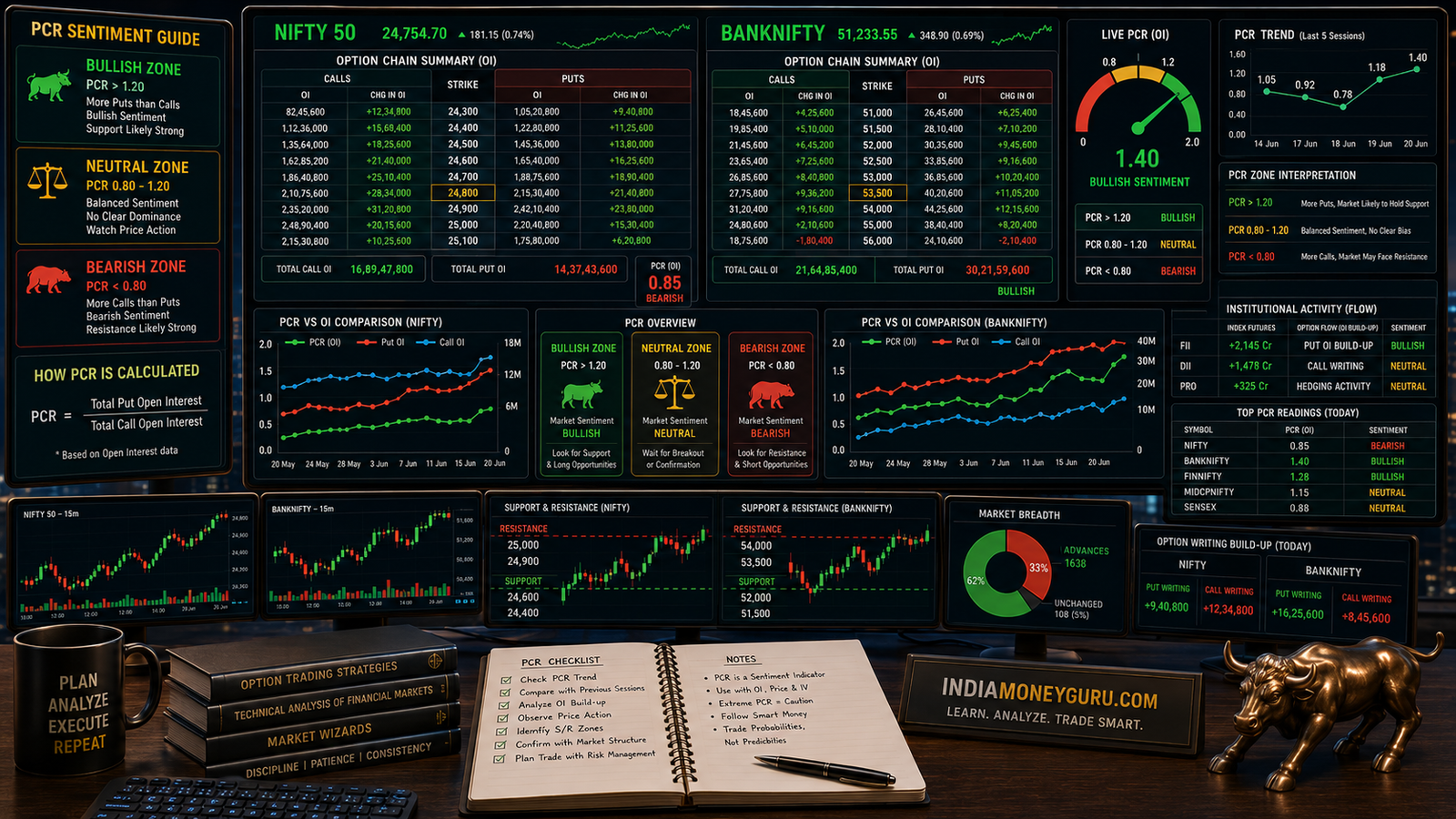
Put Call Ratio, commonly known as PCR, compares the total Put Open Interest with the total Call Open Interest in the options market.
PCR helps traders understand the balance between bearish and bullish option positioning.
A higher PCR generally indicates greater Put activity, while a lower PCR suggests greater Call activity.
PCR is considered a sentiment indicator rather than a directional prediction tool.
How Is PCR Calculated?
The basic formula is:
PCR = Total Put Open Interest ÷ Total Call Open Interest
For example:
- Total Put OI = 12 Crore Contracts
- Total Call OI = 10 Crore Contracts
PCR = 1.20
This means Put Open Interest exceeds Call Open Interest.
Why PCR Matters
PCR provides a quick snapshot of overall market sentiment.
It helps traders:
- Understand market positioning
- Identify extreme bullishness or bearishness
- Detect possible contrarian opportunities
- Validate option chain analysis
- Improve support and resistance interpretation
However, PCR should never be used as a standalone trading signal.
PCR Interpretation
PCR Below 0.8
Generally considered bearish.
This indicates Call Open Interest significantly exceeds Put Open Interest.
Possible Interpretation:
- Traders expect weakness.
- Call writers are active.
- Resistance zones may be stronger.
However, extremely low PCR values can sometimes indicate excessive pessimism and potential short-covering rallies.
PCR Between 0.8 and 1.2
Generally considered neutral.
This range often reflects balanced market sentiment.
Neither bulls nor bears have a strong advantage.
Price action becomes more important than sentiment readings in this zone.
PCR Above 1.2
Generally considered bullish.
Put Open Interest exceeds Call Open Interest.
Possible Interpretation:
- Traders expect support to hold.
- Put writers are active.
- Bullish sentiment is increasing.
However, excessively high PCR values can sometimes signal overconfidence and potential reversals.
Understanding PCR Through Market Sentiment
PCR works best as a sentiment indicator.
Think of it as a market mood meter.
Low PCR
Fear
Pessimism
Bearish positioning
High PCR
Confidence
Optimism
Bullish positioning
Neutral PCR
Balanced expectations
No clear directional bias
PCR in NIFTY Trading
NIFTY traders frequently monitor PCR to assess broader market sentiment.
Examples:
Rising PCR + Rising Market
Usually indicates strengthening bullish sentiment.
Falling PCR + Falling Market
Usually indicates strengthening bearish sentiment.
Rising PCR + Falling Market
Requires caution.
Could indicate hedging activity rather than bullish conviction.
Falling PCR + Rising Market
May indicate short covering or changing market dynamics.
PCR in BANKNIFTY Trading
BANKNIFTY is more volatile than NIFTY.
As a result:
- PCR changes faster.
- Sentiment shifts occur more frequently.
- Extreme PCR readings are more common.
BANKNIFTY traders should focus on PCR trends rather than isolated PCR values.
PCR and Open Interest
PCR becomes more powerful when combined with Open Interest analysis.
For example:
Bullish Scenario
- PCR Rising
- Put OI Increasing
- Market Rising
This often indicates strengthening bullish sentiment.
Bearish Scenario
- PCR Falling
- Call OI Increasing
- Market Falling
This often indicates strengthening bearish sentiment.
PCR and Support-Resistance Analysis
PCR can complement support and resistance identification.
Example:
If major Put writing occurs near a support level and PCR rises simultaneously, support may become more reliable.
Similarly, heavy Call writing combined with falling PCR may strengthen resistance zones.
PCR should be used as a supporting confirmation tool rather than the primary decision-making factor.
Common PCR Mistakes
Treating PCR as a Buy or Sell Signal
PCR measures sentiment, not certainty.
Ignoring Price Action
Price remains the most important market variable.
Ignoring OI Changes
PCR without OI analysis provides incomplete information.
Using PCR Alone
PCR should be combined with:
- Open Interest
- Price Action
- Implied Volatility
- Market Structure
What Professional Traders Look For
Professional traders rarely focus on a single PCR value.
Instead, they monitor:
- PCR Trend
- PCR Changes
- OI Migration
- Support and Resistance Shifts
- Institutional Positioning
The direction of PCR often matters more than the absolute value.
Practical PCR Analysis Framework
Step 1
Check current PCR.
Step 2
Compare with previous sessions.
Step 3
Analyze OI build-up.
Step 4
Observe price action.
Step 5
Evaluate support and resistance zones.
Step 6
Interpret institutional positioning.
Step 7
Create probability-based trading scenarios.
Relationship Between PCR and Option Chain Analysis
PCR is one of the core components of option chain analysis.
Combined with:
- Open Interest
- Volume
- Implied Volatility
- Market Structure
PCR helps traders build a more complete picture of market sentiment.
For a broader understanding, read our Complete Guide to Option Chain Analysis in India.
Conclusion
Put Call Ratio is a valuable sentiment indicator that helps traders understand how market participants are positioned.
However, successful traders do not rely solely on PCR. The real advantage comes from combining PCR with Open Interest analysis, price action, and disciplined risk management.
Used correctly, PCR can provide valuable insight into market sentiment and improve trading decision-making in NIFTY and BANKNIFTY markets.
FAQs
1. What is Put Call Ratio (PCR)?
PCR is a sentiment indicator that compares total Put Open Interest with total Call Open Interest.
2. What does a PCR above 1 mean?
It indicates Put Open Interest exceeds Call Open Interest.
3. Is high PCR bullish?
Generally yes, but it should be interpreted alongside other market factors.
4. Is low PCR bearish?
Generally yes, but extreme readings can sometimes signal contrarian opportunities.
5. What is a neutral PCR?
Typically between 0.8 and 1.2.
6. Can PCR predict market direction?
No. PCR provides sentiment clues, not guaranteed predictions.
7. Is PCR useful for NIFTY trading?
Yes. It is widely used by NIFTY traders to gauge market sentiment.
8. Is PCR useful for BANKNIFTY trading?
Yes. BANKNIFTY traders frequently use PCR alongside OI analysis.
9. Should PCR be used alone?
No. It should be combined with Open Interest, price action, and risk management.
10. What is more important: PCR or Open Interest?
Both complement each other. PCR measures sentiment, while Open Interest shows positioning.
References
Disclaimer
The information provided in this article is for educational purposes only and should not be considered investment advice. Trading and investing in financial markets involve risk. Always conduct your own research and consult a SEBI-registered investment adviser before making any investment decisions.