
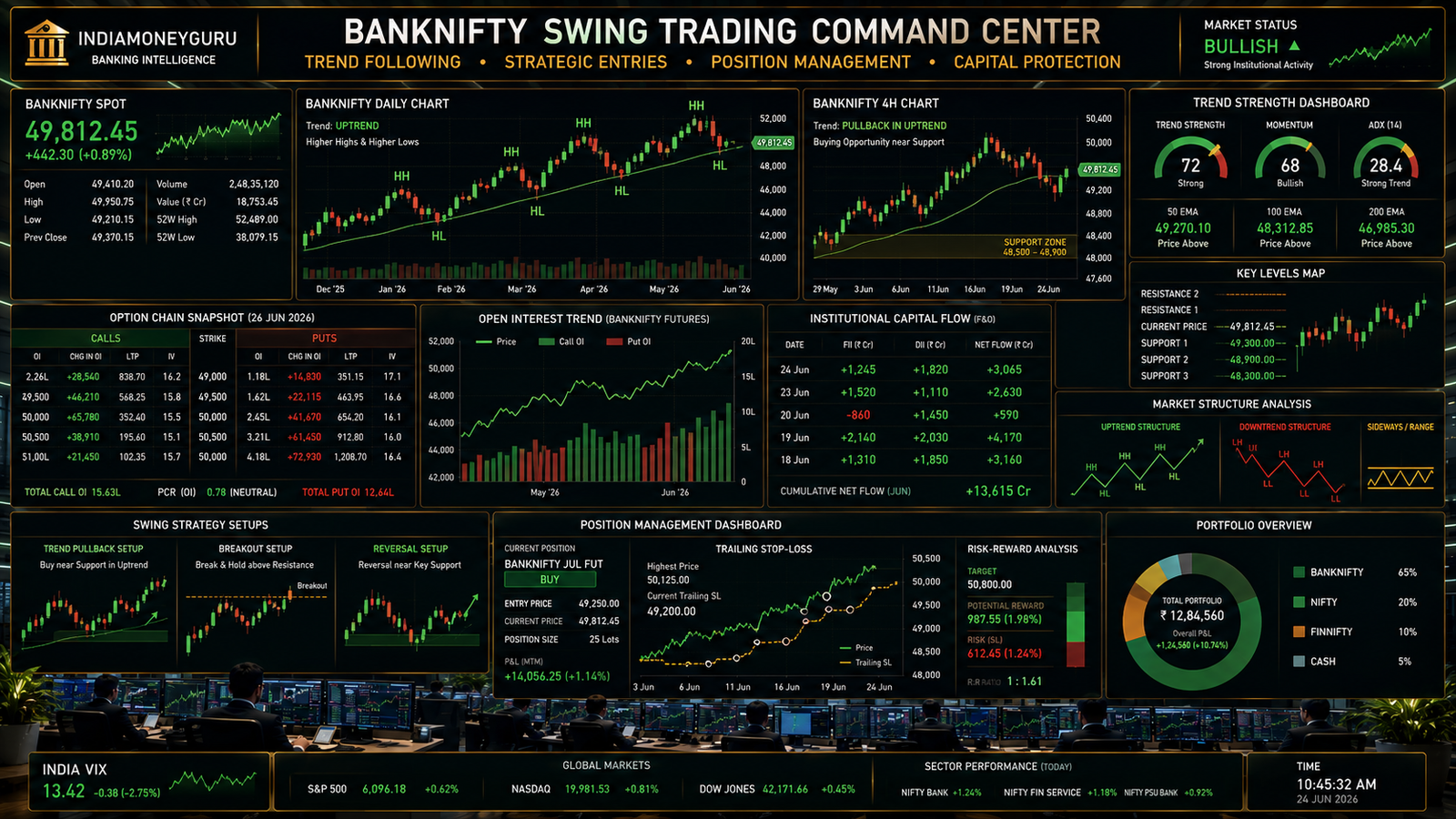
BANKNIFTY Swing Trading Guide is designed for traders who prefer holding positions for several days instead of closing every trade before the market ends. Swing trading aims to capture a meaningful portion of an established trend while avoiding the constant monitoring required for intraday trading.
Unlike intraday trading, swing traders are exposed to overnight price gaps, news events, and changing market sentiment. Therefore, trade selection, position sizing, and risk management become even more important.
This guide explains how traders can identify swing opportunities, plan entries, manage open positions, and protect capital while trading BANKNIFTY.
Table of Contents
Key Takeaways
- Swing trading focuses on capturing multi-day trends.
- Trading with the primary trend generally improves probability.
- Price action and market structure help identify quality entries.
- Option Chain analysis provides additional confirmation.
- Position management is as important as trade selection.
- Risk management remains the foundation of successful swing trading.
What Is Swing Trading?
Swing trading involves holding positions for more than one trading session, typically from a few days to several weeks, depending on market conditions.
The objective is not to capture every market movement but to participate in a significant portion of a trend.
Swing traders generally focus on:
- Trend direction
- Market structure
- Support and resistance
- Price action
- Option Chain confirmation
- Risk-to-reward ratio
Why BANKNIFTY Is Suitable for Swing Trading
BANKNIFTY often develops sustained trends driven by:
- Banking sector earnings
- RBI policy expectations
- Interest rate outlook
- Institutional buying and selling
- Global financial market sentiment
These factors can create multi-day price movements that provide opportunities for swing traders.
However, because positions remain open overnight, traders must also consider gap risk and unexpected news.
Identifying the Primary Trend
One of the most important principles of swing trading is trading in the direction of the dominant trend.
Traders commonly analyse:
- Higher highs and higher lows
- Lower highs and lower lows
- Trendlines
- Moving averages
- Market structure
- Higher timeframe charts
Trading with the primary trend generally provides a higher probability than attempting to predict major reversals.
Selecting High-Probability Swing Setups
Successful swing traders usually wait for quality setups instead of trading every market fluctuation.
Some commonly used approaches include:
Trend Pullback
After a strong trend, price often retraces toward a support area before continuing in the original direction.
Waiting for confirmation after the pullback may improve the risk-to-reward ratio.
Breakout with Confirmation
When BANKNIFTY closes above an important resistance level with strong participation, it may indicate the beginning of a fresh upward move.
Similarly, a decisive breakdown below support may signal continued weakness.
Confirmation reduces the likelihood of trading false breakouts.
Support and Resistance Reversal
If price approaches a major support or resistance level and forms a convincing reversal pattern, traders may consider swing opportunities in the opposite direction.
This approach works best when supported by market structure and volume.
Using Option Chain for Swing Trades
Although Option Chain analysis is often associated with intraday trading, it also provides useful information for swing traders.
Important observations include:
- Fresh Put Writing
- Fresh Call Writing
- Change in Open Interest
- Put-Call Ratio (PCR)
- Shift in major support and resistance strikes
These factors can help determine whether institutional positioning supports the prevailing trend.
Managing an Open Swing Position
Entering a trade is only one part of successful swing trading.
Managing the position is equally important.
Professional traders generally:
- Review market structure daily.
- Monitor important news affecting the banking sector.
- Trail stop-losses as the trend develops.
- Avoid emotional decisions during temporary pullbacks.
- Exit when the original trading thesis is no longer valid.
A disciplined management process often contributes more to long-term success than finding the perfect entry.
Position Sizing and Risk Management
Because swing trades remain open overnight, risk should always be defined before entering the position.
Consider:
- Maximum acceptable loss
- Appropriate position size
- Overnight gap risk
- Portfolio exposure
- Risk-to-reward ratio
Many experienced traders prefer risking a small percentage of trading capital on each position rather than concentrating excessive capital in a single trade.
Common Mistakes in Swing Trading
Some frequent mistakes include:
- Trading against the primary trend.
- Entering before confirmation.
- Ignoring overnight news risk.
- Moving stop-losses farther away.
- Taking oversized positions.
- Exiting profitable trades too early.
- Holding losing trades in the hope of recovery.
Avoiding these mistakes often improves long-term consistency.
Conclusion
BANKNIFTY Swing Trading Guide introduces a structured approach to capturing medium-term market trends. By combining trend analysis, price action, support and resistance, and Option Chain interpretation, traders can build higher-confidence swing trading plans while maintaining disciplined position management and risk control.
Frequently Asked Questions (FAQs)
What is the BANKNIFTY Swing Trading Guide?
The BANKNIFTY Swing Trading Guide explains how traders identify, enter, manage, and exit trades that last several days or weeks by combining trend analysis, price action, support and resistance, and Option Chain analysis.
What is the difference between swing trading and intraday trading?
Intraday traders close all positions before the market closes, while swing traders carry positions overnight or for multiple trading sessions to capture medium-term price movements.
Is BANKNIFTY suitable for swing trading?
Yes. BANKNIFTY often develops sustained trends due to institutional participation, banking-sector developments, and macroeconomic events, making it suitable for disciplined swing trading. However, traders should account for overnight gap risk.
Which timeframe is best for BANKNIFTY swing trading?
Many swing traders use Daily charts to identify the primary trend and 4-hour or 1-hour charts to refine entries. The appropriate timeframe depends on the trader’s strategy and holding period.
Should I use Option Chain analysis for swing trading?
Yes. Option Chain analysis can help identify changes in institutional positioning through Open Interest, Put Writing, Call Writing, and Put-Call Ratio (PCR). It should complement, not replace, price action and trend analysis.
What are the most common swing trading setups?
Popular approaches include:
– Trend pullbacks
– Breakout with confirmation
– Support and resistance reversals
– Trend continuation after consolidation
Each setup should be confirmed using market structure and risk management.
How long should a BANKNIFTY swing trade be held?
There is no fixed duration. A swing trade may last from a few days to several weeks depending on trend strength, price action, and whether the original trade setup remains valid.
What is the biggest risk in swing trading?
The biggest risk is overnight news or global events causing gap-up or gap-down openings. Position sizing and predefined stop-losses are essential to manage this risk.
How important is risk-to-reward ratio?
A favourable risk-to-reward ratio helps traders remain profitable even if not every trade succeeds. Many traders look for setups where the potential reward meaningfully exceeds the predefined risk.
Can beginners start with swing trading?
Yes. Many beginners find swing trading less stressful than intraday trading because it allows more time for analysis and decision-making. However, they should first understand trend analysis, support and resistance, price action, and risk management.
Disclaimer
The information provided in this article is for educational purposes only and should not be considered investment advice. Trading and investing in financial markets involve risk. Always conduct your own research and consult a SEBI-registered investment adviser before making any investment decisions.