
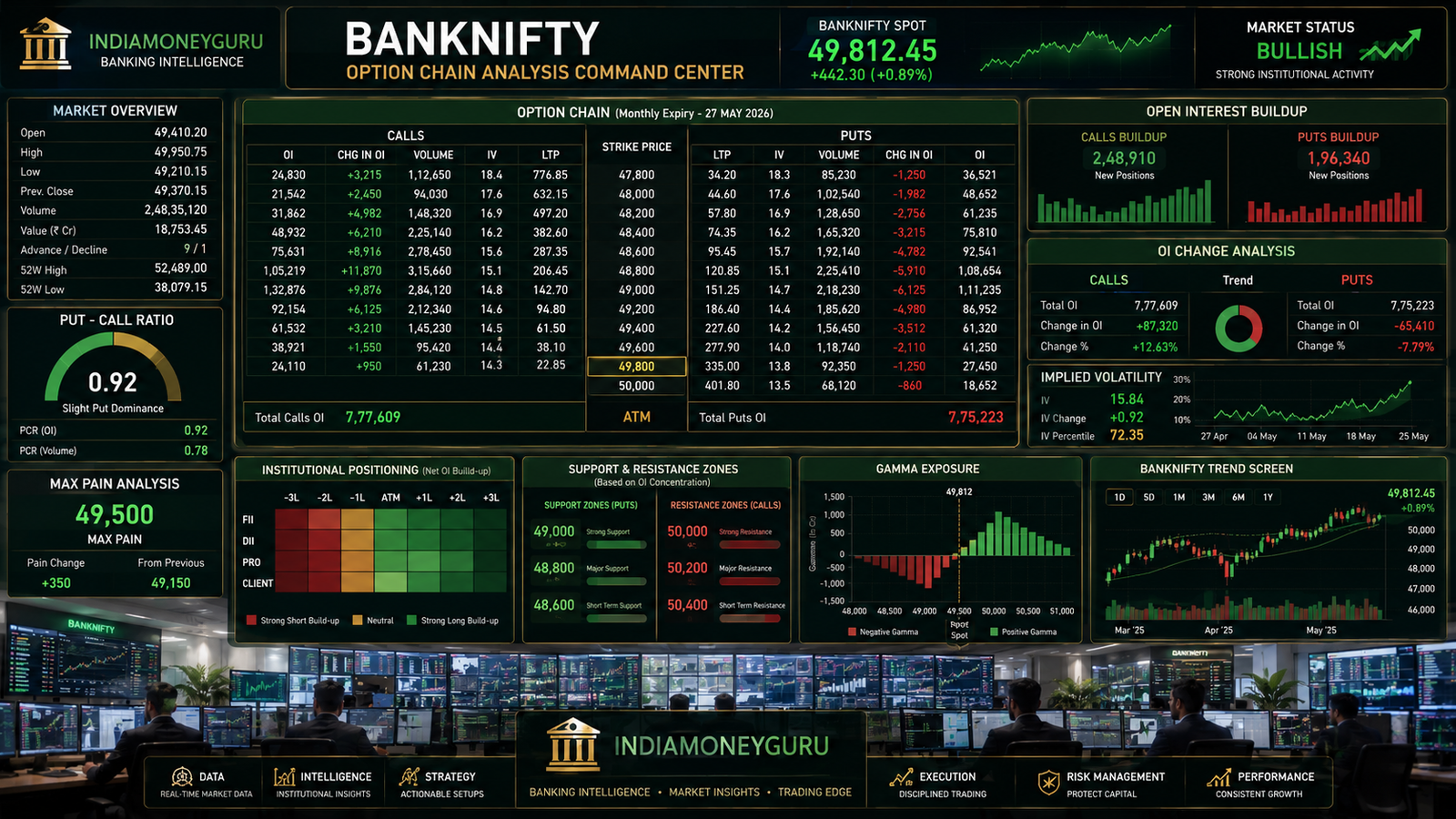
BANKNIFTY Option Chain Analysis is one of the most effective techniques used by professional derivatives traders to understand market sentiment, identify potential support and resistance levels, and track institutional positioning. By studying Open Interest (OI), option writing, Put-Call Ratio (PCR), and strike-wise activity, traders can make more informed decisions instead of relying only on price charts.
Unlike the broader Option Chain Analysis Guide, which explains the fundamentals for all options, this article focuses specifically on BANKNIFTY Option Chain Analysis and demonstrates how traders can interpret the option chain for India’s leading banking index.
Key Takeaways
- The BANKNIFTY Option Chain provides insight into current market positioning.
- Highest Put Open Interest often highlights potential support.
- Highest Call Open Interest often identifies potential resistance.
- Change in Open Interest offers valuable clues about fresh positioning.
- Option Chain analysis becomes more reliable when combined with price action and trend analysis.
- Successful traders use the Option Chain as a probability tool rather than a prediction tool.
Table of Contents
Why BANKNIFTY Option Chain Is Different
BANKNIFTY behaves differently from many other indices because it consists of India’s largest banking stocks.
It is influenced by:
- Banking sector performance
- Institutional participation
- RBI policy expectations
- Interest rate outlook
- Global financial market sentiment
As a result, Open Interest changes in BANKNIFTY often develop quickly, especially around major events, monthly expiry, and banking sector news.
For this reason, many professional traders review the BANKNIFTY Option Chain multiple times during the trading session instead of relying only on pre-market analysis.
How to Perform BANKNIFTY Option Chain Analysis
The Option Chain displays all available Call (CE) and Put (PE) contracts across multiple strike prices for the selected expiry.
For each strike, traders can view:
- Open Interest (OI)
- Change in Open Interest
- Last Traded Price (LTP)
- Volume
- Implied Volatility (IV)
- Bid and Ask Prices
The official Option Chain is available on the National Stock Exchange (NSE) website and updates continuously during market hours.
Step 1: Identify the At-the-Money Strike
The first step is locating the At-the-Money (ATM) strike.
This strike is closest to the current BANKNIFTY spot price and acts as the reference point for analysing nearby option activity.
Professional traders usually focus on:
- ATM strikes
- One to three strikes above
- One to three strikes below
These strikes generally carry the highest liquidity and institutional participation.
Step 2: Locate the Highest Open Interest
Open Interest represents the number of outstanding option contracts that remain open.
Highest Put Open Interest
Large Put Open Interest often indicates an area where traders expect buying support.
This strike may act as a potential support level unless heavy unwinding occurs.
Highest Call Open Interest
Large Call Open Interest often indicates a zone where traders expect selling pressure.
This strike may function as a resistance level until significant Call unwinding takes place.
These levels should always be viewed as probable support and resistance rather than guaranteed turning points.
Step 3: Watch Change in Open Interest
Static Open Interest tells you where positions already exist.
Change in Open Interest tells you what traders are doing today.
Examples include:
- Rising OI with rising price → Fresh Long Build-up
- Rising OI with falling price → Fresh Short Build-up
- Falling OI with rising price → Short Covering
- Falling OI with falling price → Long Unwinding
Understanding this relationship provides far more insight than simply looking at the highest OI values.
Step 4: Observe Put Writing and Call Writing
Professional traders closely monitor option writing because it reflects where participants are willing to accept risk.
Fresh Put Writing
Usually indicates confidence that BANKNIFTY will remain above a certain strike.
Fresh Call Writing
Often suggests expectations that the index may struggle to move above that strike.
Strong price momentum, however, can invalidate either assumption, which is why option writing should always be interpreted alongside price action.
Step 5: Confirm with Price Action
The Option Chain should support your trading decision—not replace it.
For example:
- Heavy Put writing near an important technical support level strengthens the bullish case.
- Significant Call writing near a major resistance level reinforces the bearish case.
When price action and Option Chain tell the same story, traders generally gain greater confidence in their analysis.
How Professional Traders Use the BANKNIFTY Option Chain
Experienced traders rarely make decisions based on a single number.
Instead, they combine:
- Option Chain
- Trend Analysis
- Support & Resistance
- Open Interest changes
- Volume
- Implied Volatility
- Price Action
This multi-factor approach helps reduce false signals and improves overall decision-making. Option chain analysis also help trades to find swing trades to capture premiums as per the market movement.
Common Mistakes to Avoid
Many beginners misuse the Option Chain by:
- Looking only at the highest Open Interest.
- Ignoring Change in Open Interest.
- Trading solely based on PCR.
- Assuming support or resistance can never break.
- Ignoring the prevailing trend.
- Failing to monitor changes throughout the trading day.
The Option Chain is dynamic. Institutional positions evolve continuously, so traders should revisit the data as market conditions change.
Conclusion
The BANKNIFTY Option Chain is one of the most effective tools for understanding how institutional participants are positioning themselves in the derivatives market. Rather than attempting to predict every price movement, traders can use Open Interest, option writing, and strike-wise positioning to identify important market levels and improve their overall analysis.
When combined with technical analysis, volume, and disciplined risk management, the Option Chain becomes an invaluable component of a professional BANKNIFTY trading process.
Frequently Asked Questions (FAQs)
What is the BANKNIFTY Option Chain?
The BANKNIFTY Option Chain is a real-time table that displays all available Call (CE) and Put (PE) option contracts across different strike prices and expiry dates. It provides information such as Open Interest (OI), Change in OI, volume, implied volatility (IV), and option prices.
How does the BANKNIFTY Option Chain help traders?
The Option Chain helps traders identify potential support and resistance levels, analyse market sentiment, monitor institutional positioning, and understand where significant option activity is taking place.
What does Open Interest (OI) indicate?
Open Interest represents the total number of outstanding option contracts that remain open. Higher Open Interest usually indicates greater market participation at a particular strike price.
How can traders identify support using the Option Chain?
Support is often identified by locating the strike price with the highest Put Open Interest or fresh Put Writing. However, this should always be confirmed using price action and other technical indicators.
How can traders identify resistance using the Option Chain?
Resistance is commonly identified through the strike price with the highest Call Open Interest or significant fresh Call Writing. These levels indicate where sellers are actively positioning themselves.
What is the importance of Change in Open Interest?
Change in Open Interest helps traders understand whether fresh positions are being created or existing positions are being closed. It often provides more actionable information than absolute Open Interest alone.
Should traders rely only on the Put-Call Ratio (PCR)?
No. PCR is a useful sentiment indicator but should never be used in isolation. Professional traders combine PCR with Open Interest analysis, price action, trend analysis, volume, and implied volatility.
Is the Option Chain useful for intraday trading?
Yes. Many intraday traders monitor the Option Chain throughout the trading session to identify changes in support, resistance, option writing activity, and institutional positioning.
What is the biggest mistake beginners make while reading the Option Chain?
One of the most common mistakes is assuming that the highest Open Interest guarantees support or resistance. Market conditions change continuously, so Option Chain analysis should always be combined with price action and proper risk management.
Which expiry should traders analyse in the BANKNIFTY Option Chain?
Under the current market structure, traders should primarily analyse the active monthly BANKNIFTY expiry contract, as weekly BANKNIFTY option contracts have been discontinued.
How often should the Option Chain be monitored during market hours?
Professional traders usually review the Option Chain multiple times during the day, especially near important support and resistance levels, after major news events, and during the final hours of trading when institutional positioning may change rapidly.
Is the BANKNIFTY Option Chain suitable for beginners?
Yes. Although it may appear complex initially, learning to interpret Open Interest, option writing, and strike-wise positioning can significantly improve a trader’s understanding of market behaviour. Beginners should first master the fundamentals before using the Option Chain for live trading decisions.
Disclaimer
The information provided in this article is for educational purposes only and should not be considered investment advice. Trading and investing in financial markets involve risk. Always conduct your own research and consult a SEBI-registered investment adviser before making any investment decisions.
5 thoughts on “BANKNIFTY Option Chain Analysis (2026): How to Read Open Interest, Support & Resistance Like a Professional”