
Executive Summary
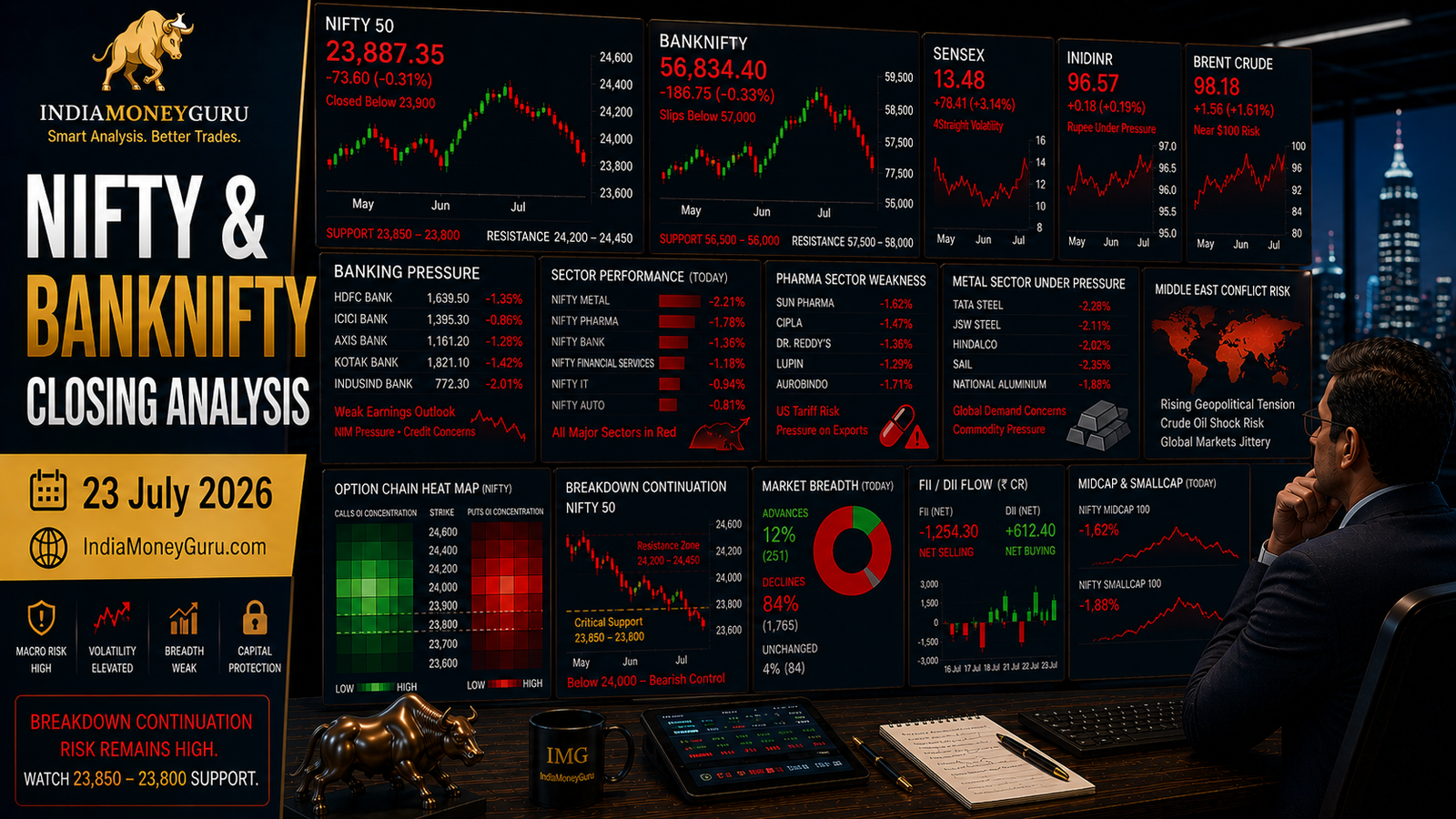
NIFTY & BANKNIFTY Closing Analysis – 23 July 2026: Indian equity markets extended losses for the fourth consecutive session on Thursday, 23 July 2026, as rising crude oil prices, weak global cues, continued profit booking and caution ahead of key earnings kept sentiment under pressure. The NIFTY 50 fell 126.65 points, or 0.53%, to close at 23,896.60, while the BSE Sensex declined 363.66 points, or 0.47%, to close at 76,391.39.
BANKNIFTY remained weak and slipped further below the 57,000 zone. Market data showed the Nifty Bank index around 56,592, down about 0.94% from the previous close of 57,126.80. This confirmed that banking weakness had not stabilised after Wednesday’s breakdown and that financial-sector leadership remained absent.
The broader market again underperformed the frontline indices. The BSE 150 MidCap Index dropped 1.01%, and the BSE 250 SmallCap Index declined 1.20%. Market breadth was weak, with 2,579 declining shares against 1,642 advancing shares on BSE. This shows that risk-off sentiment remained broad-based and not limited to index heavyweights.
India VIX rose 1.37% to 13.48, extending the volatility warning from the previous session. The volatility rise was smaller than Wednesday’s jump, but it still showed that traders were not comfortable selling protection aggressively while crude and geopolitical risks remained active.
The main macro pressure came from crude oil. Brent crude for September 2026 settlement rose $4.11, or 4.37%, to $98.18 per barrel. For India, which imports most of its crude requirements, this is a direct risk to inflation, trade deficit, rupee stability and foreign investor sentiment.
The rupee ended nearly flat at 96.5725 per dollar, close to a two-month low, as likely RBI-related dollar supply through state-run banks helped limit the impact of the oil surge. However, the currency remained under pressure because crude was rising sharply and bearish rupee positions increased.
IndiaMoneyGuru View:
The market has moved deeper into breakdown continuation. NIFTY has now closed below 23,900, BANKNIFTY has slipped below 57,000, broader markets are selling off, and crude near $98 has become the dominant macro risk. Bulls need a fast reclaim of 24,000 on NIFTY and 57,000–57,500 on BANKNIFTY to reduce downside pressure.
Table of Contents
Market Intelligence Scorecard
| Indicator | Status | Interpretation |
|---|---|---|
| NIFTY Trend | 🔴 Weak | Closed below 23,900 |
| BANKNIFTY Trend | 🔴 Weak | Slipped below 57,000 |
| India VIX | 🔴 Elevated | Rose to 13.48 |
| Market Breadth | 🔴 Weak | Decliners clearly exceeded advancers |
| Midcaps | 🔴 Weak | BSE 150 MidCap fell 1.01% |
| Small caps | 🔴 Weak | BSE 250 SmallCap fell 1.20% |
| Crude Oil | 🔴 Major Risk | Brent rose to $98.18/barrel |
| Rupee | 🔴 Weak | Closed near 96.57/USD |
| Overall Bias | Negative | Fourth straight day of decline |
Previous Session vs Today
| Parameter | 22 July 2026 | 23 July 2026 | Interpretation |
|---|---|---|---|
| NIFTY 50 | 23,996.25 | 23,896.60 | Fell below 23,900 |
| Sensex | 76,755.05 | 76,391.39 | Fourth straight decline |
| BANKNIFTY | 57,126.80 | Around 56,592 | Banking weakness extended |
| India VIX | 13.29 | 13.48 | Volatility remained elevated |
| Midcaps | Down 1.05% | Down 1.01% | Broader weakness continued |
| Small caps | Down 1.39% | Down 1.20% | Risk appetite stayed weak |
| Brent Crude | Above $95 | $98.18 | Crude risk intensified |
| Market Tone | Breakdown warning | Breakdown continuation | Selling pressure persisted |
Market Snapshot
| Index / Indicator | Closing / Reading | Market Message |
|---|---|---|
| NIFTY 50 | 23,896.60 | Down 0.53%; closed below 23,900 |
| Sensex | 76,391.39 | Down 363.66 points / 0.47% |
| BANKNIFTY | Around 56,592 | Below 57,000; banking pressure continued |
| India VIX | 13.48 | Up 1.37%; volatility still active |
| BSE 150 MidCap | Down 1.01% | Broader market underperformed |
| BSE 250 SmallCap | Down 1.20% | Small-cap risk appetite weakened |
| Brent Crude | $98.18/barrel | Major macro headwind |
| Rupee | 96.5725/USD | Near two-month low |
Market Overview
Thursday’s session confirmed that the weakness from 22 July was not a one-day panic reaction. The market continued to decline for the fourth straight session. NIFTY closed below 23,900, Sensex dropped another 363 points, and BANKNIFTY remained under pressure below 57,000.
The selling was driven by a combination of macro and earnings pressure. Rising Brent crude was the main macro trigger. Crude moving close to the $100 zone creates immediate concern for India because higher oil prices can raise the import bill, widen the current-account deficit, weaken the rupee, and increase inflation expectations.
The rupee remained close to a two-month low. Although likely RBI intervention through state-run banks helped prevent a sharper fall, the currency did not recover meaningfully. This means external pressure remained active.
Sectorally, most indices ended in the red. Metal and pharma stocks were among the pressure points, while caution ahead of key earnings also weighed on sentiment. Reuters noted that drugmakers Dr Reddy’s and Cipla, along with HPCL, declined after weak quarterly results. IndusInd Bank fell sharply despite higher quarterly profit, as investors booked profits after a prior rally.
The broader market also remained weak. Midcaps and smallcaps fell more than the benchmarks, and breadth remained negative. This makes the decline more serious because it shows that risk-off sentiment has expanded beyond only large-cap names.
Auto and media shares were among the few pockets of relative strength, but they were not enough to change the broader market tone.
IndiaMoneyGuru Unique Insight
The following is the key takeaway from today’s session:
The market is no longer trying to repair Wednesday’s breakdown; it is extending it.
This is the key change.
On 22 July, the market broke below major support because crude shocked sentiment. On 23 July, the market did not immediately recover. Instead, NIFTY slipped further below 23,900, BANKNIFTY moved below 57,000, mid-caps and small-caps continued to fall, and VIX stayed elevated.
That means traders are not treating the previous fall as a simple dip-buying opportunity. They are still reducing risk.
For IndiaMoneyGuru readers, the practical interpretation is:
- NIFTY below 23,900 confirms weak momentum.
- BANKNIFTY below 57,000 shows banks are not ready to lead recovery.
- Broader-market underperformance confirms risk-off sentiment.
- India VIX at 13.48 means volatility risk remains active.
- Brent crude near $98 is the most important macro variable now.
- Rupee stability depends partly on RBI support.
- Any recovery must first reclaim lost levels, not just bounce intraday.
Today’s fall should be treated as a breakdown continuation session, not a normal consolidation day.
NIFTY Analysis
NIFTY closed at 23,896.60, down 126.65 points. This is technically important because the index failed to reclaim 24,000 after Wednesday’s breakdown and instead closed below 23,900.
The short-term structure has now weakened further. The earlier support zone around 24,000 has become resistance. Unless NIFTY quickly moves back above 24,000, recovery attempts may face selling pressure.
The next key downside area is 23,850–23,800. If NIFTY holds this area, a short-covering bounce is possible. But if 23,800 fails, the index may move toward 23,650.
The first recovery level is now 24,000. A move above 24,000 can create relief, but a stronger repair requires 24,200. Until NIFTY moves back above 24,200, the short-term bias remains cautious to negative.
The near-term NIFTY view is negative below 24,000 and weak below 23,900.
BANKNIFTY Analysis
BANKNIFTY remained weak and slipped below the 57,000 zone, trading around 56,592. This shows that the banking index has not stabilized after Wednesday’s sell-off.
The fall below 57,000 is important because BANKNIFTY had already lost its earlier breakout confirmation near 58,500. Now the structure has shifted lower, and the index must first stabilise near 56,500–56,000 before any durable recovery can form.
IndusInd Bank was a major weak stock after investors booked profits, despite a higher June-quarter profit. PSU banks also remained under pressure during the session, continuing their recent losing streak.
For recovery, BANKNIFTY must first reclaim 57,000. The second important level is 57,500. A stronger repair requires 58,000, but that level is now far from the current structure.
Until BANKNIFTY moves back above 57,500–58,000, it remains a drag on NIFTY rather than a support.
Option Chain Intelligence
The option-chain structure remains defensive.
On 22 July, NIFTY closed below 24,000, turning that strike from support into a contested resistance zone. On 23 July, NIFTY closed below 23,900, which confirms that 24,000 did not get reclaimed.
This means Call writers may stay active around 24,000 unless the index moves above that zone decisively. On the downside, 23,850–23,800 is the next important support zone. If this area breaks, Put unwinding can extend the decline toward 23,650.
For BANKNIFTY, 57,000 has become the first recovery level after today’s weakness. Below 56,500, downside risk can extend toward 56,000.
The message from the derivatives is:
NIFTY has failed to reclaim 24,000, so the market remains in defensive positioning unless 24,000 is recovered quickly.
Institutional Activity
Institutional behaviour is likely to remain cautious because the market is facing a combination of crude risk, rupee pressure, earnings uncertainty and weak breadth.
Reuters reported that the rupee stayed near its two-month low even though likely RBI-related dollar supply helped limit losses. This suggests that the currency market remains under pressure from oil, and foreign investors may remain cautious if crude continues to rise.
Reuters also reported that Brent crude rose over 4% to above $98 as Middle East tensions escalated. Analysts warned that a sustained oil spike above $100 could severely affect India’s macro outlook because India is the world’s third-largest crude importer.
Business Standard reported weak breadth and broad underperformance in midcaps and smallcaps. This means domestic risk appetite also weakened.
The institutional message is clear:
- Crude is now the dominant macro risk.
- Rupee stability is fragile.
- FII sentiment may remain cautious.
- Domestic buying is likely to be selective.
- Broad-market risk reduction is still active.
India VIX Analysis
India VIX rose 1.37% to 13.48. This is a continuation of the volatility expansion that began on 22 July.
The VIX move was not as sharp as Wednesday’s 5.49% jump, but the direction remains important. Rising VIX during a falling market shows that traders are still pricing downside and event risk.
For option sellers, this is not the ideal environment for aggressive naked selling. Premiums may look attractive, but crude-led overnight gaps and geopolitical headlines can create sharp moves.
For directional traders, elevated VIX means position sizing should remain controlled. If the rupee or crude move negatively, even relief bounces can be swiftly reversed.
Sector Rotation
| Sector | Trend | Interpretation |
|---|---|---|
| BANKNIFTY / Banks | Weak | Banking index slipped below 57,000 |
| PSU Banks | Weak | Extended recent losing streak |
| Pharma | Weak | Weak earnings and tariff-risk concerns weighed |
| Metal | Weak | Global-risk sentiment hurt the sector |
| Oil Marketing / HPCL | Weak | Weak results and crude pressure hurt sentiment |
| IT | Cautious | Infosys earnings awaited |
| Midcaps | Weak | BSE 150 MidCap fell 1.01% |
| Small caps | Weak | BSE 250 SmallCap fell 1.20% |
| Auto | Positive | Relative strength pocket |
| Media | Positive | One of the few advancing NSE sectors |
The sector message is still broad risk-off. Isolated pockets gained, but the broader market remained weak.
Support and Resistance
| Index | S1 | S2 | S3 | R1 | R2 | R3 |
|---|---|---|---|---|---|---|
| NIFTY | 23,850 | 23,800 | 23,650 | 24,000 | 24,200 | 24,300 |
| BANKNIFTY | 56,500 | 56,000 | 55,500 | 57,000 | 57,500 | 58,000 |
Trading Plan for Next Session
The next session should be treated as a breakdown-continuation test.
For bullish traders, NIFTY must reclaim 24,000. Without a move above 24,000, any bounce may remain only a short-covering move. A stronger recovery requires a move above 24,200.
For BANKNIFTY traders, 57,000 is the first recovery level. If the index remains below 57,000, weakness can extend toward 56,500 and then 56,000.
For option sellers, avoid aggressive naked positions. A rising VIX, crude near $98 and weak breadth favour defined-risk strategies.
For intraday traders, avoid buying early weakness only because prices look low. Wait for either support defence near 23,850–23,800 on NIFTY or a decisive reclaim above 24,000.
For swing traders, fresh long positions should be delayed until NIFTY reclaims 24,000 or shows a strong reversal from the 23,850–23,800 zone.
Risk Factors to Watch
Key risks for the next session include:
- NIFTY failing to reclaim 24,000
- NIFTY breaking below 23,800
- BANKNIFTY staying below 57,000
- BANKNIFTY breaking below 56,500
- Brent crude moving closer to $100
- Rupee weakening toward its record low
- India VIX rising above 14
- Infosys and IndiGo earnings reactions
- Pharma and metal weakness continuing
- Mid-cap and small-cap selling extending further
The biggest risk is crude. If Brent crosses and sustains above $100, India-specific macro pressure may intensify quickly.
Trading Lessons
Today’s session offers three important trading lessons.
First, a broken support becomes resistance. NIFTY lost 24,000 on Wednesday and failed to reclaim it on Thursday.
Second, breakdowns need confirmation. Today confirmed Wednesday’s weakness because the market continued lower instead of reversing.
Third, macro risk can override stock-specific positives. Even when some earnings pockets remain active, crude and currency pressure can dominate index direction.
Key Takeaways
For investors, avoid rushing into broad-market buying while crude and rupee pressure remain active.
For traders, NIFTY must reclaim 24,000 to reduce downside pressure.
For BANKNIFTY traders, the index must recover above 57,000 and then 57,500 to stabilise.
For option sellers, defined-risk trades are preferable because the VIX is elevated and crude-led gaps remain possible.
For swing traders, wait for either a reclaim above 24,000 or a clear reversal from 23,850–23,800.
Editorial Conclusion
Indian markets closed lower for the fourth consecutive session on 23 July 2026. NIFTY slipped to 23,896.60, Sensex closed at 76,391.39, and BANKNIFTY fell below the 57,000 zone. The broader market also weakened, with midcaps and smallcaps falling more than the benchmarks.
The key macro pressure came from crude oil, with Brent rising to $98.18 per barrel. The rupee remained near a two-month low at 96.5725 per dollar, even though likely RBI intervention limited a sharper decline. India VIX rose to 13.48, confirming that volatility risk remains active.
This is no longer a simple support retest. The market has entered breakdown-continuation mode. Bulls must reclaim 24,000 on NIFTY and 57,000–57,500 on BANKNIFTY to prevent the decline from deepening.
IndiaMoneyGuru View:
NIFTY below 23,900 and BANKNIFTY below 57,000 keep the market bias negative. Traders should stay defensive, avoid aggressive naked option selling, and wait for clear recovery above lost support zones before assuming that the correction is over.
Frequently Asked Questions (FAQs)
What was the NIFTY closing level on 23 July 2026?
The NIFTY 50 closed at 23,896.60, down 126.65 points or 0.53%.
What was the Sensex closing level on 23 July 2026?
Sensex closed at 76,391.39, down 363.66 points or 0.47%.
What happened to BANKNIFTY on 23 July 2026?
BANKNIFTY slipped below the 57,000 zone and traded around 56,592, showing continued banking-sector weakness.
Why did the Indian stock market fall today?
The market fell because Brent crude rose sharply near $98 per barrel, global cues were weak, profit booking continued, earnings caution remained active, and broader markets sold off.
What happened to India VIX today?
India VIX rose 1.37% to 13.48, showing that volatility risk remained active.
Was the broader market weak today?
Yes. The BSE 150 MidCap Index fell 1.01%, and the BSE 250 SmallCap Index declined 1.20%.
What is the key NIFTY support now?
The key immediate support is 23,850, followed by 23,800 and 23,650.
What level must NIFTY reclaim?
NIFTY must reclaim 24,000 first. A stronger recovery requires a move above 24,200.
What is the key BANKNIFTY support now?
The key immediate support is 56,500, followed by 56,000 and 55,500.
References
Disclaimer
The information provided in this article is for educational purposes only and should not be considered investment advice. Trading and investing in financial markets involve risk. Always conduct your own research and consult a SEBI-registered investment adviser before making any investment decisions.