
Opening Hook
NIFTY BANKNIFTY Weekly Market Wrap-Up 7 August 2026: This was not a normal trading week.
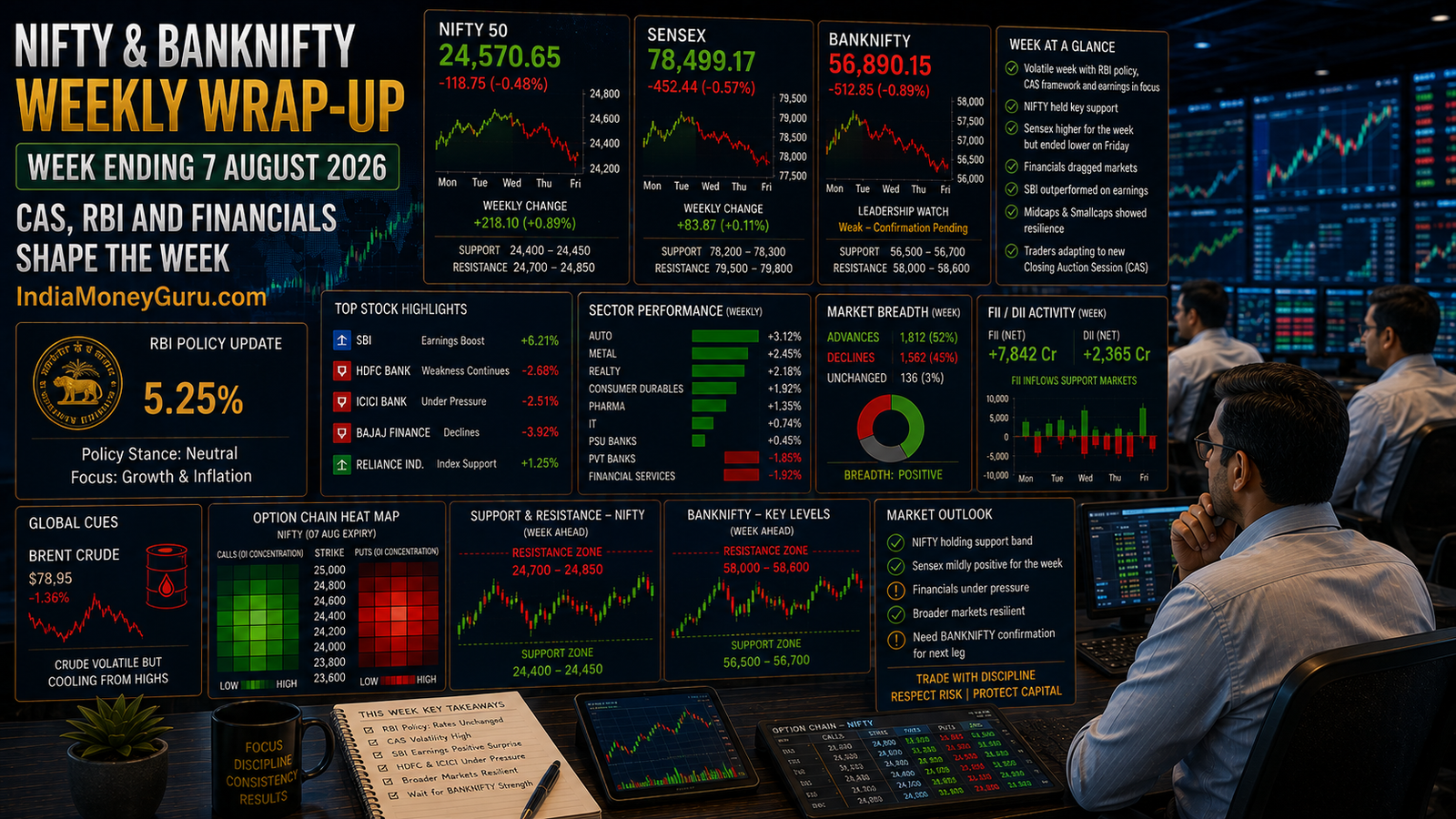
NIFTY ended the week with gains, but traders had to deal with a new closing auction system, sharp index divergence, RBI policy, weekly expiry volatility, crude oil swings, foreign inflows and pressure in heavyweight financials.
So the real story of the week was not just whether the market went up or down. The bigger story was this: the way traders read closing prices changed.
Table of Contents
The Week in Simple Words
For the week ending 7 August 2026, NIFTY closed at 24,570.65, while Sensex ended at 78,499.17. Compared with the previous Friday close, both benchmarks still finished the week higher, even though Friday ended weak.
The week began with a sharp CAS-led NIFTY closing move on Monday. Tuesday brought weekly expiry confusion. Wednesday was dominated by the RBI rate pause. Thursday saw the Sensex rise sharply while the NIFTY stayed almost flat. Friday finally showed fatigue as financials dragged the market lower.
This week should be read in continuation with the NIFTY and BANKNIFTY closing analysis for 7 August 2026, where NIFTY held support, but financials clearly remained the weak link.
Weekly Market Snapshot
| Indicator | Weekly Reading | Market Message |
|---|---|---|
| NIFTY 50 | 24,570.65 | Weekly gain, but momentum cooled on Friday |
| Sensex | 78,499.17 | Weekly gain despite Friday fall |
| NIFTY Support Zone | 24,500–24,450 | Still intact |
| BANKNIFTY Tone | Mixed to weak | Private banks did not confirm leadership |
| Strong Pockets | IT, auto, SBI, select earnings names | Stock-specific strength |
| Weak Pockets | Financials, HDFC Bank, ICICI Bank, Bajaj Finance | Main drag on sentiment |
| Key Event | CAS launch | Changed closing-price behaviour |
| Macro Event | RBI held repo rate at 5.25% | Banks stayed cautious |
| Crude Oil | Volatile | Helped early in the week, pressured sentiment later |
| FII Flows | Positive in August so far | Supportive but not enough alone |
What Really Moved the Market This Week?
1. CAS changed the closing game
The biggest market event this week was the rollout of the Closing Auction Session, or CAS, from 3 August 2026.
Under the new framework, closing prices for F&O-linked cash-market stocks are discovered through an auction instead of the earlier VWAP-based final 30-minute average. This sounds technical, but its impact was very visible.
On Monday, NIFTY moved sharply near the close. On Tuesday, weekly expiry became more volatile. On Wednesday and Thursday, NIFTY and Sensex showed unusual divergence. By Friday, traders were still adjusting to the new closing-price behaviour.
That is why the 3 August CAS-led NIFTY closing analysis became an important reference point for the whole week.
For traders, the lesson is simple: the final close now needs more interpretation. Do not look only at the closing number. Also check where the index traded during normal market hours and how much of the final move came during the auction window.
2. RBI paused, but banks did not celebrate
The RBI kept the repo rate unchanged at 5.25% and retained a neutral stance. The decision was broadly expected, but the market reaction was more selective than bullish.
NIFTY held steady after the policy, but banks did not show strong follow-through. HDFC Bank and ICICI Bank remained weak during the week, and BANKNIFTY failed to become the clear leader.
This is important because a sustainable NIFTY rally usually needs banking support. Without BANKNIFTY participation, index rallies can become dependent on Reliance, IT, autos or a few earnings-driven stocks.
The NIFTY BANKNIFTY Closing Analysis 5 August 2026 captured this well: NIFTY was stable after the RBI pause, but BANKNIFTY remained the missing confirmation.
3. Financials dragged; SBI stood out
Friday showed the problem clearly.
Financials weighed on the market, with HDFC Bank and ICICI Bank under pressure. Bajaj Finance also declined after concerns linked to a draft RBI proposal on revolving-credit products.
But SBI was different. It gained after strong quarterly earnings, supported by healthy loan growth. This gave the market one positive banking story, but it was not enough to call the whole BANKNIFTY structure strong.
For readers, this distinction matters. SBI strength is positive, but it is not the same as broad banking leadership.
BANKNIFTY needs private-bank support before the market can move into a cleaner bullish phase.
4. Crude oil helped, then became a risk again
Crude oil was another important swing factor.
Early in the week, softer crude helped Indian market sentiment because lower crude usually supports inflation comfort, rupee stability and foreign-investor confidence. Later in the week, renewed oil pressure and Middle East uncertainty again became a reason for caution.
For India, crude matters because it affects inflation, current account pressure, rupee movement and sector margins. So even when NIFTY is technically strong, traders should keep crude on the dashboard.
NIFTY Weekly Analysis
NIFTY’s weekly close above 24,500 is constructive. The index absorbed a lot of noise: CAS launch, expiry-day swings, RBI policy and Friday’s financial-sector pressure.
But the rally was not clean. NIFTY failed to hold above the 24,700–24,800 zone for long, and Friday’s weakness showed that buyers are becoming more selective.
For next week, NIFTY’s structure is simple:
- Above 24,500, the index remains stable.
- Above 24,700–24,800, momentum can improve.
- Below 24,450, the market may slip back into deeper consolidation.
Traders should not treat every dip as bearish, but they should also avoid assuming that the market is in a confirmed breakout.
The better reading is that NIFTY is holding support, but it still needs cleaner follow-through.
BANKNIFTY Weekly Analysis
BANKNIFTY was the most important missing piece this week.
The market received support from IT, autos, Reliance, SBI and select earnings-led names. But large private banks did not move together. HDFC Bank, ICICI Bank and other financial heavyweights remained uneven.
This made the weekly market structure less convincing.
For BANKNIFTY, the key zone to watch next week is around 56,800–56,500 on the downside and 57,500–57,800 on the upside. A move above resistance with private-bank participation can improve sentiment. But if BANKNIFTY keeps failing near higher levels, NIFTY may struggle to sustain rallies.
The main message is that BANKNIFTY has not broken down badly, but it has not confirmed leadership either.
Sector Rotation: What Worked and What Didn’t
This week was not about one clean sector trend. It was about rotation.
IT recovered after earlier profit booking and helped stabilise the market. Autos also showed strength in parts of the week. SBI gave a positive earnings-led banking story. Smallcaps and midcaps remained resilient, showing that domestic risk appetite has not disappeared.
But financials were the main drag. When HDFC Bank, ICICI Bank and Bajaj Finance stay under pressure, the market becomes heavy even if other sectors participate.
Friday’s session made this visible: auto and IT outperformed, while banking and financial stocks dragged the benchmarks.
Option Chain and CAS Message
For option traders, this was one of the most important weeks of the year.
CAS has changed the behaviour of the closing window. The final 15–25 minutes now require more attention, especially around expiry. The old habit of assuming that the final close will behave like the earlier VWAP method may not work immediately.
This has three practical implications:
- Avoid oversized expiry-day positions near the close.
- Watch normal-session levels separately from CAS-discovered closing levels.
- Use defined-risk structures and proper lot sizing.
During such weeks, traders should review the Position Size Calculator before increasing exposure. This is exactly the kind of market where risk management matters more than prediction.
FII, DII and Macro Reading
Foreign flows remained supportive. Reuters reported that foreign investors bought a net $1.3 billion of Indian shares so far in August after buying $2.1 billion in July.
This is positive because India had earlier faced pressure from crude, rupee weakness and global uncertainty. However, flows alone cannot carry the market if the largest financial stocks remain weak.
The broader macro picture is mixed but not alarming:
- RBI paused rates at 5.25%.
- Crude remains a key risk.
- Rupee stability is important for foreign flows.
- Earnings are supporting select stocks.
- Broader markets remain resilient.
- CAS has created short-term trading uncertainty.
So the macro message is supportive, but not risk-free.
What Traders Should Watch Next Week
Next week, traders should focus on confirmation rather than prediction.
1. NIFTY above 24,500
If NIFTY holds this zone, the market can attempt another recovery toward 24,700–24,800.
2. BANKNIFTY leadership
This is the biggest signal. If private banks recover, the rally becomes healthier. If banks remain weak, NIFTY may stay range-bound.
3. CAS stability
The market needs a few more sessions to adjust to the new closing auction system. Watch whether volatility reduces near the close.
4. Crude oil
If crude cools again, India gets macro relief. If crude rises sharply, banks, rupee and inflation expectations may come under pressure.
5. FII flow continuation
Foreign inflows are helpful. If they continue, dips may get bought faster.
6. Midcap and smallcap resilience
Broader markets stayed strong this week. If they continue holding, market sentiment remains positive even if NIFTY consolidates.
Weekly Support and Resistance
| Index | Support Zone | Resistance Zone | Bias |
|---|---|---|---|
| NIFTY | 24,500 / 24,450 | 24,700 / 24,800 | Stable but needs follow-through |
| BANKNIFTY | 56,800 / 56,500 | 57,500 / 57,800 | Mixed, awaiting leadership |
IndiaMoneyGuru Weekly Takeaway
This week was positive on paper but complicated in practice.
NIFTY and Sensex ended the week higher, but Friday’s weakness showed that the market is not yet in a clean one-way rally. CAS changed closing-price behaviour. RBI gave no surprises. Crude remained a swing factor. FII flows supported sentiment. Broader markets stayed resilient. But BANKNIFTY and private banks failed to give strong confirmation.
Simple view: NIFTY is holding support, but the next meaningful rally needs calmer CAS behaviour and stronger BANKNIFTY participation.
FAQs
Did NIFTY end the week higher?
Yes. NIFTY ended the week higher despite Friday’s fall and closed at 24,570.65.
What was the biggest market event this week?
The biggest event was the launch of the new Closing Auction Session, or CAS, which changed closing-price behaviour and created index divergence.
What did RBI do this week?
The RBI kept the repo rate unchanged at 5.25% and retained a neutral stance.
Why did BANKNIFTY underperform?
BANKNIFTY lacked broad private-bank support. HDFC Bank and ICICI Bank remained weak, while SBI was a stock-specific positive after strong earnings.
What should traders watch next week?
Traders should watch NIFTY’s 24,500 support, BANKNIFTY leadership, CAS volatility, crude oil, FII flows and broader market participation.
References
- Reuters: Indian shares slip, trim weekly gains as financials, oil pressures weigh
- Reuters: Indian shares rise on stable crude, earnings; weekly expiry spurs sharp Sensex swings
- Reuters: Indian share benchmarks inch higher after RBI rate pause
- Reuters: India’s central bank holds rates, awaits clearer inflation signal before acting
- Economic Times: Market wrap – TCS, SBI, M&M, Trent among top gainers and losers on Nifty and Sensex on Friday
- Economic Times: Closing Auction Session – why SEBI says the new framework is better than VWAP
Disclaimer
The information provided in this article is for educational purposes only and should not be considered investment advice. Trading and investing in financial markets involve risk. Always conduct your own research and consult a SEBI-registered investment adviser before making any investment decisions.